Decoding Korean traditions woven into 'Perfect Crown'
Even before its premiere, "Perfect Crown" generated buzz for bringing together two of Korea’s hottest stars in a lavish palace rom-com, starring IU (Lee Ji-eun) as the ambitious chaebol heiress Seong Hui-ju and Byeon Woo-seok as the powerless Grand Prince Ian.
Set in a modern-day Korea where the monarchy still exists under a constitutional system, the series imagines how fragments of Korea’s royal past might survive into the 21st century.
As the drama heads into its grand finale this weekend, viewers may find themselves drawn not only to its palace love story, but also to the many traditional Korean references woven throughout its fictional royal world.
From royal ancestral rites to symbolic court paintings, here is a closer look at the historical and cultural references woven into the series’ pivotal moments, drawing on academic research and materials from the Korea Heritage Service.

Royal red
From the very first episode, Seong Hui-ju makes a striking entrance in a red suit at a palace event, drawing startled reactions from those around her. Later episodes gradually reveal the symbolism behind the choice: red is associated with the king.
In the court culture of the Joseon era (1392-1910), red was regarded as a color of royal authority and prestige. But not all shades carried the same meaning. Officials and court ministers also wore red, but a deeper shade — daehong (deep crimson) — was reserved for the king, marking it as the royal red.
Producing this particular hue was an exacting craft. There were specialized artisans responsible for producing the color through a labor-intensive dyeing process that required 40 to 50 repeated cycles to achieve the final, saturated tone.
Safflower was essential to producing this color, and it was extremely expensive, valued to the point of being comparable to the output of a large stretch of farmland.
Eosahwa, flower bestowed by the king
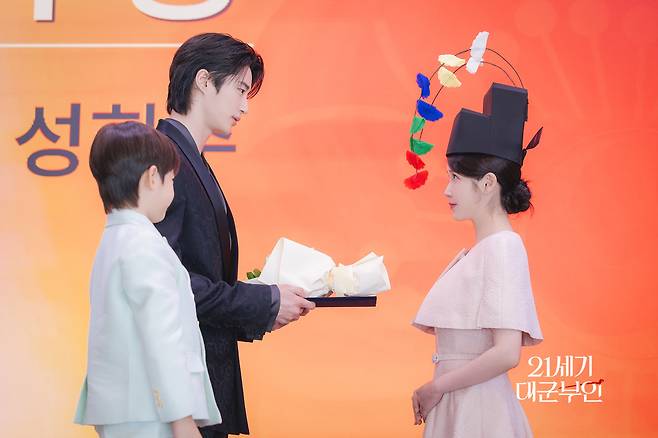
In episode 2, Seong Hui-ju receives the award for best entrepreneur during a state business ceremony presided over by the king. Alongside the prize, she is presented with an eosahwa, which literally means "flowers bestowed by the king."
During the Joseon Dynasty, eosahwa were ceremonial paper flowers bestowed by the king upon those who passed the state civil or military examinations. Passing the gwageo, the notoriously rigorous national examination system, was one of the few paths into government office and often required 15 to 20 years of study. Held only once every three years, it selected just 33 successful examinees.
Typically, eosahwa featured colorful paper blossoms — often in blue, red, yellow and white — attached to two bamboo stems. Successful applicants would pin them behind their gat, the traditional Korean hat, and parade through the streets accompanied by music for days as a public display of prestige and honor.
Jongmyo Jerye and Joseon-era identification card
Episode 3 features one of the series’ most overtly traditional sequences.
As Hui-ju faces the threat of being taken in for questioning over a fire, she tries to contact Ian. But he cannot answer his phone, as mobile devices are forbidden during the royal ancestral rite he is attending.
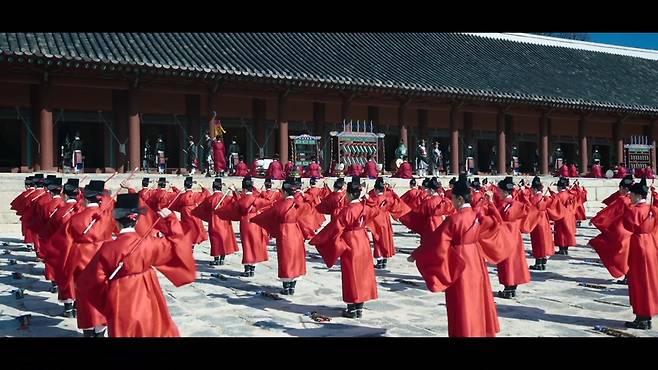
The ceremony depicted is Jongmyo Jerye, the state ritual held at Jongmyo Shrine, where the memorial tablets of Joseon kings and queens are enshrined.
The rite, recognized by UNESCO on its register of Intangible Cultural Heritage of Humanity, encompasses music, dance and ceremonial offerings in a single elaborate ritual.
The episode recreates the spectacle, with performers in crimson robes moving in orderly lines while court musicians play in the foreground as Ian and other royal figures proceed with the rite.
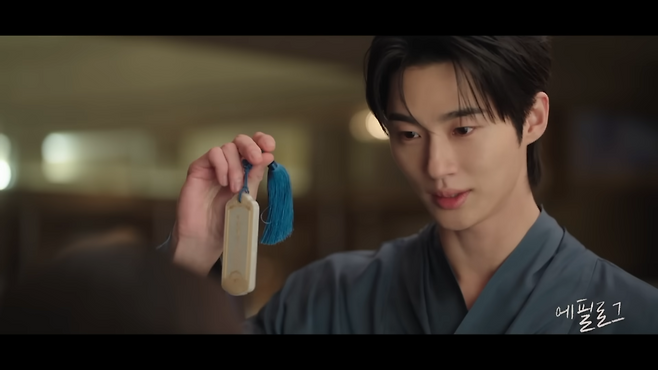
A key object in resolving the crisis is the hopae, a Joseon-era identification tag used in the drama as an emergency means of summoning the Grand Prince.
The Joseon-era hopae functioned much like an early identification card. It was originally created to help the state manage military service and labor obligations. The wooden tag listed personal information such as a person’s name, age and year of birth on the front, while an official seal was stamped on the back.
Joseon law required all men over the age of 16 — from noble yangban to enslaved people — to carry one. In the case of slaves, the tag also identified the master to whom they belonged.
Irworobongdo, the royal folding screen
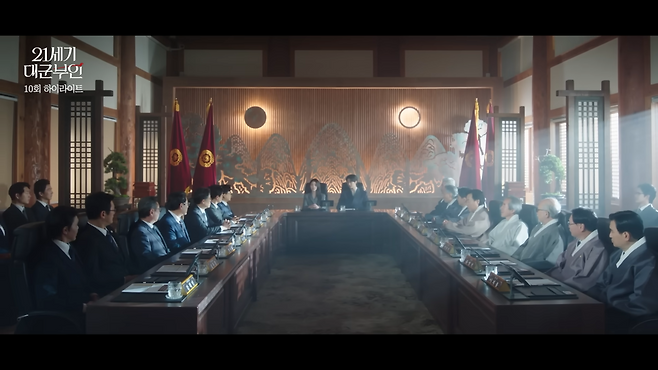
Also among the recurring symbolic motifs is Irworobongdo, which literally means the painting of sun, moon and five peaks.
The painting, traditionally displayed behind the king’s throne during the Joseon Dynasty, depicts the sun, moon, five mountain peaks, waterfalls and pine trees. Together, the imagery symbolizes royal authority, natural balance and wishes for the prosperity and longevity of both the monarch and the nation.
The sun represents the king, while the moon symbolizes the queen. The natural elements featured in the painting are also associated with the sipjangsaeng, or the 10 symbols of longevity in Korean tradition.
Some viewers may also recognize the image from the animated film "KPop Demon Hunters," where an Irworobongdo-inspired backdrop appeared during the fictional Idol Awards performance of Huntrix’s "Golden."
In "Perfect Crown," the folding screen repeatedly appears in scenes involving the reigning king. It is seen behind the young king’s throne and in flashbacks involving the late king.
In the latest episode, the series uses the contemporary-inspired screen as a backdrop as Ian receives a royal decree from the young king — a scene that may foreshadow a shifting balance of power to come.
"Perfect Crown" is available for streaming on Disney+ internationally.
Copyright © 코리아헤럴드. 무단전재 및 재배포 금지.