Exclusive: Samsung SDI’s $3.5B joint battery project with GM ‘paused’ amid EV slowdown
전체 맥락을 이해하기 위해서는 본문 보기를 권장합니다.
On the matter, Samsung SDI commented that it and GM "continue to work together and will discuss future plans."
"Automakers are bound by joint ventures to take offtake volumes, and when those volumes fall short, they are left with the burden of sharing the resulting losses," said Lee Ho-geun, an automotive engineering professor at Daeduk University. "To regain flexibility, they are willing to absorb near-term financial pain to unwind these structures."
이 글자크기로 변경됩니다.
(예시) 가장 빠른 뉴스가 있고 다양한 정보, 쌍방향 소통이 숨쉬는 다음뉴스를 만나보세요. 다음뉴스는 국내외 주요이슈와 실시간 속보, 문화생활 및 다양한 분야의 뉴스를 입체적으로 전달하고 있습니다.
![Samsung SDI headquarters in Giheung, Gyeonggi [SAMSUNG SDI]](https://img3.daumcdn.net/thumb/R658x0.q70/?fname=https://t1.daumcdn.net/news/202605/14/koreajoongangdaily/20260514103901332wxrj.jpg)
A $3.5 billion battery project led by a joint venture between Samsung SDI and General Motors (GM) in New Carlisle, Indiana, has been put on hold, as the U.S. automaker recalibrates its EV strategy amid moderating demand.
"The project is being paused," a spokesperson for the Indiana Economic Development Corporation told the Korea JoongAng Daily recently. The agency, chaired by Indiana Gov. Mike Braun, handles investments in the state.
The suspension will inevitably delay the project’s original timeline, which called for mass production to begin in the fall of 2027 with an annual capacity of up to 36 gigawatt hours, enough to make around 300,000 EVs.
Several options are reported to be under discussion, including a potential shift in battery chemistry to lithium iron phosphate units preferred by automakers, as well as GM’s potential withdrawal from the joint venture, similar to its decision last year regarding a third battery plant in Michigan in a 50:50 project with LG Energy Solution called Ultium Cells.
On the matter, Samsung SDI commented that it and GM "continue to work together and will discuss future plans."
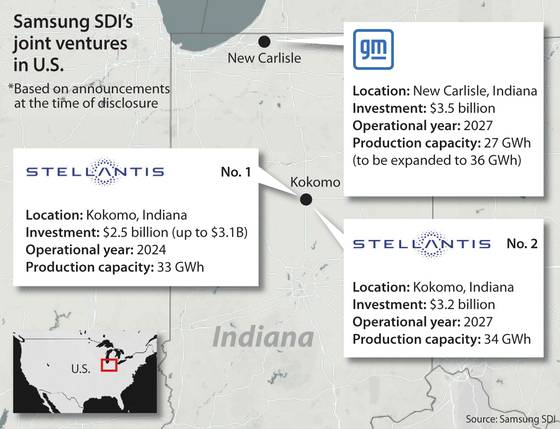
Whether the project moves forward will depend largely on how strongly EV demand recovers. A prolonged Iran war that drives oil prices higher could make that scenario more likely.
The uncertainty comes as GM undertakes a sweeping reassessment of its EV capacity and manufacturing footprint, seeking to align its operations with softer-than-expected consumer demand on the back of rolled-back U.S. EV incentives.
The Detroit-based automaker reflected a total of $7.6 billion in expenses related to production cutbacks across its EV and battery operations last year alone, including a substantial fourth-quarter write-down.
Of them, around $400 million in third quarter charges tied to “contract cancellation fees and commercial settlements associated with EV-related investments,” followed by an additional $4.2 billion in fourth quarter charges stemming from “supplier commercial settlements, contract cancellation fees and other charges,” according to regulatory filings with the U.S. Securities and Exchange Commission.
In fact, GM last year sold its entire stake in Ultium Cells’ third Michigan plant to LG Energy Solution for $2.14 billion. The venture, established in 2020, runs two plants in Ohio and Tennessee that have also been shut down since the beginning of the year due to weak battery sales.
LG Energy plans to independently operate the Michigan facility, producing batteries for energy storage systems (ESS) as well as EV batteries destined for Toyota Motor.
![Samsung SDI CEO Choi Joo-sun speaks at the company's 56th regular shareholder meeting in southern Seoul on March 18. [SAMSUNG SDI]](https://img4.daumcdn.net/thumb/R658x0.q70/?fname=https://t1.daumcdn.net/news/202605/14/koreajoongangdaily/20260514060155468dvfd.jpg)
![Samsung SDI's P6 prismatic battery [SAMSUNG SDI]](https://img2.daumcdn.net/thumb/R658x0.q70/?fname=https://t1.daumcdn.net/news/202605/14/koreajoongangdaily/20260514060158170ozla.jpg)
Global automakers are increasingly pulling back from battery joint ventures with Korean firms, in a bid to regain flexibility over production planning and capital deployment.
Stellantis has already stepped back from a plan to build a battery plant in Canada with LG Energy Solution by selling its 49 percent stake for just $100, despite already racking up $980 million in investment in the project. LG Energy intends to convert the facility into a production site for ESS batteries.
The outlook for the $3.2 billion No. 2 battery plant by Stellantis and Samsung SDI also remains uncertain, after Bloomberg reported that the automaker is seeking to exit the venture.
“Automakers are bound by joint ventures to take offtake volumes, and when those volumes fall short, they are left with the burden of sharing the resulting losses,” said Lee Ho-geun, an automotive engineering professor at Daeduk University. “To regain flexibility, they are willing to absorb near-term financial pain to unwind these structures.”
“From an automaker’s perspective, withdrawing from joint ventures and shifting to short-term supplier contracts is a more effective approach."
Ford had plans to operate three battery plants in partnership with SK On — two in Kentucky and one in Tennessee — under a joint venture, BlueOval SK. However, the two companies have decided to dissolve the joint venture and move toward independent operations.
The Donald Trump administration ended federal EV incentives Sept. 30 last year, which granted up to $7,500 in tax credits for EV purchases, along with a $4,000 credit for used EV purchases.
EV sales in the United States fell around 30 percent on year to 213,000 units in the first quarter, according to data from Cox Automotive. Of all car sales, EVs came in at just around 5.8 percent.
Samsung SDI posted an operating loss of 1.72 trillion won ($1.15 billion) and a net loss of 584.9 billion won last year, swinging into the red on both counts. In the first quarter of this year, its operating loss narrowed to 155.6 billion won from 434.1 billion won in the same period a year earlier.
![Samsung SDI's former CEO, Choi Yoon-ho, right, takes a photo with General Motors CEO Mary Barra after the two companies first signed a memorandum of understanding on a joint U.S. battery plant in March 2023. [SAMSUNG SDI]](https://img3.daumcdn.net/thumb/R658x0.q70/?fname=https://t1.daumcdn.net/news/202605/14/koreajoongangdaily/20260514060159651lwcz.jpg)
BY SARAH CHEA [chea.sarah@joongang.co.kr]
Copyright © 코리아중앙데일리. 무단전재 및 재배포 금지.
- HYBE announces new girl group Saint Satine along with new company motto
- The world discovers a young girl living in the mountains. What follows is murder and betrayal.
- Exclusive: Samsung SDI’s $3.5B joint battery project with GM ‘paused’ amid EV slowdown
- Boy band 2PM to hold first full-group concert in Korea in nearly three years
- Complaints rise over teachers trying to influence students who can vote
- Samsung running out of options as strike looms and gov't cautiously weighs stronger involvement
- Korean Air, Asiana to finally merge on Dec. 17, six years after acquisition deal
- Decaf or not decaf? Gov't to change coffee regulations starting in 2028.
- Seoul braces for midsummer heat with temperatures expected to top 30 degrees Celsius from Thursday