'Think twice before posing with hand signs': Experts warn of fingerprint theft
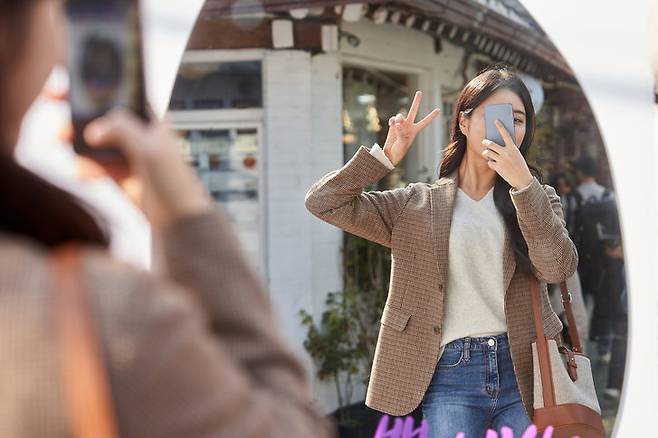
From daily selfies to group photos, the classic 'V' hand sign may now pose a security risk, with AI technology making fingerprint theft easier than ever, according to a news report Tuesday.
In a recent reality program, Chinese security expert Li Chang demonstrated how fingerprints could be extracted from a celebrity’s selfie using AI tools, warning that the seemingly harmless hand sign could put personal biometric information at risk.
“If the pads of the fingers are directly exposed toward the camera and photographed from within about 1.5 meters of the lens, there is a high possibility that fingerprint information can be extracted relatively clearly," Chang said during the show.
Photos taken from 1.5 to 3 meters away could still reveal roughly half of the fingerprint details, he added.
Concerns over fingerprint replication from photos are not entirely theoretical.
Last year in Hangzhou, Zhejiang province, China, a group of criminals reportedly tried to unlock a smart door lock using a hand photo previously uploaded online by the homeowner, local media reported.
While the V sign is traditionally associated with peace in many Western countries, it has long been a staple photo pose in East Asian countries, including China, South Korea and Japan.
News reports about fingerprint theft linked to photos especially struck a chord with Koreans, who are widely known for using a variety of hand gestures when taking pictures.
“Isn’t the V sign basically a must in group photos? This is scary,” one user wrote on Threads.
Among the popular hand gestures here are finger hearts made by crossing the thumb and index finger, half heart gestures formed with one hand against the cheek and the flower pose, in which both palms are placed beneath the chin like flower petals.
It is common to see Korean celebrities posing with hand hearts at press conferences, airports and public events at the request of photographers.

Still, not all selfies pose an immediate security risk, as fingerprints can only be reconstructed when conditions such as lighting, focus, shooting distance and image quality are suitable, said Pei Zhiyong, director of the Qianxin Industry Security Research Centre, in an interview with The South China Morning Post.
"It’s safer not to share too many photos showing your fingers online and to avoid saving your fingerprints on devices you don’t fully trust," he added.
Copyright © 코리아헤럴드. 무단전재 및 재배포 금지.