Rebounding from a Plunge: Does POSCO Future M's Z-Score Signal a Revival?
Solid Support from Basic Materials and Group Backing
Will the 'Two-Track' Strategy for Cathode and Anode Materials Work?
[Korea Financial Times, Kim JaeHun] Various factors influence corporate value. For an objective evaluation, diverse variables must be considered. Through the 'Altman Z-score,' the Korea Financial Times aims to take a multidimensional look at the current situations, responses, and financial health of companies, and deeply explore the meanings hidden within. <Editor's Note>
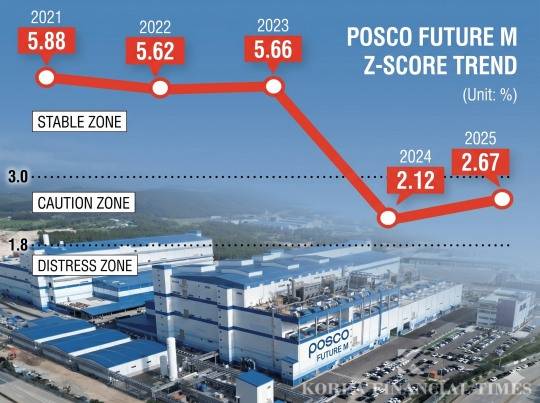
POSCO Future M, a secondary battery materials affiliate of POSCO Group, saw its Altman Z-score rebound slightly last year. This was thanks to its focus on a "selection and concentration" investment strategy and financial management amidst the EV chasm (a temporary slowdown in demand).
Based on this, POSCO Future M aims for a definitive rebound through a two-track strategy encompassing both cathode and anode materials businesses, which is unique in Korea.
Although burdens on financial indicators remain, POSCO Group's business direction is cited as a mid-to-long-term positive factor. POSCO Holdings, the group's business holding company, is heavily investing in building a secondary battery value chain centered on POSCO Future M through the localization of secondary battery materials and the diversification of supply chains.
Plunge Due to the 'Chasm'
Using the corporate data platform DeepSearch, the Korea Financial Times calculated and analyzed POSCO Future M's Altman Z-score for the past seven years. The financial health of the company was analyzed based on financial statement items (X1(Working Capital/Total Assets) + X2(Retained Earnings/Total Assets) + X3(Operating Profit/Total Assets) + X4(Market Capitalization/Total Liabilities) + X5(Sales/Total Assets)). For manufacturing companies, a score of 3.0 or higher is considered a safe zone, while below 1.8 is evaluated as a distress zone.
POSCO Future M's Z-score rose from 4.42 in 2019 to 5.28 in 2020, the dawn of the EV era, and further increased to 5.88 in 2021. The score maintained a safe zone at 5.62 in 2022 and 5.66 in 2023, but plunged to 2.12 in 2024.
The decline between 2023 and 2024 is particularly notable. In just one year, the Z-score plummeted by 3.54 points, falling from the safe zone to a 'warning zone.' The sluggish secondary battery materials market conditions caused by the EV chasm had a decisive impact.
Amid this, as investments continuously increased, the asset and liability structures changed significantly. Looking at the trend of POSCO Future M's Z-score components, the decrease in X4 (Market Capitalization/Total Liabilities) is the most prominent. This indicator shows a company's ability to pay off debts; a lower number means a higher dependency on debt.
POSCO Future M's X4 plummeted from 7.47 in 2023 to 2.39 in 2024. During this period, POSCO Future M's market capitalization sharply decreased from KRW 27.8092 trillion to KRW 11.0075 trillion. Conversely, total liabilities increased from KRW 3.7231 trillion to KRW 4.6119 trillion during the same period.
Generally, order-based companies like POSCO Future M tend to aggressively increase capital expenditures (CAPEX) to expand market share. Manufacturers sometimes engage in aggressive order-taking while bearing losses to secure market share. This means that although POSCO Future M's earnings and stock prices fell due to the EV chasm, it expanded investments by increasing borrowings and liabilities.
POSCO Future M's CAPEX surpassed KRW 1 trillion for the first time in 2023 at about KRW 1.37 trillion, and approximately KRW 2.06 trillion was executed in 2024. Last year, it decreased to about KRW 1.5 trillion under a financial stabilization stance.
On the other hand, POSCO Future M's operating profit decreased by about 75% from KRW 165.8 billion in 2022 to KRW 35.8 billion in 2023. In 2024, it was tallied at about KRW 700 million. Retained earnings also shrank from about KRW 1 trillion to KRW 760.8 billion over the same period. Earnings are vastly insufficient to cover the increased borrowings for investments.
Changed Atmosphere... Profitability 'Not Yet'
Signs of hope emerged for POSCO Future M, which endured a gloomy period until 2024. Last year, its Z-score rebounded slightly to 2.67.
The key factor that led the Z-score rebound is also the X4 figure. It rose by 1.2 points from 2.39 in 2024 to 3.59 in 2025, recording 2.16 on a weighted contribution basis, accounting for the largest portion of the total sum (2.67).
Particularly encouraging is that its market capitalization at the end of last year was about KRW 16 trillion, maintaining a level of about 3.6 times its total liabilities of KRW 4.6 trillion. This is interpreted as partially reflecting the assessment of credit and growth potential, such as ESS (Energy Storage Systems) and POSCO Group's mid-to-long-term secondary battery growth strategy, along with the recovery of investment sentiment in secondary battery stocks that began in the second half of last year.
In this process, the paid-in capital increase by its parent company, POSCO Holdings, pursued last year also contributed to stabilizing the capital structure.
POSCO Holdings executed a paid-in capital increase of about KRW 1 trillion to stabilize POSCO Future M's finances and enhance its technological prowess. Capital expansion through a paid-in capital increase can lead to an effect of improving the debt-to-equity ratio, which likely had a favorable impact on the rise of the X4 ratio.
However, profitability indicators still seem to need time. POSCO Future M's X3 (Operating Profit/Total Assets) stayed at 0.0036 in 2025. X3 is an indicator showing profitability relative to a company's assets; a lower number means poorer asset utilization.
Compared to POSCO Future M's total assets of about KRW 9 trillion as of the end of last year, its EBITDA (Earnings Before Interest, Taxes, Depreciation, and Amortization) was only KRW 32.8 billion, indicating extremely low asset profitability. Looking at the X3 trend: 0.031 in 2021, 0.0358 in 2022, 0.0057 in 2023, 0.0001 in 2024, and 0.0036 in 2025. It sharply deteriorated after 2022 and only showed a slight recovery in 2025.
The X2 (Retained Earnings/Total Assets), a cumulative corporate profitability indicator, also continuously declined from 0.2288 in 2021 to 0.0843 in 2025. While retained earnings, which were at the level of KRW 1 trillion in 2021, stood at KRW 770.9 billion at the end of last year, total assets expanded from about KRW 4 trillion to about KRW 9 trillion during the same period, entrenching a structure where the cumulative profitability ratio is diluted. This implies that there is a time lag before facility and infrastructure investments turn into profits.
The fortunate aspect is that signs of a turnaround to profit have begun to appear this year. In the first quarter of this year, POSCO Future M recorded an operating profit of KRW 17.7 billion. It turned to a surplus compared to the same period last year, and increased by 3.2% compared to the previous quarter. EBITDA and net income also successfully turned to a surplus with KRW 10 billion and KRW 6.3 billion, respectively.
In particular, it is encouraging that the operating loss of the battery materials business, including the secondary battery materials invested in so far, was KRW 1.1 billion, a significant decrease from the previous quarter (KRW 61.2 billion).
Group Backing... Two-Track Strategy for Cathode and Anode
This year, POSCO Future M will preemptively respond to changing market trends with batteries for not only ESS but also robots and Urban Air Mobility (UAM) in the future. In particular, it plans to accelerate its profitability rebound by encompassing both cathode and anode materials businesses, making it the only domestic secondary battery materials company to do so. Cathode and anode materials are core materials accounting for approximately 40% and 20% of battery production costs, respectively.
For Lithium Iron Phosphate (LFP) cathode materials for ESS, the company will convert existing lines at the Pohang cathode materials plant to respond to customer supply requests starting late this year. A newly established plant aiming for mass production and supply in the second half of 2027 is scheduled to break ground in May.
The anode materials business actively utilizes the global "de-China" trend. Chinese companies hold about 85% of the global anode materials market. However, following the U.S. Inflation Reduction Act (IRA) and the strengthening of European Union (EU) supply chain regulations, the global battery industry is pushing "de-China" as a core strategy.
To strengthen the competitiveness of its artificial graphite anode materials business, whose demand is continuously expanding alongside the growth of the ESS market, POSCO Future M is pursuing a plan to secure a production base in Vietnam. Domestically, it has also expanded spherical graphite production facilities for anode materials production within the Saemangeum National Industrial Complex in Jeonbuk.
POSCO Holdings, the POSCO Group's business holding company, has set the localization of secondary battery materials and supply chain diversification as the core strategic axes of the group and continues related investments. Last month, it invested approximately KRW 1 trillion to acquire an Australian lithium mine. In addition, it is focusing on supply chain diversification by recently consecutively signing contracts for the additional acquisition of an Argentine lithium salt lake and investment in Australian hard-rock lithium.
Particularly, the vertical integration structure across the entire secondary battery value chain—including cathode materials, anode materials, lithium, and nickel—promoted primarily by POSCO Future M, is evaluated as a strategy to simultaneously secure cost competitiveness and supply stability through the internalization of the material supply chain.
Kim Hyun-soo, a researcher at Hana Securities, diagnosed in a recent report, "Based on the recovery of cathode materials shipments and the growth potential of anode materials, POSCO Future M can justify the highest premium among global secondary battery materials companies," adding, "Long-term earnings visibility is higher than its competitors as the group's vertical integration completeness is the highest, and its product portfolio is evenly distributed from LFP for ESS to mid-nickel high-voltage ternary cathode materials."
Kim JaeHun (rlqm93@fntimes.com)
Copyright © 한국금융신문 All Rights Reserved.