PPP leader claims Lee government’s foreign policy could weaken US alliance
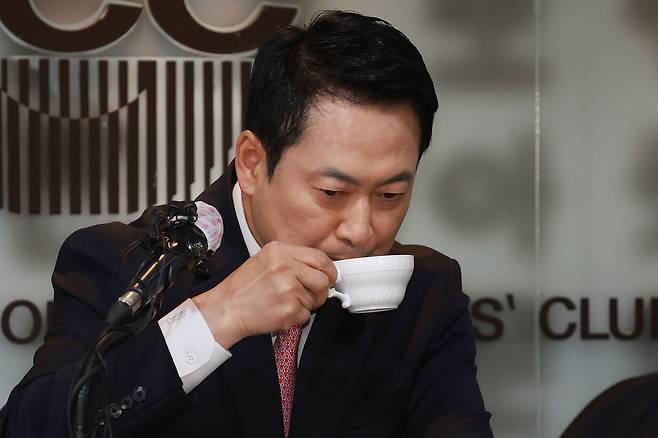
South Korea’s main opposition leader said Friday that many South Koreans were concerned that the Lee Jae Myung government’s foreign and security policy could weaken the South Korea-US alliance.
“Many people are worried that the South Korea-US alliance may collapse and that South Korea may be leaving the free world,” People Power Party Chair Rep. Jang Dong-hyeok said during a press conference with foreign correspondents at the Press Center in central Seoul.
“I hope the Lee Jae Myung government will change the direction of its foreign and security policy, even now, and return to a path that protects the national interest and the people,” he said.
Claiming that the country's foreign and security policies differ significantly from those of past administrations — even those led by the current ruling party — Jang accused the Lee adminsitration of weakening the alliance with the US.
“President Lee has asked whether South Korea needs to rely on foreign troops, referring to US Forces Korea as a ‘foreign military,’ while also pushing hastily for the transfer of wartime operational control,” Jang said.
“Many South Koreans are concerned that the policy direction may be aimed at the withdrawal of US troops from South Korea,” he added.
Jang also cited what he described as growing tensions with traditional allies, including and Lee’s criticism of Israel on social media and friction between Seoul and Washington over Coupang. US lawmakers have protested over the South Korean government’s investigation into a massive data breach at the US-listed e-commerce giant.
“When I recently visited the United States, I confirmed that many people in the US government, Congress and broader policy circles were concerned about the current state of South Korea-US relations,” he said.
“No previous government has been hostile to the liberal democratic bloc or denied the South Korea-US alliance itself. I believe the Lee Jae Myung government should revise this foreign and security policy direction as soon as possible.”
He argued that South Korea’s diplomatic leverage and economic growth have expanded when the country strengthened its alliance with the US and broadened cooperation with the free world.
Jang also criticized Lee’s economic policy, saying the president’s philosophy of a “basic economy” is far from a market economy.
“He is insisting on anti-market policies, including in real estate policy,” Jang said. “The government is also continuing to push laws that infringe on basic rights, including media legislation that would impose punitive damages on the press.”
He also accused the ruling Democratic Party of pushing through bills aimed at controlling the judiciary.
“They are unconstitutional and anti-democratic laws that have been abused in many authoritarian states as tools to strengthen dictators’ power,” Jang said.
In April, the Democratic Party passed a special counsel bill to investigate what it describes as excessive or fabricated indictments by prosecutors under the former Yoon Suk Yeol administration.
“The ultimate goal is to eliminate the president’s own trials,” Jang said. “It is an unconstitutional and illegal special counsel bill that runs directly counter to the fundamental rule-of-law principle that no one can be a judge in their own case and to the constitutional spirit that all citizens are equal before the law.”
Jang said the Lee government’s judicial restructuring and anti-market economic policies are no longer merely domestic political issues, citing warnings from the OECD Working Group on Bribery over South Korea’s move to dismantle the prosecution service.
Copyright © 코리아헤럴드. 무단전재 및 재배포 금지.