Samsung bonus dispute: How far could the impact spread?
Samsung Electronics’ escalating labor dispute over bonus distribution is drawing global attention, raising concerns that disruptions at the world’s largest memory chip-maker could ripple through the global semiconductor supply chain.
The union is demanding the removal of caps on performance-based bonuses and payouts equivalent to 15 percent of operating profit — estimated at around 45 trillion won ($31 billion). If talks fail, the union plans to launch a walkout on May 21, beginning with a rally near Samsung Chairman Lee Jae-yong’s residence in Yongsan-gu, Seoul.
At stake is not only Samsung’s earnings, but also the stability of an already strained tech ecosystem increasingly dependent on AI chips.
Fears of major disruption stem from the sheer scale of Samsung’s operations. Industry estimates suggest a full shutdown of chip plants could cost the company tens of billions of won per minute, or roughly $677 million a day.
Yet the actual production impact may prove less severe than headline figures suggest.
“The manufacturing lines are about 90 percent automated, so the strike’s direct impact is likely to be contained,” a former semiconductor engineer said on condition of anonymity. “Clients are well aware of this.”
Unlike labor-intensive industries, semiconductor fabs are designed to operate continuously with minimal human intervention, making them structurally more resilient to work stoppages.
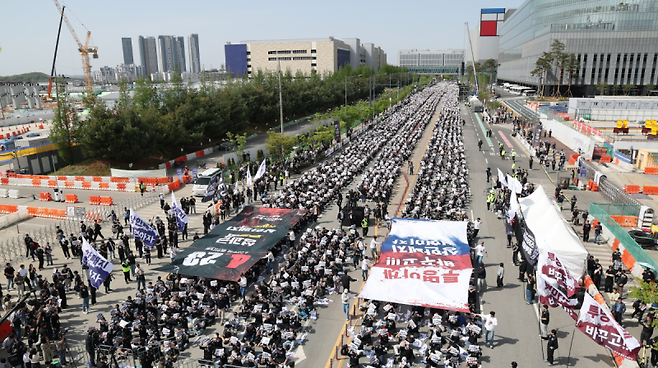
Still, even limited labor action has already dented efficiency. During a recent overnight rally involving around 40,000 union members at Samsung’s Pyeongtaek chip complex in Gyeonggi Province, memory fabs recorded an 18.4 percent decline in production performance, and foundry lines plunged 58.1 percent during the shift, according to the union.
The timing is particularly sensitive. The semiconductor market is already grappling with tight supply, especially for advanced memory used in AI servers and accelerators.
Samsung sits at the center of that ecosystem alongside rivals such as TSMC and SK hynix. Any prolonged disruption, even if partial, risks worsening existing bottlenecks.
KB Securities estimates that a strike could disrupt roughly 3 percent of global memory chip supply.
However, concerns that competitors such as SK hynix or TSMC could quickly capitalize on Samsung’s troubles may be overstated.
Much of Samsung’s output is tied to long-term supply agreements and inventory buffers across the supply chain may help absorb short-term shocks, according to Kim Yang-paeng, a researcher at the Korea Institute for Industrial Economics and Trade.
“In the short term, it is difficult for customers to drastically change suppliers due to existing contracts and qualification processes,” Kim said.
Leading-edge semiconductor capacity is also already largely fully booked, leaving little room for rivals to absorb sudden shifts in demand.
Still, Samsung’s handling of the dispute could affect future contracts, particularly as supply stability remains a top priority for major clients such as Nvidia and AMD.
“Global big tech clients could begin looking at alternative suppliers such as TSMC as part of efforts to spread risk,” said Song Heon-jae, an economics professor at the University of Seoul. “In the semiconductor industry, where process verification takes enormous time and money, customers who leave are difficult to win back.”
The more immediate damage may come from profitability. Citigroup estimates that reflecting the union’s demands in earnings forecasts could lower Samsung’s operating profit projections for 2026 and 2027 by around 10 to 11 percent.
The dispute also highlights a broader debate across the semiconductor industry over how to share profits generated by the AI boom.
Samsung’s labor union argues that weak bonuses could accelerate talent departures to SK hynix, now a leader in AI memory.
“Even now, there are employees forming study groups as soon as they join the company to prepare for moving to SK hynix,” one Samsung chip employee said.
Other chipmakers, however, use different compensation structures rather than tying payouts directly to annual operating profit.
Last year, SK hynix removed caps on performance bonuses through a labor agreement that guarantees employees incentives tied to 10 percent of operating profit for the next decade, resulting in unusually large payouts during the AI memory boom.
US chipmakers such as Nvidia rely more heavily on stock-based compensation and long-term incentives linked to company valuation.
At Nvidia, soaring share prices during the AI boom have sharply boosted employee wealth, with Jensen Huang repeatedly emphasizing employee compensation as a strategic investment.
Samsung management, meanwhile, argues that maintaining technological leadership requires sustained spending on research and facilities.
The company plans to spend 110 trillion won this year on research and development and capital expenditures as it races to strengthen its AI semiconductor leadership.
“The idea of distributing a fixed percentage of operating profit can be meaningful from the standpoint of employee motivation,” said Kim Yong-jin, a business professor at Sogang University. “But the criteria need to become more sophisticated.”
Copyright © 코리아헤럴드. 무단전재 및 재배포 금지.