Women artists who trailblazed ‘environments’ revived in Seoul
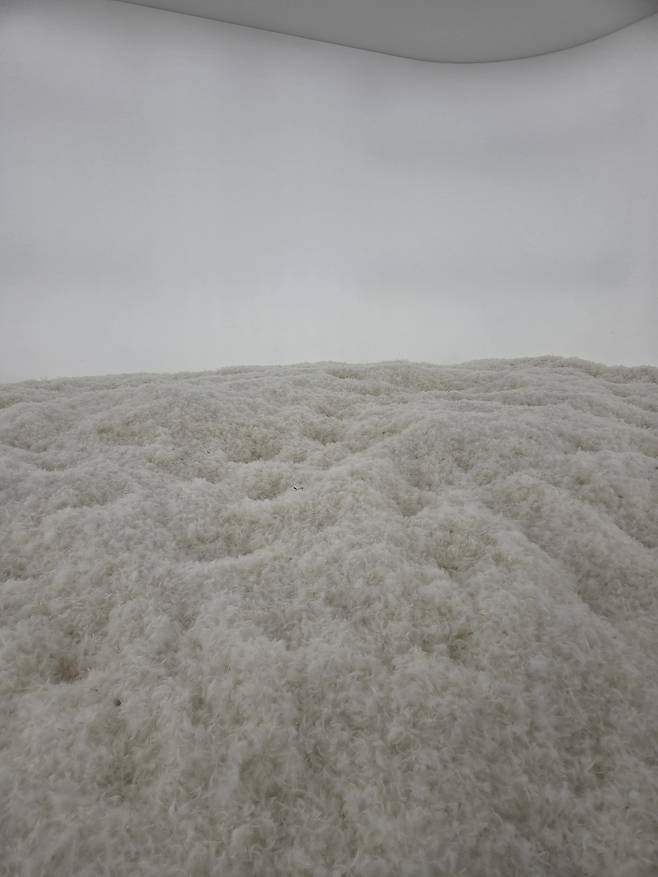
Stepping into a room filled with 136 kilograms of goose feathers felt like walking on clouds. This surreal space at the Leeum Museum of Art in Seoul is the immersive environment work “Feather Room” by American artist Judy Chicago.
The piece, originally conceived in 1966 for the Rolf Nelson Gallery in Los Angeles, challenged the authority of rigid materials in male-dominated architectural traditions at the time.
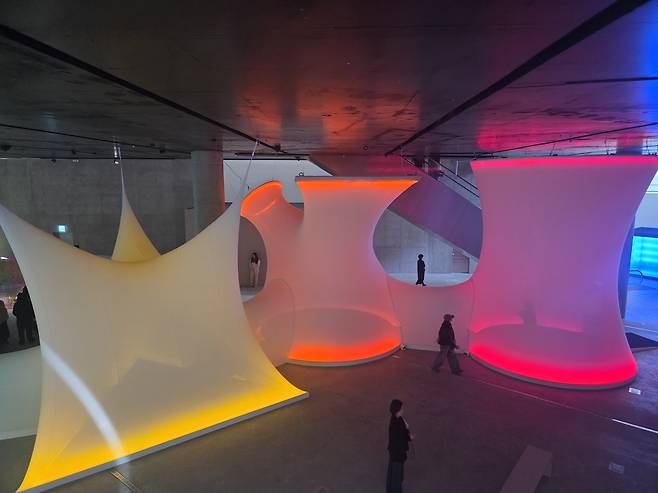
Sixty years later, it is revived in Seoul at “Inside Other Spaces: Environments by Women Artists 1956-1976,” shedding light on pioneering female artists who trailblazed “environments” and actively embraced new media and experimental forms.
The concept of “environment” — which is “ambiente” in Italian and introduced by Argentine art master Lucio Fontana in 1949 — refers to an immersive art form where viewers enter a work and experience it through light, sound, color and movement.
Later absorbed into what is now known as installation art, the art genre marked a shift from viewing art to inhabiting it during the mid-1900s, according to the museum.
The Seoul exhibition, originally conceived at Haus der Kunst in Munich in 2023, has expanded and evolved through its presentations at MAXXI in Rome and M+ in Hong Kong before arriving here.
The project is the culmination of an extensive transdisciplinary research led by Marina Pugliese, director of MUDEC Milan and Andrea Lissoni, artistic director of Haus der Kunst.
“We were very keen and use the word forensic to respect all the details of the work, without interpreting in any way,” Pugliese said. “It's important also to say that we worked both on artists who had passed away and the artists who are still alive.”
Featuring 11 artists, including Judy Chicago and Jung Kang-ja, the exhibition revisits the movement from Tsuruko Yamazaki’s “Red” in 1956 to the 1976 Venice Biennale, foregrounding the overlooked role of women artists.
The Seoul presentation features “Muche-Jeon (Incorporeal Exhibition)” by Korean avant-garde pioneer Jung Kang-ja, marking the first reconstruction of the historic environment since its forced dismantling in 1970 for “political agitation.”
The work has been painstakingly revived through archival research, testimonies and collaboration with the artist’s family.
Another highlight is “Dream House,” conceived in 1962 by visual artist Marian Zazeela and experimental composer La Monte Young, first realized in 1966 in New York. Since 2003, Korean artist Choi Jeong-hwa has joined the project, extending the work across generations. The presentation at Leeum marks its debut in Asia.
For the museum, the exhibition balances scholarly rigor with accessibility, said Kim Sung-won, vice director of the museum.
“This exhibition manages to achieve both. It is academically and art historically significant, while also being engaging for the general public. Even young children who may not fully understand it can immediately respond to and enjoy the works,” Kim said.
The exhibition runs through Nov. 29.
Copyright © 코리아헤럴드. 무단전재 및 재배포 금지.