Cycling Korea: Circumnavigating volcanic island of Jeju offers spectacular scenery with plenty of wind
![Ridding along the coast west of Seogwipo in Jeju on April 4. [JIM BULLEY]](https://img3.daumcdn.net/thumb/R658x0.q70/?fname=https://t1.daumcdn.net/news/202605/01/koreajoongangdaily/20260501082747904khgq.jpg)
This article is part of a series on long-distance cycling in Korea. For an overview of the cross-country route, click here. For more detailed information on logistics, including how to rent a bike, navigate, book accommodation and fly with a bike, click here. For all articles in the series, click here.
Jeju Island, for the uninitiated, is a subtropical island a little less than 100 kilometers (62 miles) south of the Korean mainland. It’s famous for its generally temperate climate, abundance of citrus and seafood and the native black pigs that put its samgyeopsal a cut above the rest of the country.
It is a beloved holiday destination for Koreans, so much so that the Seoul-Jeju air route remains the world's busiest, according to an Aerospace Global News analysis. As many as 39,000 people can fly from Seoul to Jeju every day, and flights are regularly sold out.
It is also a great cycling destination. Jeju is home to another of Korea’s certified cycling routes, the Jeju Fantasy Bicycle Path, covering roughly 240 kilometers around the circumference of the island, and as early spring often sees the mainland locked in a cycle of unseasonably cold weather and warmer days with high levels of pollution, flying south for a weekend on the bike seems like a no-brainer.
![Riding through the palm trees to the east of Seogwipo on April 4. The southeast of the island is especially wild, but also very exposed when the winds pick up. [JIM BULLEY]](https://img4.daumcdn.net/thumb/R658x0.q70/?fname=https://t1.daumcdn.net/news/202605/01/koreajoongangdaily/20260501082748230tsef.jpg)
That search for warmer riding weather led my party of three south on the first weekend of April, with plans to tackle the 240-kilometer course over three mid-distance days.
Flying to Jeju with a bike is a fairly painless experience. Korean company Roundel offers rental bike boxes for 40,000 won ($27) round-trip, allowing riders to pick up a box at their airport of departure, return it upon arrival in Jeju and then do the same thing backward on the way back. This service is now available at most mainland airports, and Jeju is such a hotspot that Roundel even has a dedicated space outside the terminal where you can rebuild your bike.
Like other official Korean cycling routes, the Jeju circuit features a series of stamp booths, allowing riders to complete the necessary pages of their Korean cycling passport. Completion of Jeju does not earn a medal like the cross-country route, but it does earn a shiny sticker and is a step toward the grand slam medal.
More information on flying with a bike in Korea and the passport system can be found in the "Cycling in Korea" logistics story.
![The seafront just north of Jeju International Airport provides the first photo opportunity on April 3. [JIM BULLEY]](https://img2.daumcdn.net/thumb/R658x0.q70/?fname=https://t1.daumcdn.net/news/202605/01/koreajoongangdaily/20260501082748525hirg.jpg)
Samdado Before hitting the road in Jeju, it’s worth learning a bit more about the island — and more specifically, about the traditional concept of samdado, or "the island of three abundances," as it will be very relevant to the rider.
One abundance is women. Jeju has historically had more women than men and is globally famous for the haenyeo, female freedivers who harvest seafood along the island's coast. Cycling the circumference will take riders into some less populated areas where the chances of seeing genuine haenyeo in action are higher, so it’s worth keeping your eyes open.
The second abundance is stone. Jeju is a volcanic island, and there is basalt as far as the eye can see. This isn’t hugely relevant to a budding biker, although it does make for some nice scenery.
![Rocks line the route at Hallim in Jeju on April 3. [JIM BULLEY]](https://img4.daumcdn.net/thumb/R658x0.q70/?fname=https://t1.daumcdn.net/news/202605/01/koreajoongangdaily/20260501082748833ulft.jpg)
The final and most important abundance, at least for us, is wind. Jeju is famously windy — it sits in the middle of the Korea Strait with absolutely no shelter and is battered by wind year-round. Anyone looking to cycle Jeju needs to be ready to deal with strong winds, adding a bit of a challenge to what is otherwise a fairly easy route.
On my trip, the wind was a constant and very unwelcome companion. Despite cycling in a circle, the wind somehow contrived to never be behind us, and on the afternoon of the second day, it jumped up to gale force levels and did its level best to knock us clean off our bikes.
![Seongsan Ilchulbong seen over the breakers on a windy April 4. [JIM BULLEY]](https://img2.daumcdn.net/thumb/R658x0.q70/?fname=https://t1.daumcdn.net/news/202605/01/koreajoongangdaily/20260501082749135ixem.jpg)
Yet despite the wind, the Jeju Fantasy Bicycle Path is perhaps the most beautiful of all Korea’s official trails. The wind was an obstacle, but never enough of one to detract from the breathtaking views along the ride. As long as you can get your head down and keep pedaling, riding Jeju is well worth the battle with the elements.
You can choose to cycle around Jeju in either direction. We went counterclockwise, which seemed to be the most popular option.
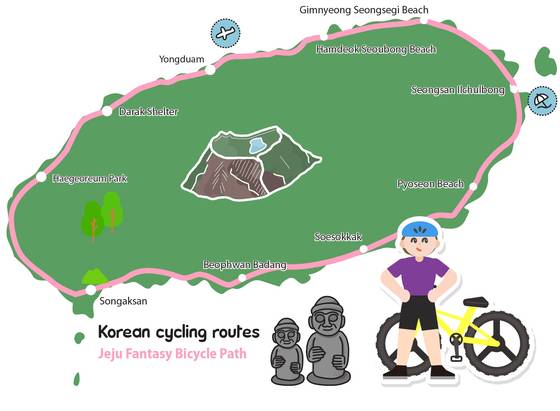
Look west After piecing together your bike at Jeju International Airport, it’s a couple of minutes' work to ride out of the car park and down to the coast, where you can pick up the Fantasy Bicycle Path. The route is marked the majority of the way around the island by a painted blue line, making it very easy to follow without a GPS headset or phone.
It’s almost exactly 20 kilometers from the airport to the first stamp of the day, at Darak Shelter. The beauty of Jeju is that there is no reason to rush, and the first few hours on Day 1 are spent coasting through the touristy northwest of the island. Darak Shelter sits on the edge of Aewol, an area known for its cafes, and there are plenty of opportunities to stop for your first caffeine boost of the day during the run to Darak.
![Celebrating with a stamp at the Darak Shelter stamp booth in Jeju on April 3. Darak Shelter is the first booth after the airport when circumnavigating the island anti-clockwise. [JIM BULLEY]](https://img1.daumcdn.net/thumb/R658x0.q70/?fname=https://t1.daumcdn.net/news/202605/01/koreajoongangdaily/20260501082750847sxcm.jpg)
From there, it’s another 19 kilometers to Haegeoreum Park, and the second stamp of the day. Haegeoreum Park itself, at least as of April, appears to be either under construction or under demolition, so the stamp booth is not somewhere you’ll want to stop for long. But just before you reach it, the route passes through the vibrant seaside town of Hyeopjae, the most popular tourist destination on the west coast.
Depending on what time your flight gets in, Hyeopjae could be a good place to stop for lunch. It’s certainly worth taking a break and taking a wander around the beach if you can, and if you want to pick up a reward for later, Josie’s Bottle Shop has quite possibly the best collection of craft beer in Korea.
![Riding toward the sea somewhere near Aewol in Jeju on April 3. [JIM BULLEY]](https://img4.daumcdn.net/thumb/R658x0.q70/?fname=https://t1.daumcdn.net/news/202605/01/koreajoongangdaily/20260501082751154tgnh.jpg)
Officially, it’s 35 kilometers from Haegeoreum Park to the next stamp at Songaksan, although there are a number of route variants that could cut the distance down a bit. This section traces the southwestern coast of the island, still the least touristy part of Jeju.
The route here takes you through some very picturesque and largely untouched small villages, although it also spends a fair amount of time on the side of a reasonably major road. The riding is mostly flat, but it was made significantly harder when this intrepid writer rode it by the sudden arrival of a storm, complete with strong winds and quite a bit of rain.
![Riding in the rain-swept southwest of Jeju on April 3. Jeju Island sits very exposed in the middle of the Korea Strait, and cyclists should be prepared for all possible weather. [JIM BULLEY]](https://img1.daumcdn.net/thumb/R658x0.q70/?fname=https://t1.daumcdn.net/news/202605/01/koreajoongangdaily/20260501082751495uuts.jpg)
That storm was the only rain we saw over the three days, and it served as an important reminder that Jeju is an island in the middle of the sea, and the weather can change very quickly. We were prepared for this, although my attempts to avoid carrying a waterproof jacket by bringing a bright orange poncho proved entirely inappropriate. The reality is that when riding Jeju, you do need to be prepared for all weather eventualities — I carried more for the three-day trip in April than for the entire cross-country in September of last year.
Weather permitting, the ride up to Songaksan, or Mount Songak, is especially dramatic. A 104-meter-high volcanic cone, Songaksan, erupts from the coastline quite suddenly, appearing significantly higher than the surrounding terrain. If you have time, there’s a 2.1-mile hiking route and a number of places to stop for a meal or a drink.
Near Songaksan is the far larger Sanbangsan, a 395-meter-high lava dome that dominates the landscape of southwestern Jeju.
![Sangbangsan erupts from the coastline in the southwest of Jeju on April 3. [JIM BULLEY]](https://img1.daumcdn.net/thumb/R658x0.q70/?fname=https://t1.daumcdn.net/news/202605/01/koreajoongangdaily/20260501082751805mpus.jpg)
Just after Songaksan, we opted to stop for the night, clocking 78 kilometers on Strava for a well-earned rest.
Into the wind The second day of the Jeju ride takes you through some of the most beautiful sections of the island as you cross the entire south coast and make your way up the east.
But first you have to earn it. The 30 kilometers between Songaksan and the next stamp at Beophwan Badang includes quite a few climbs — none particularly large, but a fairly relentless up and down to start the day nonetheless. All are rideable, and the frequent views of the coastline make it very much worth it.
![Riding toward the sea on the outskirts of Seogwipo on April 4. [JIM BULLEY]](https://img1.daumcdn.net/thumb/R658x0.q70/?fname=https://t1.daumcdn.net/news/202605/01/koreajoongangdaily/20260501082752144lnbk.jpg)
The early part of the second day will take you past the Jungmun area, where a lot of Jeju’s fancier resorts are based — if you’re so inclined, Jungmun would be comfortably reachable on Day 1 — and on past Seogwipo, the island’s second city and another good place to stop for a coffee.
Just east of central Seogwipo is the stamp at Soesokkak, 14 kilometers down the road from Beophwan Badang. A lot of that stretch is spent hugging the coast, and the views are especially spectacular.
![Waves break over a light house in Seogwipo on April 4. [JIM BULLEY]](https://img1.daumcdn.net/thumb/R658x0.q70/?fname=https://t1.daumcdn.net/news/202605/01/koreajoongangdaily/20260501082752480sruw.jpg)
We stopped for lunch just past Soesokkak, immediately before making our way into the southeast of the island. While the southwest is the least touristy part of the Jeju coast, the southeast is the most untouched. It’s quieter and wilder down there, with devastatingly beautiful views of the sweeping coastline, basalt walls and palm trees.
Unfortunately for us, it was also here that the wind returned with a serious vengeance and enough force that all three of us had a turn being blown into the bushes. The 28-kilometer ride to Pyoseon Beach became a serious slog, although even gale-force winds couldn’t detract from the views.
![The reporter takes a well-deserved break on a very wind-swept afternoon in southern Jeju on April 4. [JINSIL YU]](https://img2.daumcdn.net/thumb/R658x0.q70/?fname=https://t1.daumcdn.net/news/202605/01/koreajoongangdaily/20260501082752784kjqf.jpg)
Just past the Pyoseon Beach stamp center is a good place to stop for coffee, especially if you’ve spent the last couple of hours being battered by the elements. From here, the next stamp at Seongsan Ilchulbong is about 22 kilometers away, but there’s no reason to travel that far today.
We stopped for the night just a few kilometers outside of Seongsan Ilchubong, by the Seopjikoji promontory. Here we stayed at PLAYCE Camp, which is an affiliate of the Korea JoongAng Daily, along with the far grander nearby Phoenix Island resort. Other hotels are available, of course, but the two JoongAng properties are well-positioned for a stop off on this side of the island.
![Horses graze by the sea just south of Seongsan Ilchulbong in Jeju on April 4. [JIM BULLEY]](https://img2.daumcdn.net/thumb/R658x0.q70/?fname=https://t1.daumcdn.net/news/202605/01/koreajoongangdaily/20260501082753102sfxx.jpg)
Dinner was, of course, Jeju’s famous black pork. You could fuel the whole trip with the stuff if you wanted, although there's plenty of good seafood to try, as well as regular Korean staples, including the best way to protein-load: Fried chicken.
Over the top Day three starts at Seongsan Ilchulbong, a popular tourism destination where you’ll pick up a stamp in the shadow of Korea’s most famous volcanic cone. Heading north from here, we’ll quickly be back into the more touristy and beachy parts of the island, with rolling coastline for much of the ride back to Jeju City.
![Riding across the water to the Seongsan Ilchulbong stamp booth on April 5. [JIM BULLEY]](https://img1.daumcdn.net/thumb/R658x0.q70/?fname=https://t1.daumcdn.net/news/202605/01/koreajoongangdaily/20260501082753368mqyb.jpg)
It’s 29 kilometers from Seongsan Ilchulbong to the next stamp at Gimnyeong Seongsegi Beach, but it’s a lovely, gentle ride with plenty of opportunities to stop for coffee. It was breezy for us, and I would expect similar conditions most days, but nowhere near the gale-force winds of Day 2.
From Gimnyeong, you follow the north coast, and the coastline starts to look decidedly tropical. It’s white sand beaches and turquoise waters as you roll along the nine kilometers to the popular seaside resort town of Hamdeok.
Hamdeok has a stamp at the Hamdeok Seoubong Beach booth, and it is also a good place to stop for lunch. Day 3 is a slightly shorter day — about 68 kilometers all told — so feel free to take your time and stop and enjoy the small seaside towns.
![The sun shines at Woljeongri Beach in Jeju on April 5. [JIM BULLEY]](https://img1.daumcdn.net/thumb/R658x0.q70/?fname=https://t1.daumcdn.net/news/202605/01/koreajoongangdaily/20260501082753705bpxy.jpg)
After Hamdeok, you start to enter the sprawl of Jeju City itself, and although there are a few scenic detours, the route now mainly tracks the main road into town. In fact, if you’ve got a flight to catch, you can just plow straight down the main road into town, although you will miss out on more of that Jeju coastline.
The final stamp of the trip is deep within Jeju City, at Yongduam, just before the airport. Take your time getting here — we stopped for a well-earned beer along the way — as the only thing left to see after this stamp is three kilometers of city riding on your way to the terminal.
![A painted blue line keeps cyclists on track in Jeju on April 5. [JIM BULLEY]](https://img4.daumcdn.net/thumb/R658x0.q70/?fname=https://t1.daumcdn.net/news/202605/01/koreajoongangdaily/20260501082754050dcrl.jpg)
At Yongduam, there is a tourist information center where you can hand in your fully stamped bike passport to receive the silver completion sticker. This can also be done at the Roundel center in the airport terminal itself, so don’t worry if the tourist information center is closed. As with all Korean cycle routes, completing one also earns you a sticker for your helmet.
It’s just a few minutes from Yongduam to the airport, where you can pick up your Roundel box, pack up your bike and head back to the mainland. Alternatively, you could spend a day or two in Jeju exploring the city or the island's center. Although there aren’t stamps to be earned, there’s plenty of riding in Jeju’s more mountainous interior, including a bit of gravel.
![The reporter's fully loaded bike outside the Sehwa Fifth-Day Market in Jeju on April 5. [JIM BULLEY]](https://img4.daumcdn.net/thumb/R658x0.q70/?fname=https://t1.daumcdn.net/news/202605/01/koreajoongangdaily/20260501082754465jdiq.jpg)
BY JIM BULLEY [jim.bulley@joongang.co.kr]
Copyright © 코리아중앙데일리. 무단전재 및 재배포 금지.
- ADOR wins court order to provisionally seize real estate assets in suit against Danielle, former CEO
- How Vietnam's Phu Quoc is becoming Koreans' favorite vacation getaway
- Former first lady given four-year sentence for stock manipulation, bribery in appeals ruling
- Surge in tourists expected during extended 'Super Golden Week' holiday period
- Foreign tourist arrivals top pre-pandemic levels on BTS comeback in March
- Seoul's largest-ever international garden show blends nature, tradition and K-culture
- Samsung vs. Apple: Foldable fight begins with wide-format debuts
- Filipino woman, Vietnamese man recognized by gov't as human trafficking victims
- Samsung Electronics posts historic $38.6B Q1 profit, fueled by AI chip shortage
- Three more victims added to 'motel murder' suspect's indictment