South Korea's first AI film hits theaters. But is it watchable?
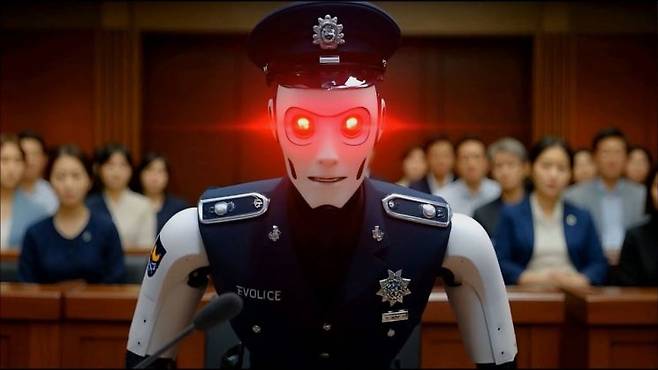
In a near-future where AI sits in every household, an AI-powered robot police officer hunts a child it has flagged as a future criminal. A grieving father takes the algorithm to court.
That is the conceit of "I'm Popo," billed by its distributor as the first South Korean feature with visuals generated entirely by AI.
Director Kim Il-dong, a webtoon artist making his feature directing debut, wrote the script and ran the prompts himself. Voice work was handled by professional voice actors, but no on-screen performers were cast. The director said the 64-minute film took roughly two months to assemble, working largely alone.
"What I wanted to argue most with this project is that the era of the one-person film has arrived," Kim told reporters Friday at the Seoul Film Center, where the picture screened for press ahead of its May 21 theatrical release.
What follows is part courtroom drama, part scenic detour, with the camera frequently breaking off to sweep across exotic landscapes and spectacle before circling back to its central question: whether AI can stand in for human judgment.
The finished work makes a stronger case for the headline than for the medium. "I'm Popo" carries the commercialized gloss made all too familiar by AI slop: photorealistic faces with a plastic sheen, features that shift from shot to shot, rapid-fire cuts papering over scenes that won't hold together.
A short film's worth of story is dragged out across 64 minutes, with long passages that play less like a narrative feature than a karaoke screen running behind a song.
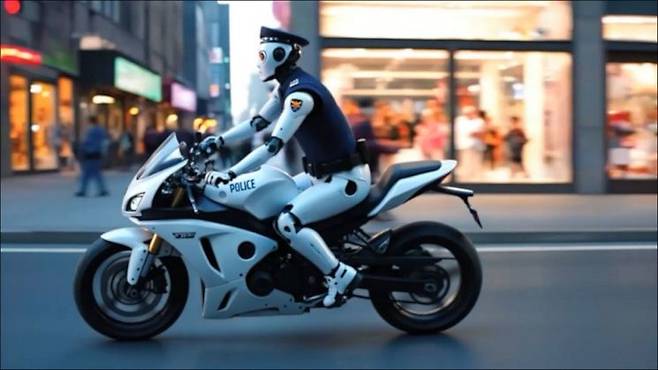
Kim acknowledged the visible seams. "AI-generated images do come across as awkward, frankly. So we recorded the dubbing first, let the sound carry and then attached the visuals," he said. To keep characters from morphing into one another, he added, he based their faces on people close to him.
Much of Kim's frustration on Friday was directed at the release timeline. The film was completed roughly a year ago, he said, and the gap between the tools available then and the tools available now is substantial. Recent video generators can sustain shots well past the five-second ceiling that constrained earlier production.
"My biggest regret is that we should have released it the moment it was finished last year," he said. "With AI, it's better to learn it late."
He framed the project, in part, as a prompt for a conversation he sees as overdue. "AI has come into our lives, and we may be getting gaslit by it without even realizing," he said. "I wanted to give people a reason to think about it once more."
Korean cinema has been creeping toward this threshold for a while, but a theatrical feature built end-to-end on generative AI is new ground.
Kang Yun-sung's "Run to the West," released by CJ CGV last October, used AI rendering for creatures and effects sequences alongside live-action work from Byun Yo-han and Yang Se-jong. Earlier experiments, including CJ ENM's "M Hotel" and "It's Me, Mun-hee," clocked in under 20 minutes apiece.
As it happens, "I'm Popo" won't hold the title alone for long. "Man in Hanbok," a period drama adapted from Lee Sang-hoon's bestselling novel of the same name, opens the same day in Korean theaters.
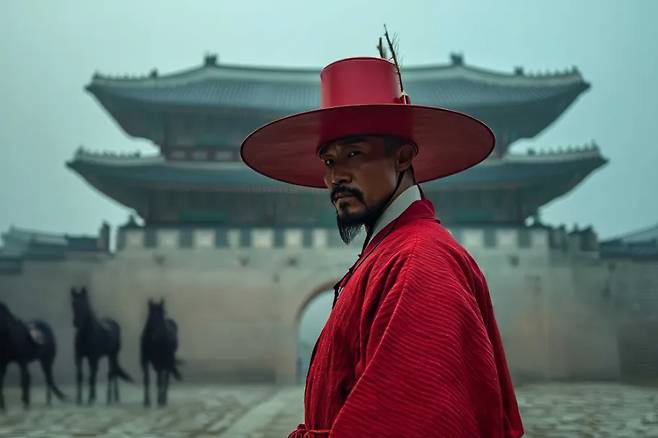
The film renders its medieval Korean and Renaissance Italian settings entirely through generative AI. It took the grand prize at the second Korea Artificial Intelligence Cinema Festival earlier this year and has played at the Busan International AI Film Festival and the World AI Film Festival.
The push into AI filmmaking has drawn its share of controversy. Last month, a short AI film titled "The Meter Reader" was posted to YouTube featuring a digitally generated lead whose face and voice closely resembled those of actress Yeom Hye-ran.
The actor's agency told local media no such permission had been granted, with Yeom later telling reporters she had only learned of the project through news coverage. The video was pulled shortly after.
Copyright © 코리아헤럴드. 무단전재 및 재배포 금지.