Samsung strike could shake trust in chip supply chain, economist warns
전체 맥락을 이해하기 위해서는 본문 보기를 권장합니다.
"Global big tech clients could begin looking at alternative suppliers such as TSMC as part of efforts to spread risk," Song said. "In the semiconductor industry, where process verification takes enormous time and money, customers who leave are difficult to win back."
"Semiconductor technology can lose competitiveness after falling behind by just one or two years," Song said. "At a time when Nvidia, TSMC and Intel are fighting for leadership in AI chips, Samsung cannot afford to spend resources on internal disputes."
이 글자크기로 변경됩니다.
(예시) 가장 빠른 뉴스가 있고 다양한 정보, 쌍방향 소통이 숨쉬는 다음뉴스를 만나보세요. 다음뉴스는 국내외 주요이슈와 실시간 속보, 문화생활 및 다양한 분야의 뉴스를 입체적으로 전달하고 있습니다.
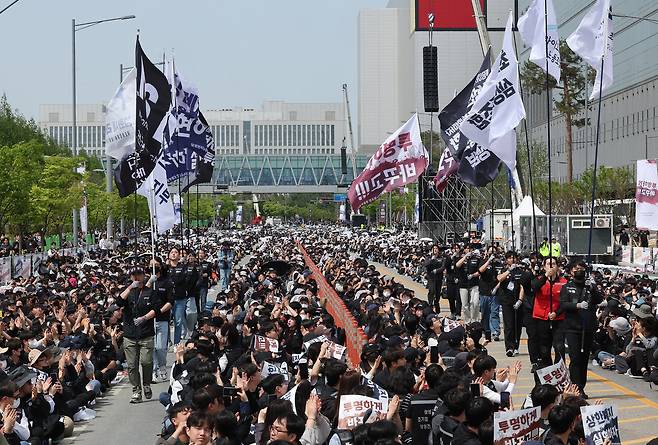
Samsung Electronics could face more than a temporary production hit if its labor union follows through on a planned strike next month, with disruption risking customer confidence, supply reliability and Korea’s broader chip competitiveness, an economist warned.
According to industry sources Sunday, Song Heon-jae, a professor of economics at the University of Seoul, said at a recent seminar hosted by the Ahnmin Policy Forum that a shutdown of chip plants could cost Samsung tens of billions of won — several million dollars — per minute, or about 1 trillion won ($677 million) a day. A prolonged strike could shave as much as 10 trillion won from chip operating profit, he said.
The greater risk, he argued, is not the immediate production loss but the possible damage to Samsung’s standing as a reliable supplier.
“Global big tech clients could begin looking at alternative suppliers such as TSMC as part of efforts to spread risk,” Song said. “In the semiconductor industry, where process verification takes enormous time and money, customers who leave are difficult to win back.”
Samsung’s joint labor action committee, comprising the Samsung Electronics Labor Union, the National Samsung Electronics Union and Samsung Electronics Labor Union Donghaeng, said production at the tech giant’s Pyeongtaek chip complex in Gyeonggi Province was disrupted during the night shift after tens of thousands of union members gathered for a rally at the site on Thursday.
According to the coalition, some 40,000 union members attended the rally. During the 10 p.m. to 6 a.m. shift, production performance — which the union refers to as “moving” — fell 18.4 percent at memory fabs and 58.1 percent at foundry fabs, it said.
Song said major customers such as Advanced Micro Devices and Nvidia place a high priority on supply stability, making even a limited disruption a potential blow to Samsung’s credibility.
The bigger damage, he added, may not show up immediately in earnings. He cited the erosion of customer trust, market share losses as clients absorb switching costs, missed opportunities in the AI chip race, the departure of key talent and a deeper Korea discount as possible risks.
“Semiconductor technology can lose competitiveness after falling behind by just one or two years,” Song said. “At a time when Nvidia, TSMC and Intel are fighting for leadership in AI chips, Samsung cannot afford to spend resources on internal disputes.”
At Thursday’s rally, the committee called for the cap on performance-based bonuses to be scrapped and said it would launch a general strike from May 21 to June 7.
The unions are demanding greater transparency in how bonuses are calculated, the removal of the current cap that limits performance pay to 50 percent of annual salary, and a written commitment to set aside 15 percent of operating profit as the bonus pool.
The walkout is expected to begin with a gathering near Samsung Electronics Chairman Lee Jae-yong’s residence in Yongsan-gu, Seoul. The Samsung Electronics Labor Union filed a rally notice with Yongsan Police Station on Friday for an event near Lee’s home at around 1 p.m. on May 21, the first day of the planned strike.
The notice listed about 50 participants. A union official said, however, that the turnout could still change and that the event would likely be closer to a press briefing on the strike plan than a full-scale protest.
If carried out, it would mark Samsung Electronics’ second general strike since its founding in 1969, following a 25-day walkout in July 2024.
Copyright © 코리아헤럴드. 무단전재 및 재배포 금지.