NPS Exits Coupang, Doubles Down on E-Mart in Retail Portfolio Reshuffle
Move reflects improved E-Mart fundamentals and shift in NPS investment strategy
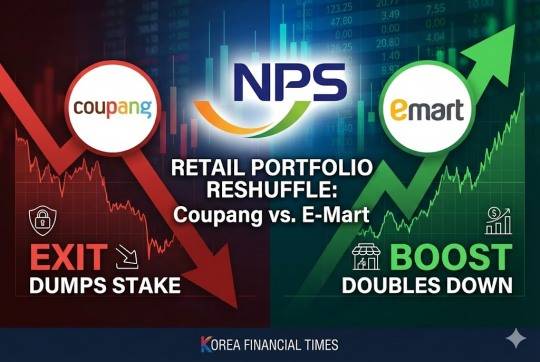
Coupang Stake Sharply Reduced
According to industry sources, the NPS recently made a significant cut to its Coupang holdings. The NPS had been a major institutional investor in Coupang since the company's initial public offering, holding shares valued at more than KRW 200 billion at the time of listing.
According to the NPS Fund Management Division's operational disclosures, the fund's investment in Coupang stood at KRW 218.1 billion as of 2024, representing a 0.05% weighting within its overseas equity asset class and a 0.41% ownership stake. The NPS is understood to have liquidated most of this position by early this year, around the time of Coupang's personal data breach incident in late last year.
Industry observers have noted that the controversy surrounding Coupang's data leak may have partly influenced the investment decision. As the issue expanded beyond the National Assembly and domestic regulators to draw international attention, analysts say it may have added to the burden on institutional investors.
However, given that NPS overseas equity management is based on passive index-tracking strategies and periodic rebalancing, it is difficult to attribute the divestment solely to any specific issue. The NPS has consistently adjusted individual stock weightings in line with volatility and market conditions as part of its broader global portfolio rebalancing process.
In addition, NPS investment guidelines require the application of responsible investment principles that factor in not only financial considerations but also corporate social responsibility performance, meaning ESG risks are among the comprehensive criteria for investment decisions.
The Case for Buying E-Mart
Having pared down its Coupang position, the NPS moved to increase its E-Mart stake, raising its overall exposure to large-cap domestic retail. This stands in contrast to the fund's decision to reduce its E-Mart holdings last year.
According to a regulatory filing dated the 1st of this month, the NPS purchased 289,818 shares (1.05%) of E-Mart on February 5, bringing its total ownership stake from 7.89% to 8.94%. The NPS had previously sold 577,489 shares of E-Mart last year, trimming its stake from 9.99% to 7.89%.
On the day of the NPS purchase, E-Mart's share price rose KRW 9,000 (9.5%) from the previous session to close at KRW 103,600, reflecting heightened market attention.
E-Mart has recently strengthened its shareholder return policy alongside improving profitability. With store renovation effects and early profitability at new locations contributing to a recovery in earnings, analysts suggest that the addition of value-enhancement measures — including shareholder returns — influenced the NPS's move.
A shift in the NPS's asset allocation strategy also appears to have been a factor. President Lee Jae-myung directed the NPS late last year to review increasing its domestic equity weighting. In response, the NPS adjusted its target allocation in January of this year, lowering the overseas equity target from 38.9% to 37.2% while raising the domestic equity target by 0.5 percentage points, from 14.4% to 14.9%.
Industry observers view the NPS's recent trading activity as the result of simultaneous asset class strategy adjustments and individual stock-level investment judgments, rather than a simple like-for-like sector rotation. The broader trend toward value stocks with clear earnings visibility and defined shareholder return policies — amid the current interest rate environment and heightened market volatility — is also seen as a key backdrop. The divergent investment flows between Coupang and E-Mart are likewise viewed as being closely tied to these shifting market conditions.
Beyond E-Mart, the NPS has been rebalancing its exposure across the domestic retail sector more broadly. According to Financial Supervisory Service filings dated the 1st of this month, the NPS increased its stakes in Lotte Shopping and Shinsegae. It acquired an additional 180,852 shares (0.64%) of Lotte Shopping, bringing its total holding to 3,023,471 shares (10.69%), while adding 22,582 shares (0.05%) of Shinsegae to raise its stake to 1,272,156 shares (13.47%).
Conversely, the NPS trimmed its positions in Hyundai Department Store and BGF Retail. It sold 172,187 shares (0.76%) of Hyundai Department Store, retaining 2,874,314 shares (12.70%), while offloading 172,982 shares (1%) of BGF Retail to reduce its stake to 1,436,670 shares (8.31%).
Park seulgi (seulgi@fntimes.com)
Copyright © 한국금융신문 All Rights Reserved.