2026 Korea Herald Architecure Talk reimagines public space with Dominique Perrault
전체 맥락을 이해하기 위해서는 본문 보기를 권장합니다.
"What makes architecture alive is not material, but air, space, volume and light. Architecture gives structure to empty space, and it is through natural light that it begins to breathe."
"Increasing density, however, does not mean we will suffocate. If we simply build higher and more, we will end up withering within those spaces. What matters is to treat the ground as a resource," Perrault said on his architectural concept of "groundscape."
이 글자크기로 변경됩니다.
(예시) 가장 빠른 뉴스가 있고 다양한 정보, 쌍방향 소통이 숨쉬는 다음뉴스를 만나보세요. 다음뉴스는 국내외 주요이슈와 실시간 속보, 문화생활 및 다양한 분야의 뉴스를 입체적으로 전달하고 있습니다.
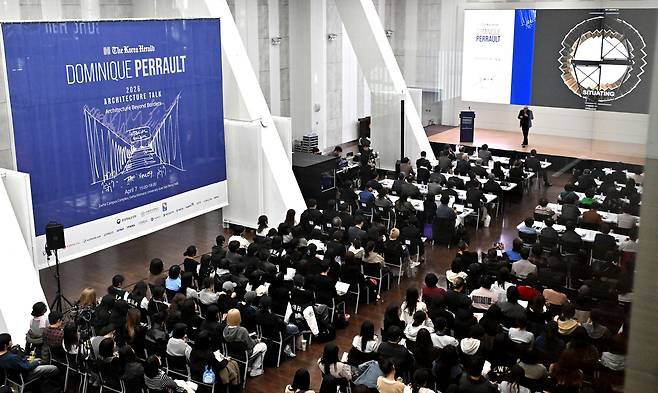
The 2026 Korea Herald Architecture Talk in Seoul explored changing perceptions of public architecture and public space, as well as where they should be heading in both Korea and France.
The fourth edition of the Korea Herald Architecture Talk concluded Tuesday at the Ewha Campus Complex, drawing more than 400 attendees. French architect and keynote speaker Dominique Perrault had designed the iconic venue.
Marking the 140th anniversary of South Korea-France diplomatic ties, the annual architecture talk put public architecture in the two countries in the spotlight, featuring works by Perrault, followed by a discussion on the architectural systems of Korea and France.
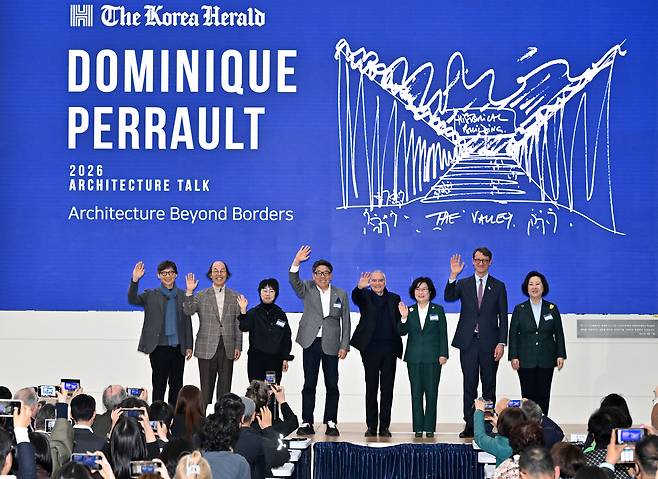
After brief networking among architectural experts, diplomats and government officials at the VIP session, the event started at 3 p.m. with opening remarks by Herald Media Group CEO Choi Jin-young, followed by welcoming remarks by Ewha Womans University President Lee Hyang-sook.
"We sincerely welcome all of you who have filled this space with your passion for architecture. It is a great pleasure and honor to open the fourth Korea Herald Architecture Talk. This forum marks a special moment to envision the future of cities beyond borders, and it is a particular honor to host a true master of our time," Choi said.
Congratulatory remarks were delivered by Jung Hyang-mi, deputy minister for culture and arts policy at the Ministry of Culture, Sports and Tourism, as well as French Ambassador Philippe Bertoux.
"This year’s edition holds a very special significance, as it coincides with the 140th anniversary of diplomatic relations between France and Korea, as well as the 140th anniversary of the founding of Ewha Womans University — two milestones that testify to the depth and longevity of our shared history," the ambassador said in French.
Also attending were Philippe Van Hoof, chairperson of the European Chamber of Commerce in Korea, and David-Pierre Jalicon, chairman of the French-Korean Chamber of Commerce and Industry.
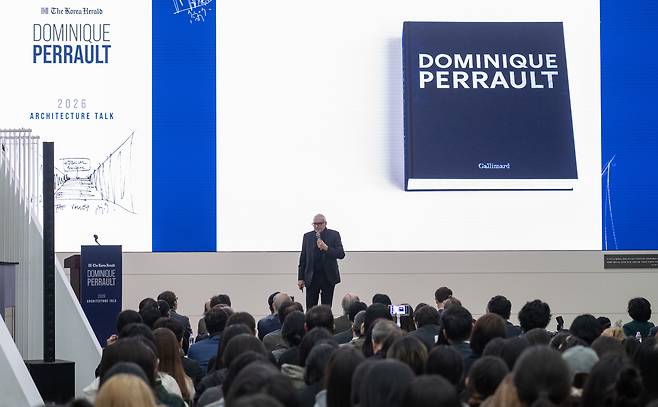
Perrault’s keynote presentation, titled "Dominique Perrault on Public Architecture: Ground, Light and the Civic Realm," was based on his newly released monograph published by Gallimard, offering insight into his architectural philosophy.
He emphasized a redefinition of the ground — not as a boundary, but as a space people can use and experience — as seen in his projects such as the Ewha Campus Complex, Villejuif Gustave Roussy station and the ongoing Gangnam International Transit Center in Seoul.
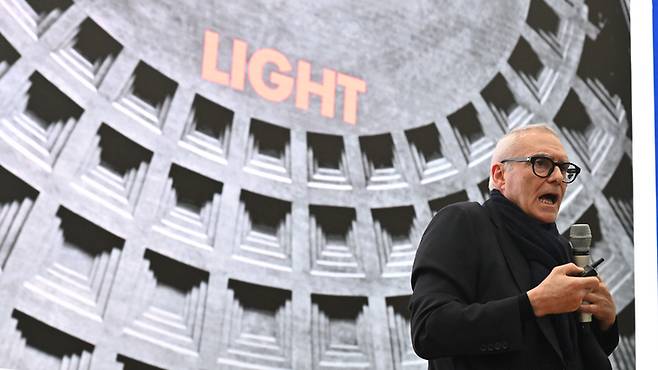
"People think architecture has to be visible, but embedding a building into the ground does not mean it disappears," he said.
"What makes architecture alive is not material, but air, space, volume and light. Architecture gives structure to empty space, and it is through natural light that it begins to breathe."
Perrault warned that cities continue to destroy vast areas of green space as they expand, contending that future urban development should focus on increasing density rather than spread.
"Increasing density, however, does not mean we will suffocate. If we simply build higher and more, we will end up withering within those spaces. What matters is to treat the ground as a resource," Perrault said on his architectural concept of "groundscape."
For the ongoing GITC project, Perrault said the space will not remain only a transport hub, but "must be a place where people live and experience the city."
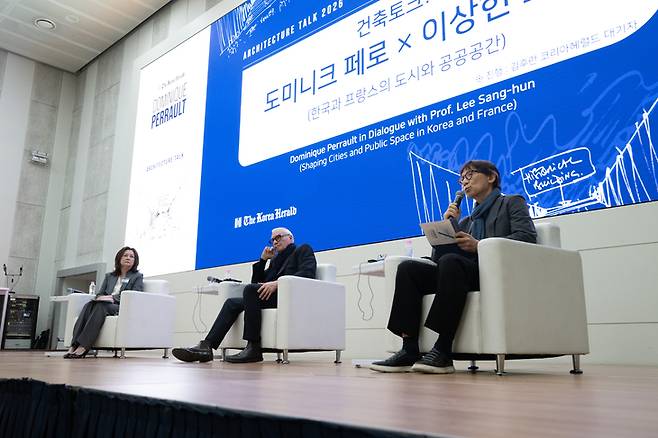
The Korea Herald Architecture Talk continued with the 60-minute "Shaping Cities and Public Space in Korea and France" discussion between the French architect and Lee Sang-hun, emeritus professor of architecture at Konkuk University.
Lee argued that all architecture is inherently public, but Korea lacks historical and cultural foundations for public space. He pointed to weak discourse, limited trust in architects and structural issues that hinder design integrity.
Perrault emphasized that public space emerges through time, use and memory, not design alone. He explained that in Europe, public space initially emerged from centers of power such as royal squares, before evolving into civic spaces. Over time, he said, these spaces became truly public through use, memory and collective experience.
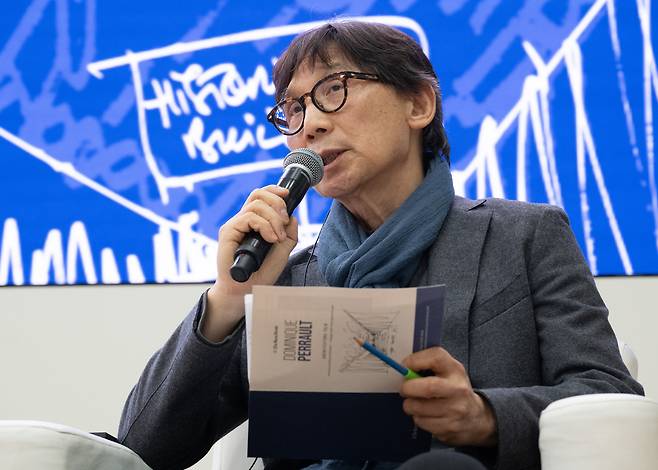
The discussion opened to the audience for questions. During the Q&A, one architecture student asked how a culture that supports the creation of new public spaces rooted in heritage could be developed in Korea.
In response, Perrault suggested closer collaboration between Korean and French students, proposing joint workshops where students could study public space and historical context together while exchanging ideas.
"Talking about architecture is not enough. Architecture is about projects — proposals, drawings, designs," he said. "We need to create a lab. It would be very interesting to bring Korean students to France."
"It is time to stop talking and start working," Perrault said.
Copyright © 코리아헤럴드. 무단전재 및 재배포 금지.