China's YMTC closes in on NAND leaders as Korea moves upmarket
China’s Yangtze Memory Technologies Co. is rapidly closing in on the world’s top makers of NAND flash memory, scaling production and advancing into higher-layer chips at a faster-than-expected pace. Korean chipmakers, long dominant in the market, are accelerating their shift to advanced nodes to defend their technological lead against a fast-rising Chinese challenger once seen as a clear underdog.
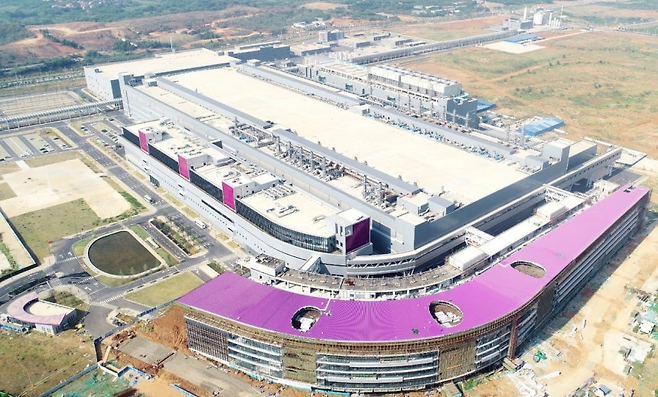
According to industry sources on Tuesday, YMTC has pulled forward the timeline for its third-phase fab in Wuhan, China, bringing expected mass production from 2027 to as early as the second half of this year. The plant, which broke ground in September 2025, is in the final stages of equipment installation.
With its first and second fabs already running at full capacity, the additional output is expected to significantly boost YMTC's global footprint. The company is widely seen as on track to surpass SK hynix and Micron Technology in shipment volumes as early as this year, tightening its grip on the No. 3 spot behind Samsung Electronics and Japan's Kioxia.
"NAND flash memory is less dependent on leading-edge lithography than DRAM or foundry processes," said Lee Jong-hwan, a professor in the department of system semiconductor engineering at Sangmyung University, noting it is a relatively more accessible area for Chinese firms to advance under US equipment sanctions, with greater reliance on domestically built tools.
"The challenge from Chinese companies poses a credible competitive threat, underscoring the need for vigilance. Korean chipmakers should keep up with their R&D efforts to reinforce their technological edge."
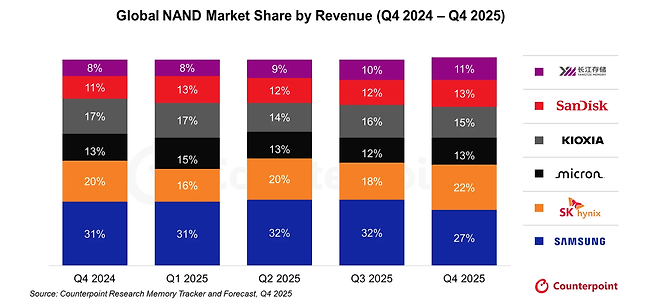
YMTC's rise has been driven by a volume-driven expansion strategy. Its share of global NAND shipments climbed to around 13 percent in the third quarter of last year from roughly 10 percent in the first quarter, and is projected to reach 15 percent this year.
The company processed about 1.29 million wafers in 2024, rising to 1.77 million last year. Output is expected to approach 2 million this year, potentially putting YMTC ahead of Micron and on par with SK hynix in shipment terms. By comparison, Samsung is expected to process about 4.7 million wafers and Kioxia about 4.69 million, according to Omdia.
The expansion comes as rivals increasingly focus on higher-margin segments such as server memory, opening space for YMTC to gain share in consumer markets including smartphones, PCs and automotive applications.
While YMTC still trails in revenue terms, with an 11 percent market share, it is growing rapidly and aims to expand further by year-end as it pushes into higher-end products.
After its attempt to enter Apple's supply chain was blocked by US export controls in 2022, YMTC has expanded into Southeast Asia, including Vietnam, while deepening its domestic presence. Supply constraints are now prompting a reassessment, with Apple reviewing the use of YMTC’s NAND, according to Reuters.
"Supplying Apple would signal YMTC's entry into top-tier global supply chains beyond its China-focused base," an industry official said. "Given that Apple has traditionally sourced NAND from Samsung, SK hynix and Kioxia, YMTC's market position would change significantly."
Beyond scale, YMTC is also closing the technology gap. The company has achieved around 270-layer NAND and recently unveiled its PC550 SSD featuring 294-layer chips. It is preparing to mass-produce NAND exceeding 300 layers under its X5-9080 lineup later this year, according to Digitimes.
That would effectively narrow the technology gap with global leaders, with SK hynix currently mass-producing 321-layer NAND, while Samsung is at 286 layers.
Yield rates and process stability are also improving, supported by continued investment and its Xtacking 4.0 architecture -- the company's proprietary 3D chip-stacking technology.
"By the headline metric of layer count, China has effectively caught up with Korea in NAND," said an industry official. "To maintain their competitive edge, Korean chipmakers will need to develop next-generation technologies, including high-bandwidth flash."
YMTC is also doubling down on investment. The company has established a new entity, Changcun Phase III (Wuhan) Integrated Circuit Co., with registered capital of 20.72 billion yuan ($3 billion), covering the full value chain from design to manufacturing and sales.
It is also considering a domestic listing in China, with its valuation expected to exceed $40 billion.
Korean chipmakers are tightening NAND output to support prices and focus on DRAM, while doubling down on advanced products to protect margins.
Samsung has halted 128-layer NAND production at its Xian plant in China and is ramping up 236-layer chips, as it pivots to premium segments. The facility accounts for about 40 percent of its NAND output. The company is also offloading older equipment and plans to introduce 286-layer NAND in 2026, with a road map extending beyond 400 layers.
SK hynix is taking a similar approach, maintaining investment in NAND. The company increased spending at its Dalian plant in China by more than 50 percent last year, to 440.6 billion won, signaling its intent to defend market share even as competition intensifies.
The company is also taking lead in developing HBF, which stacks multiple 3D NAND dies vertically, similar to how high-bandwidth memory stacks DRAM. The company recently formed a consortium with Sandisk to standardize HBF specifications globally.
Copyright © 코리아헤럴드. 무단전재 및 재배포 금지.