Lee’s chief of staff heads to Kazakhstan, Oman, Saudi for oil, naphtha supplies
전체 맥락을 이해하기 위해서는 본문 보기를 권장합니다.
Kang underscored the importance of his trip, saying the government sees "the current energy instability has entered a prolonged phase."
"We believe the trip is necessary if it allows us to bring in even one more barrel of crude oil or secure even one more ton of naphtha."
이 글자크기로 변경됩니다.
(예시) 가장 빠른 뉴스가 있고 다양한 정보, 쌍방향 소통이 숨쉬는 다음뉴스를 만나보세요. 다음뉴스는 국내외 주요이슈와 실시간 속보, 문화생활 및 다양한 분야의 뉴스를 입체적으로 전달하고 있습니다.
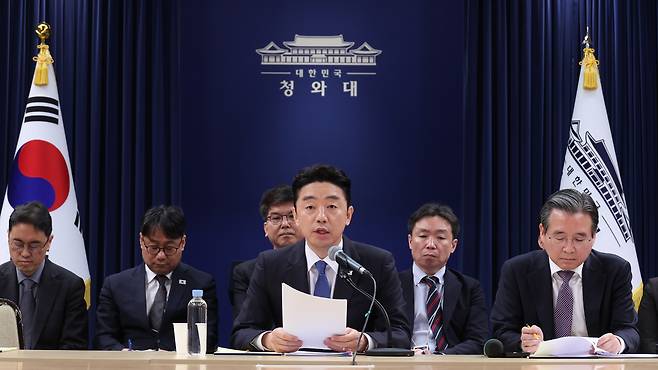
President Lee Jae Myung’s chief of staff is set to visit Kazakhstan, Oman and Saudi Arabia to lock in additional crude oil and naphtha supplies, as South Korea braces for a prolonged energy shock from the Middle East war.
Presidential chief of staff Kang Hoon-sik said Tuesday that “securing alternative supply lines remains an urgent task until the Middle East situation is fully resolved,” during a news conference held Tuesday morning ahead of his departure from Seoul later in the day.
“Our economy heavily depends on crude oil and naphtha imported from the Middle East region. As a result, it is also true that there are some difficulties in supply and demand,” Kang said.
South Korea relied on the Strait of Hormuz, which has been effectively blocked by Iran, for 61 percent of its crude oil imports and 54 percent of its naphtha imports last year, according to Kang.
Kang, who will visit the three countries as the president’s special envoy for strategic economic cooperation, will be accompanied by officials from relevant ministries, including the Ministry of Trade, Industry and Resources, and energy company representatives.
Kang underscored the importance of his trip, saying the government sees “the current energy instability has entered a prolonged phase.”
“When I visited the UAE earlier, securing 24 million barrels was intended to quickly ease energy uncertainty, even if only in the short term. This trip, by contrast, should be understood as an effort to prepare for longer-term supply stability,” Kang said.
“We believe the trip is necessary if it allows us to bring in even one more barrel of crude oil or secure even one more ton of naphtha.”
This marks Kang’s second overseas trip to mitigate energy shocks as Lee’s special envoy since the outbreak of the war in the Middle East on Feb. 28.
In mid-March, Kang visited the United Arab Emirates and secured an additional 18 million barrels of crude oil. South Korea has procured a total of 24 million barrels of crude oil from the UAE under emergency arrangements, including 6 million barrels from the UAE in early March secured through a hotline operation.
“To ensure the government’s high-level consultations do not end as mere rhetoric, we will work closely with the companies actually importing these supplies and spare no necessary support until crude oil tankers and petroleum product carriers arrive at domestic ports,” Kang said.
Asked about the feasibility of purchasing US crude oil as a way to mitigate energy shocks, Kim Yong-beom, presidential chief of staff for policy, gave an affirmative response during the news conference.
US President Donald Trump recently urged countries to “buy oil from the United States of America,” saying, “We have plenty,” during a news conference on April 1.
However, questions have arisen over the feasibility of such a move, as South Korea’s refining infrastructure is highly optimized for processing heavy crude, making the direct use of lighter US crude less efficient from both an economic and operational standpoint.
Kim explained that lighter crude imported from the US would be stored in government reserves, while an equivalent volume of heavier crude from state stockpiles would be supplied in exchange.
“The US has abundant light crude. Whether from the US or elsewhere, if we import light crude, we can offer a swap,” Kim said. “Most of our strategic reserves consist of heavy crude, so we are in a position to exchange it. That means we can purchase light crude, including from the US. We are currently operating a swap program.”
Asked about the possibility of a second supplementary budget in response to the Middle East war, which would follow the extra budget currently under review at the National Assembly, Kim downplayed the prospect.
Kim's remarks came as the National Assembly’s Special Committee on Budget and Accounts began reviewing the supplementary budget bill of 26.2 trillion won ($17.4 billion) on Tuesday. The government and the ruling Democratic Party of Korea aim to secure its passage Friday.
“A second supplementary budget is a very premature discussion, and that is a highly general proposition at this point. For now, the goal is to swiftly deliberate on and execute the supplementary budget of around 26 trillion won,” Kim said.
Kim explained that the current extra budget was drafted on the assumption of about three months of direct shocks and six months of indirect fallout from the Middle East war, adding that any further budgetary response should be considered only after the first supplementary budget is fully implemented.
“For now, the top priority is to swiftly deliberate on, finalize and execute the first supplementary budget,” Kim underscored.
Copyright © 코리아헤럴드. 무단전재 및 재배포 금지.