Lee, Macron pledge joint response to Mideast energy shock, Hormuz security
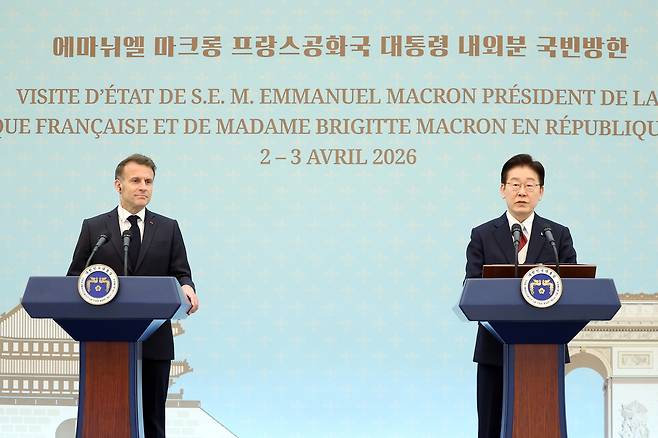
President Lee Jae Myung said that he and French President Emmanuel Macron had agreed to coordinate to address the energy shock triggered by the prolonged Middle East war, including efforts to secure safe passage through the Strait of Hormuz.
Lee and Macron held their summit at Cheong Wa Dae, the presidential office in Seoul, on Friday, during Macron’s first state visit to South Korea on the occasion of the 140th anniversary of the establishment of diplomatic ties.
“President Macron and I also agreed to jointly respond to the economic and energy crisis caused by the Middle East war by sharing policy experience and strategies, and to work together to ease global economic uncertainty,” Lee said during a news conference with Macron following the summit.
“We also reaffirmed our commitment to working together to secure safe maritime transport routes in the Strait of Hormuz, while expanding cooperation in nuclear energy and offshore wind, thereby strengthening energy security.”
Macron said he and Lee had “addressed the crisis in the Middle East, the conditions for a process of de-escalation, and the conditions — within a clearly established international framework — for negotiations with Iran that would allow for the reopening of the Strait of Hormuz.”
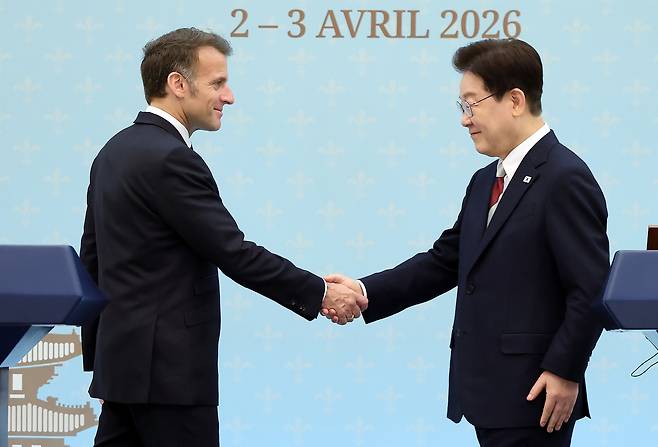
Macron underscored the importance of strengthening security cooperation between Seoul and Paris against the backdrop of a volatile global landscape and the shared values of the two countries, including support for United Nations multilateralism, respect for international law and a commitment to lasting peace.
“Given the international instability and our shared commitment to effective multilateralism, we believe in this coalition of independent countries,” Macron said.
“On that basis, we must strengthen our defense relationship through regular strategic exchanges, information sharing and interoperability between our armed forces,” he added.
Macron further said that the French military's Pegase mission, which will make a stop in the Republic of Korea in September, would serve as a clear example of such cooperation, as would the annual port calls of French naval vessels, which Paris has intensified in recent years.
On that matter, Lee also highlighted that Seoul and Paris "will further expand mutually complementary cooperation in future security domains such as space and defense industry."
South Korea and France have notably revised their General Security of Military Information Agreement or GSOMIA. Cheong Wa Dae explained that the update aims to “strengthen the protection and management of classified military information exchanged in the fields of defense and armaments cooperation, thereby enhancing mutual trust between the two countries.”
Speaking at the news conference, Lee also underscored that “the two countries agreed to further strengthen joint responses to global challenges as global strategic partners,” and disclosed Macron’s formal invitation for him to attend the G7 summit to be held in June in Evian-les-Bains, France.
Lee underlined that he and Macron “agreed to promote joint growth in advanced science and future industries, and to actively create the conditions necessary to leap forward together as leading innovation powers.”
On the occasion of the summit, Seoul and Paris have elevated their "Comprehensive Partnership for the 21st Century," forged in 2004, to a "Global Strategic Partnership" — an upgrade 22 years in the making.
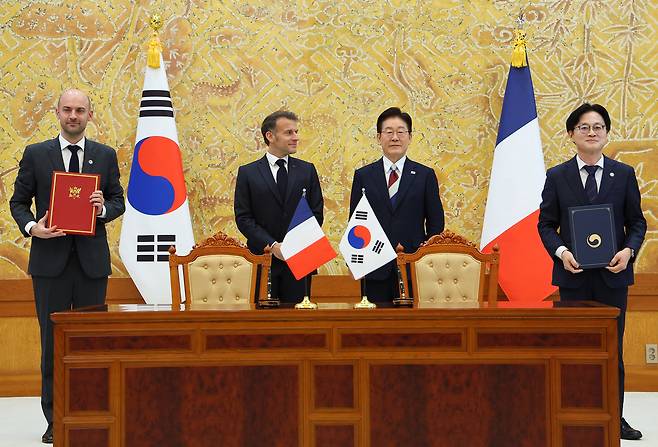
Following the summit, South Korea and France revised three existing agreements — the working holiday agreement, the cultural and technical cooperation agreement, and the General Security of Military Information Agreement. Both sides signed 11 memoranda of understanding and letters of intent spanning nuclear fuel cooperation, clean energy and critical minerals.
Lee also highlighted a memorandum of understanding signed between Korea Hydro & Nuclear Power, or KHNP, and French companies Orano and Framatome. He said that agreement would “ensure a stable supply of fuel for our nuclear power plants, as well as lay the groundwork for joint entry into the global nuclear energy market.”
From 2020 to 2024, KHNP imported a total of 2,077 tons of enriched uranium for nuclear fuel, with France accounting for the largest share at 38 percent, followed by Russia at 32 percent, the United Kingdom at 25 percent and China at 5 percent.
Another MOU signed between KHNP and Electricite de France, or EDF, Lee said, will “make a significant contribution to the growth of the offshore wind power industry.”
Lee also said Seoul and Paris had “established a foundation for the stable development of the critical minerals industry” through the signing of a letter of intent on cooperation in critical mineral supply chains.
Lee further explained that the letter of intent on cooperation in artificial intelligence, semiconductors and quantum technologies, signed on the sidelines of the summit, is expected to “serve as a key foundation for new growth drivers in future industries.”
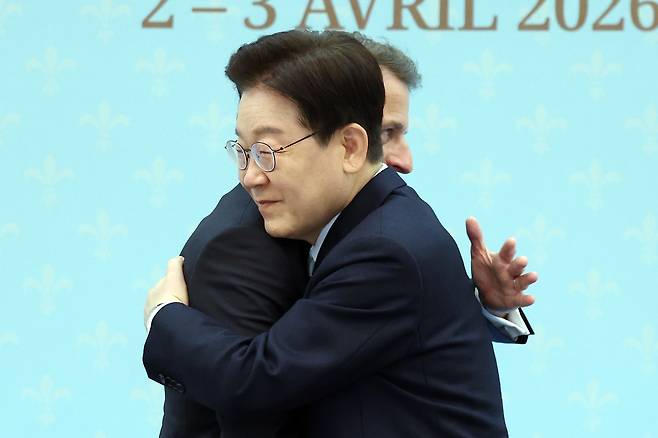
Expanding cultural cooperation was a key focus of the summit.
Lee explained that Seoul and Paris expect to expand cultural cooperation into new areas such as e-sports through the “protocol amending the Korea–France cultural and technical cooperation agreement.” Lee also disclosed that revisions to the air services agreement were nearing completion.
The working holiday agreement has been revised to raise the eligible age limit from 18–30 to 18–35, broadening opportunities for youth exchanges between South Korea and France.
On the occasion of Macron’s visit, the Centre Pompidou Hanwha Seoul officially opened in Yeouido on Friday. “It will enhance access to French art and establish itself as one of Seoul’s landmark destinations, enriching the daily lives of our people,” Lee said.
“Building on these diverse achievements in cooperation, our two countries will vigorously advance toward opening an era of one million people-to-people exchanges, where people and cultures move freely between us,” Lee added.
Macron’s visit marks the first by a French leader to South Korea since former President François Hollande’s state visit in 2015, and his first trip to Seoul since taking office in 2017, as the two countries commemorate the 140th anniversary of diplomatic relations.
Macron said Lee’s upcoming state visit to France in September “will reinforce our shared conviction that our two countries have much to accomplish together in the years ahead.”
Copyright © 코리아헤럴드. 무단전재 및 재배포 금지.