Public architecture should be both functional and ambitious: Dominique Perrault
French architect says political will important in public commissions
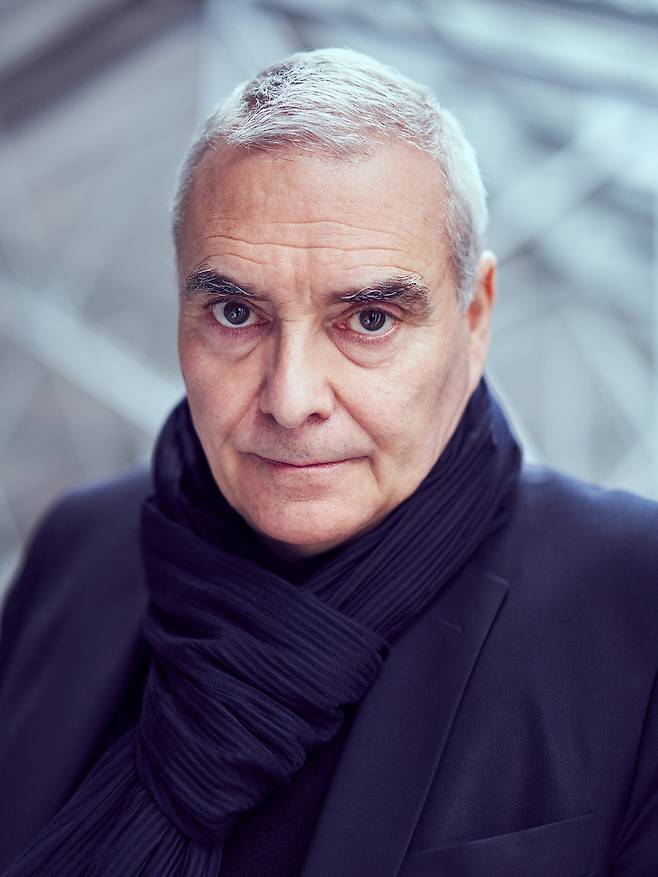
Architect and urban planner Dominique Perrault is widely known for redefining public space with the concept of "groundscape."
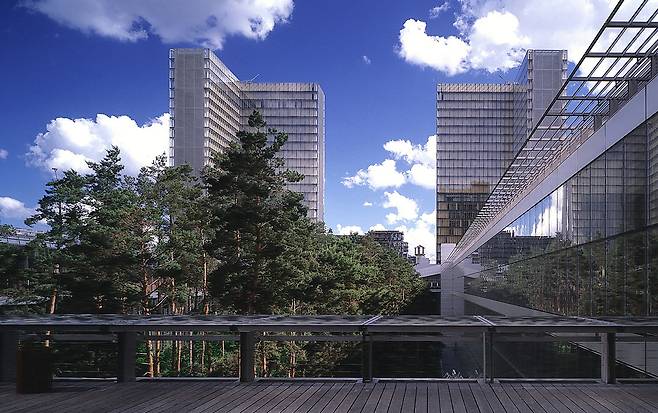
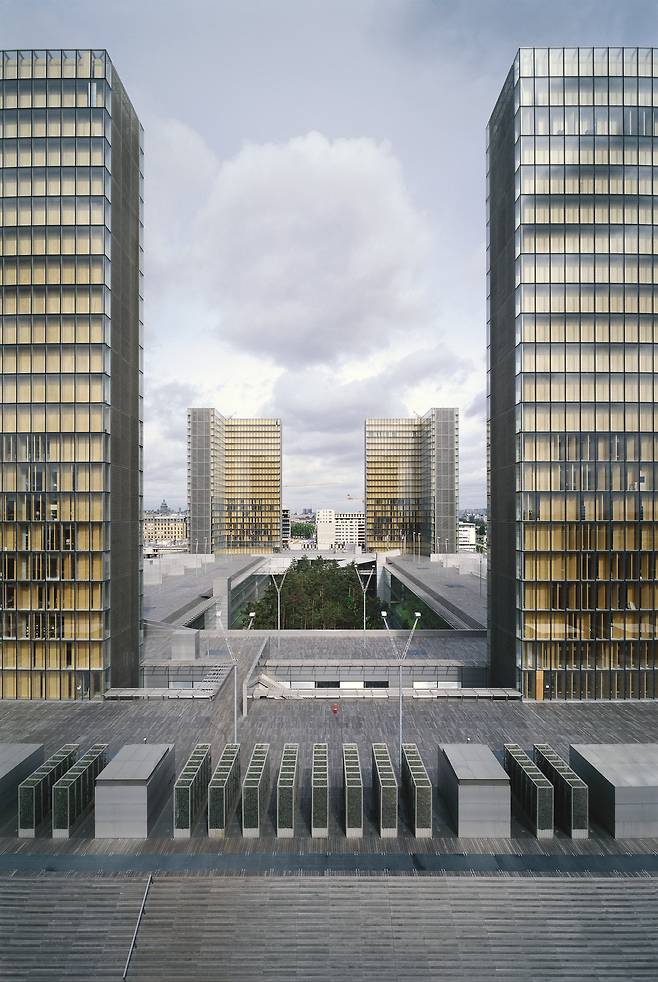
Perrault came to international recognition in 1989 at the age of 36 after winning the competition for the National Library of France in Paris, a landmark project that exemplifies his approach to spatial concepts.
Rather than asserting a monumental presence, the building’s iconic design emphasizes voids, horizontality and the integration of the landscape, allowing architecture to emerge subtly from its context.
Integrating architecture with the surrounding landscape through minimal and ground-oriented design, the architect blurs boundaries between above and below ground, creating spaces that are both infrastructural and experiential.
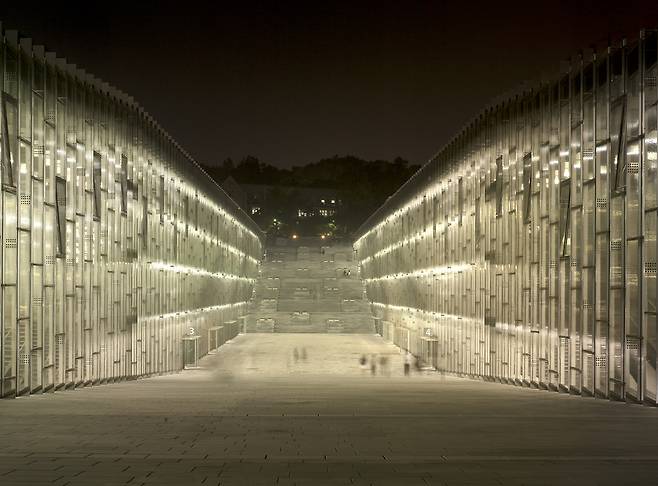
Perrault’s architectural philosophy continues to be seen in projects such as the Ewha Campus Complex at Ewha Womans University in Seoul completed in 2008. Here, the campus is carved into the ground, forming an "urban valley" that merges circulation, light and public space.
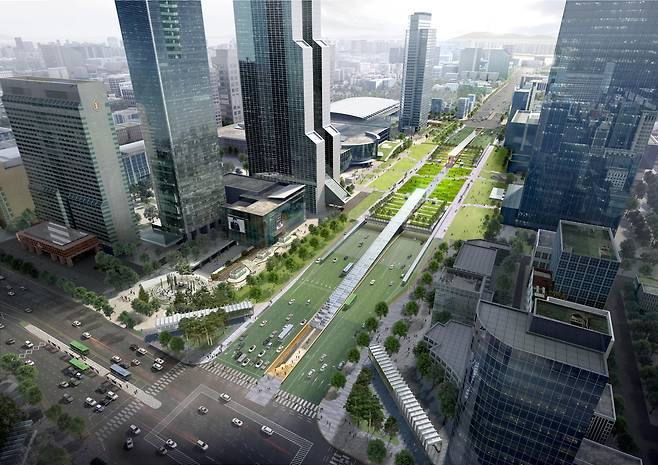
Lightwalk — Gangnam Intermodal Transit Center, which is currently being built in southern Seoul, is designed to function as an underground station as well as a public space. A major departure from the city's other underground spaces, the design envisions natural light pouring in through glass arcades.
Expected to be completed in 2028, the transit center stretches along Yeongdong-daero, a major thoroughfare south of the Han River, and connects to Coex, Seoul’s largest convention center.
The primary function of the 95,000-square-meter space is as a transportation hub for bus, subway, train, car and bicycle, and is expected to serve some 600,000 people each day.
However, Lightwalk also features a total of 72,000 square meters of retail, office and other program space. Above ground, a sprawling public park will be built, offering space for play and relaxation.
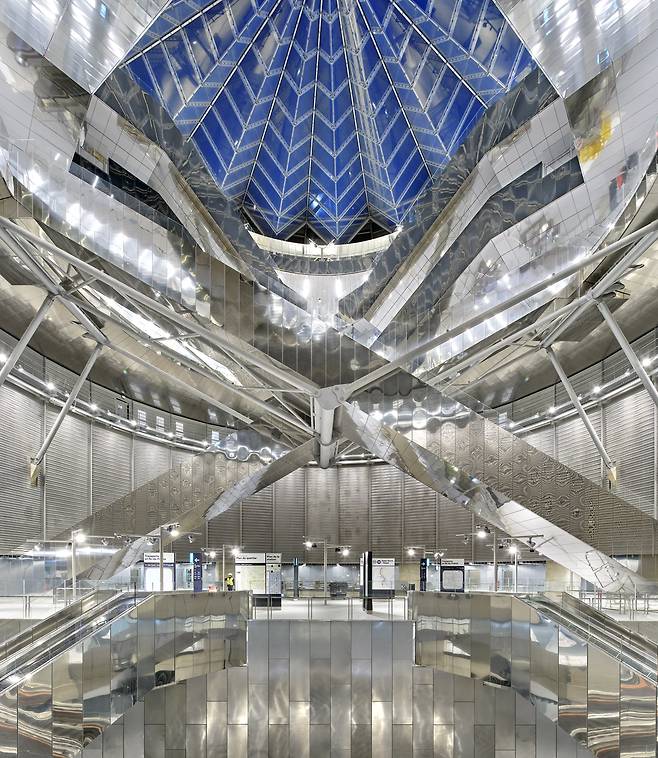
Born in 1953 in Clermont-Ferrand, France, Perrault founded his own architectural studio, Dominique Perrault Architecture, in 1981. His recent major works include the award-winning Villejuif-Gustave Roussy Station, a massive light-filled transport hub in Paris, and the athletes’ village for the Paris 2024 Olympic Games.
The Korea Herald spoke to Perrault ahead of the 2026 Korea Herald Architecture Talk titled "Architecture Beyond Borders — Dialogue With Dominique Perrault," scheduled to take place April 7 at Ewha Womans University in Seoul.
Korea Herald: What is the role and function of public architecture in cities today?
Dominique Perrault: Public architecture plays a fundamental role in shaping the city, both past and present. It is grounded in the construction of essential infrastructure, facilities, public spaces and services that form the foundation of urban life.
Beyond this functional dimension, it carries a collective ambition: Everything that pertains to the common good finds expression through public commissioning. This, in turn, helps organize the city, guide its development and ensure its capacity to accommodate and shelter the entire population. Public architecture also contributes to the coherence and identity of territories by structuring shared spaces that are accessible to all.
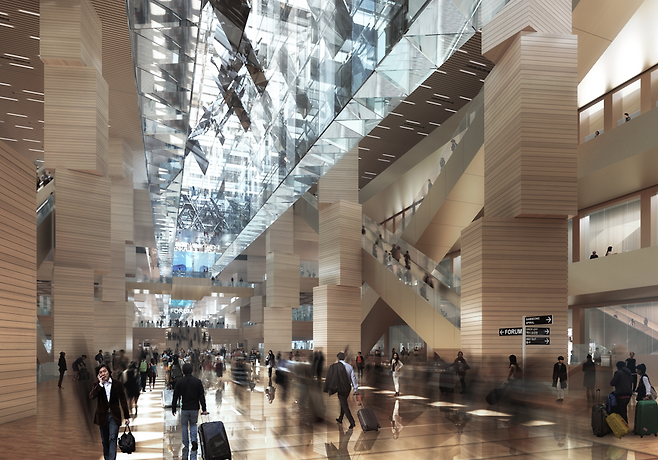
DP: The GITC project serves as a clear demonstration of public investment, having been funded both by the South Korean government and the city of Seoul. This significant commitment to transport infrastructure raises, in my view, a fundamental question: How can it be transformed into true architecture?
In my work, I argue that public commissions should not be limited to producing purely functional infrastructure, but should also embody architectural ambition. This idea underpins my approach, which can be summarized as follows: Ensuring that infrastructure becomes architecture in its own right.
The GITC project provides a concrete illustration of this perspective. It is not merely a transport hub, but a large public gallery capable of accommodating more than 700,000 travelers per day, connecting metro, bus and rail within a structured space guided by natural light, which directs passenger flow. This large gallery functions like a covered passage, flooded with daylight through a wide glass canopy, while protecting users from the elements.
KH: In France, architects play a significant role in public architecture. In your experience, do you find this to be the case in Korea as well?
DP: The issue is less about architects themselves than about public commissioning. In France, their role has been strengthened through strong political will, particularly from the presidency of Francois Mitterrand onward, when public commissioning was elevated to the level of a true national policy.
This momentum enabled young architects to gain access to public commissions and to actively contribute to the production of public buildings, as I did with the National Library of France. In other words, it was primarily the commitment of the state and the successive governments that gave architects this central role.
In Korea, the situation is different. Public commissioning does exist, but it is not part of a policy that is as explicitly defined or structured at the national level. It is generally less visible, less frequent, and in some ways less demonstrative. As a result, the role of architects in public architecture depends above all on the political framework that supports, or does not support, public commissioning.
KH: What, in your opinion, are some of the major systemic problems in Korea’s public architecture?
The issue of systemic difficulties primarily relates to the organization of public procurement. To be effective, it must be strongly regulated. This is essential, on the one hand, to ensure oversight of public funds and prevent risks of corruption, and on the other hand, to guarantee quality control (programmatic, architectural and technical) of projects.
Public architecture, funded by citizens, must meet a high standard of excellence, both in its design and its execution. It must also ensure genuine usability and value for citizens.
From this perspective, it seems essential that each major project be led by a clearly identified public body responsible for supervising, monitoring and supporting the entire process. However, this is precisely what is lacking in Korea.
In my view, the absence of a sufficiently strong governance structure is a major obstacle to the development and quality of public procurement.
KH: What are the big issues in public architecture in France and Korea today?
DP: The major challenges of public architecture lie in the pursuit of high architectural quality across all public buildings. The aim is to design projects that serve the public interest and are capable of meeting the needs of all citizens.
Public procurement must also ensure fair access for all architects, whether experienced or not, by giving them the opportunity to take part in public projects and to fully express their talent, creativity and vision of architecture.
Finally, public procurement guarantees the integrity of projects for the benefit of citizens.
KH: What are the challenges of working on international projects?
DP: When it comes to international projects, the architect never works alone. Their role is above all to organize and coordinate multidisciplinary teams, bringing together other architects, whether local or international, as well as landscape architects, designers and engineers.
For me, a successful project always relies on this kind of multidisciplinary collaboration, often open to international talent, in order to combine different areas of expertise.
KH: What are the elements that make for "good" public architecture? Could you give an example of such work?
DP: I would cite the example of the Bibliotheque Nationale de France (National Library of France) — Francois Mitterrand site in Paris. The project, begun in 1989 and completed in 1995, was a project of national significance, as it is the country’s only national library and the largest French cultural building of the 1990s at 360,000 square meters.
The project was championed by the president of the republic and overseen by a minister in charge of "major projects," reflecting a structured and demanding public client. This organization ensured a high level of architectural quality for the building, as well as for its interior design and artistic integration, with around 20 monumental artworks incorporated into the project.
The project also illustrates the importance of meeting deadlines and budget constraints: It was completed within the five-year time frame and below the authorized cost ceiling.
For me, a "good" public architecture project is therefore defined by this combination of essential criteria: high architectural quality, cost control, adherence to deadlines and careful attention to the user experience, all under the guidance of a well-structured public client.
KH: Public architecture projects ultimately serve the public. Yet, the client is typically the government at different levels. How do you, as an architect, mediate the possible tensions between the demands of the client and the public?
DP: To manage potential tensions between the expectations of the public client and those of the general public, there must be a relationship of trust, loyalty and solidarity between the architect and the public client, whether it is the state, a local authority or another institution.
This "partnership" ensures that the project serves the public interest while maintaining a high level of architectural quality. As the end beneficiary, the public expects the completed work to be exemplary, both functionally and aesthetically.
KH: How should public architecture develop, moving forward?
DP: Public architecture must be protected and promoted, as it constitutes a shared heritage. These landmark works should be listed, maintained and preserved in the spirit of their original design. It is also important to bring architecture closer to citizens: by organizing exhibitions to make it more visible and understandable, and by creating forums for dialogue that bring together policymakers, architects and residents.
In short, the goal is to ensure that public procurement and public architecture never fade away. They must be maintained and safeguarded so that they remain alive, active, dynamic and deeply cultural.
In France, 2027 will mark the 50th anniversary of the Architecture Act. This milestone represents a unique opportunity to highlight the identity of different regions and to showcase the impact of public architecture.
The president of the republic plans to celebrate this anniversary, notably through the French pavilion at the Venice Biennale of Architecture, which will emphasize architecture as both a political and cultural endeavor, serving the public interest and strengthening its resonance with the public.
Ultimately, the aim is to ensure the lasting continuity of public procurement and public architecture.
KH: What is your ideal architect?
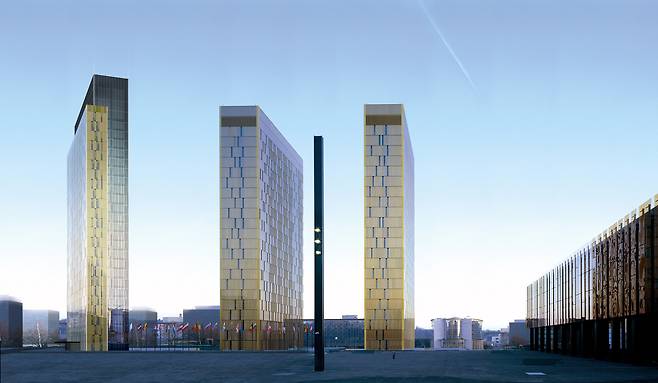
DP: Rather than speaking about the architect, I would speak about the client. I consider myself a "child of public procurement." Without it, I would never have been able to carry out projects such as the Bibliotheque Nationale de France — Francois Mitterrand site in Paris or the Court of Justice of the European Union (1996-2019).
My ideal client is therefore a visionary and enlightened one, capable of supporting and promoting the quality and integrity of public architecture.
Copyright © 코리아헤럴드. 무단전재 및 재배포 금지.