Hangeul defines Korean identity: Kim Jin-myung
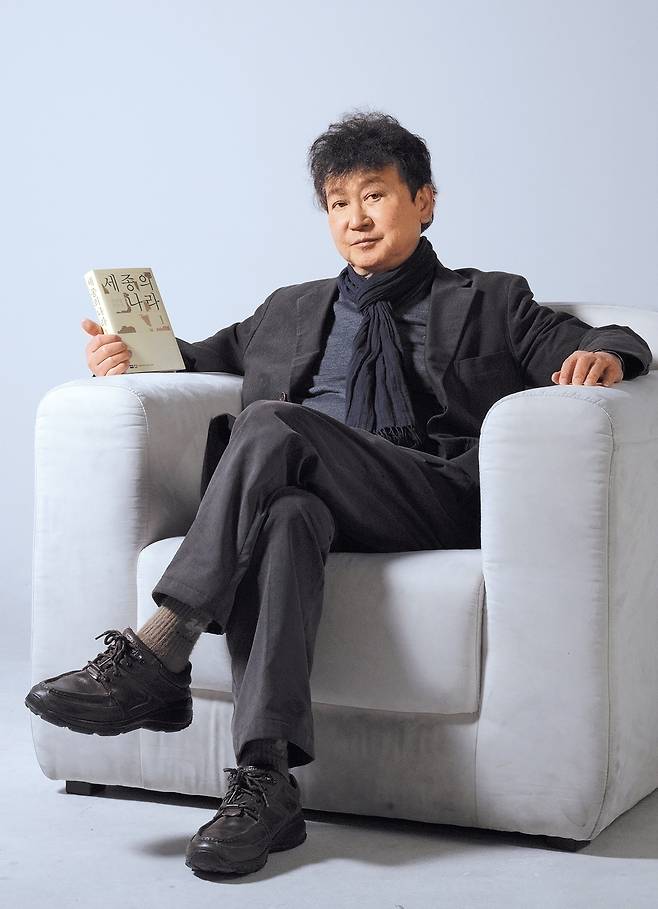
Kim Jin-myung, who dominated South Korea’s bestseller lists in the 1990s with works like "The Mugunghwa Flower Has Bloomed" and historical epics including "Goguryeo," has chosen the creation of Hangeul, for his latest subject.
"From K-pop to K-dramas, the global rise of Korean culture rests on a single foundation: Hangeul, the Korean writing system. To share it with the world, we must first understand its excellence and significance ourselves.”
In his latest novel, "The Land of Sejong," Kim turns to perhaps the most revered figure in Korean history, Sejong the Great, and to the creation of the Korean alphabet, Hunminjeongeum.
Spanning two volumes, the book blends historical record with imaginative reconstruction to trace how King Sejong, in the face of fierce opposition from his court, led the creation of a new writing system for his people.
Before Hangeul, Koreans relied on Chinese characters, known as Hanja, to write. But the system was ill-suited to the Korean language, and its complexity placed literacy out of reach for most, leaving reading and writing largely confined to the educated elite.
Set against a Joseon Dynasty overshadowed by Ming China, the novel portrays a society in which not only language, but even thought itself, was tethered to a foreign script and controlled by a narrow elite.
Hangeul for the people
Kim argues that the invention of Hangeul was not only a linguistic breakthrough but a political revolution.
“In Joseon, literacy was power. In the early Joseon period, only about 4 percent of the population — the yangban elite — could read and write Chinese characters. The remaining 96 percent were illiterate.”
Advancement through the state examination system reinforced that imbalance, concentrating authority and privilege in the hands of a few.
“Knowledge and power circulated only among the elite, while ordinary people had virtually no means to appeal injustice,” he explained.
In Kim’s telling, Hangeul upended that structure. By creating an accessible script, Sejong effectively redistributed power, transforming writing from an exclusive instrument of authority into a universal right.
“It was an attempt to build a nation in which the people themselves were sovereign,” Kim said. “That was a turning point in human civilization.”
The implications extended beyond class. While neighboring states — Japan, the Khitan, Tibet and the Mongols — had developed their own writing systems, Joseon remained dependent on Chinese characters.
“With Hangeul, Korea secured its national identity and laid the groundwork for literacy, economic growth and cultural development that are visible today,“ he said.
Where history meets imagination
The decision to fictionalize was not one Kim took lightly.
“This is a story every Korean grows up hearing,” he said. “It has been retold many times in dramas and films. I worried whether turning such an achievement into a novel might fail to do it justice.”
What ultimately persuaded him, he said, was the realization that while the broad outline of Hangeul’s creation is widely known, deeper questions — about its scientific principles and its significance — remain largely unexplored in fiction.
“That led me to ask: How well do we really understand Hangeul? I wanted to take on the challenge of revealing why it is such a scientific writing system.”
For all its historical weight, "The Land of Sejong" is a work of fiction — one that takes creative liberties. Kim introduces fictional characters, including an investigator tracking clues left by a murdered mentor and a sharp-witted woman from a fallen aristocratic family, weaving in a tragic romance and elements of mystery to drive the narrative.
One of the book’s more imaginative turns is the inclusion of Jang Yeong-sil, the celebrated inventor and engineer, as a collaborator in the creation of Hangeul. Though born into the lowest social class as a government slave, Jang rose under the patronage of Sejong to become a key figure in Sejong's scientific endeavors.
“There is no historical record that Jang directly contributed. But given the scientific nature of Hangeul and the close relationship between Sejong and Jang, it is a plausible possibility.”
For Kim, the imagined partnership reflects the intellectual spirit of the time, when language, mathematics and science were deeply intertwined.
Warning on literacy crisis
If the novel looks to the past, its urgency is rooted firmly in the present. Kim said he was driven in part by what he sees as a growing crisis of literacy in Korea.
“As our society becomes rapidly digitized, communication is shifting from text to images,” he said. “It may be entertaining, but younger generations are losing the ability to read and write. They are not reading or writing anymore.”
“Literacy forms consciousness, and consciousness shapes the self,” he continued. “The loss of literacy ultimately leads to the loss of the self.”
Over the past decade, he added, the decline has grown severe enough to threaten social cohesion. “If this continues, it could even lead to the collapse of the nation.”
For Kim, literacy is not only central to individual identity but also essential to the health of democracy. It serves, he argues, as a safeguard against authoritarianism.
“In a dictatorship, people follow orders without understanding. Even in a democracy, if citizens lose literacy, they can be drawn into authoritarianism of their own accord.”
That this is happening in a country that possesses what many linguists regard as one of the world’s most efficient writing systems strikes him as a profound irony.
His novel, he said, is meant as both a warning and a call for what he describes as a “Copernican shift” in how society values reading and language.
The remedy, in his view, is straightforward, if not easy: reading.
“There is no other way. If the current trend continues, the collapse of literacy will lead to the collapse of humanity itself.”
Taking Hangeul to the world
Kim believes that hangeul lies at the root of Korean culture — and that for South Korea to become a true cultural powerhouse, it must do more to bring its writing system to a wider global audience.
In that spirit, he recently dedicated "The Land of Sejong" to a group of 15 influential figures, including Samsung Electronics Chairman Lee Jae-yong, RM of BTS, singer Lim Young-woong and television personality Yoo Jae-suk.
“Sejong created Hangeul so that people could use it freely and with ease,” Kim said. “I sent the book to those with social influence in the hope that they will help lead efforts to restore literacy.”
He pointed in particular to RM, known for his appreciation of the Korean language. His message at the launch of Generation Unlimited at the United Nations General Assembly in 2018 — "Speak Yourself" — aligns precisely with Sejong’s original intent to give people a voice, Kim said.
For Kim, the strength of Hangeul lies in its simplicity. Each character is formed from combinations of basic strokes, allowing for both clarity and versatility. Like assembling structures from a handful of bricks, Hangeul’s system allows for endless variation from minimal components.
“Every letter is built from simple elements. From those basic strokes, you can create an infinite range of sounds.”
“For any phonetic system to succeed, its symbols must be simple,” Kim said. “There is no script as simple and yet as capable of expressing every sound as Hangeul. That is why it is such a remarkable writing system.”
Copyright © 코리아헤럴드. 무단전재 및 재배포 금지.