Inside JP at Louis Vuitton, where Korean flavors meet global precision
전체 맥락을 이해하기 위해서는 본문 보기를 권장합니다.
"Here, I use as many Korean ingredients as possible, but I think carefully about what a more global language of taste and plating looks like," he said during a menu preview in Seoul on Monday. "I wanted this to feel like a space that represents Seoul, but also one that is moving outward into the world."
"When we think of flavors like soy sauce or doenjang, they have very distinct characteristics. I try to keep those intact, but adjust temperature, texture and intensity so that more people can approach them comfortably," he said. "Even for those unfamiliar with Korean food, I want them to feel both something new and something familiar at the same time."
이 글자크기로 변경됩니다.
(예시) 가장 빠른 뉴스가 있고 다양한 정보, 쌍방향 소통이 숨쉬는 다음뉴스를 만나보세요. 다음뉴스는 국내외 주요이슈와 실시간 속보, 문화생활 및 다양한 분야의 뉴스를 입체적으로 전달하고 있습니다.
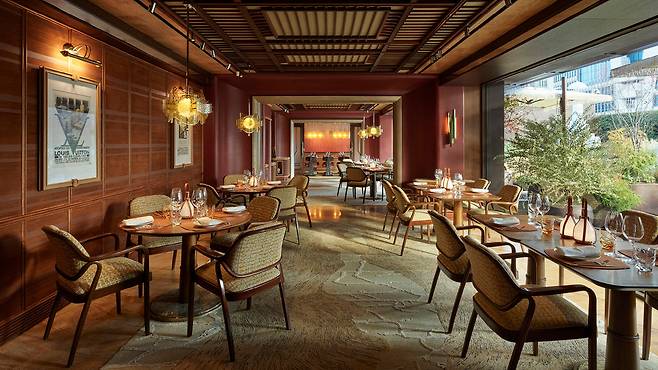
On the sixth floor of Louis Vuitton’s immersive cultural complex at Shinsegae The Reserve, chef Park Jung-hyun makes a calculated return home.
Known for leading Atomix to two Michelin stars in New York, Park debuted his first Seoul restaurant, JP at Louis Vuitton, earlier this year. On Tuesday, he introduces a new tasting menu that is at once deeply Korean and deliberately cosmopolitan.
The dining room sets the tone. Rendered in warm saffron hues, the space opens onto a terrace through a full glass wall, flooding the room with natural light by day. Newly accessible with the spring menu, the terrace — lined with tables and a small garden — offers a sense of openness rare for dining rooms in central Seoul. Servers in beige Louis Vuitton suits move with quiet precision, guiding guests through an experience that leans as much on service choreography as its cuisine.
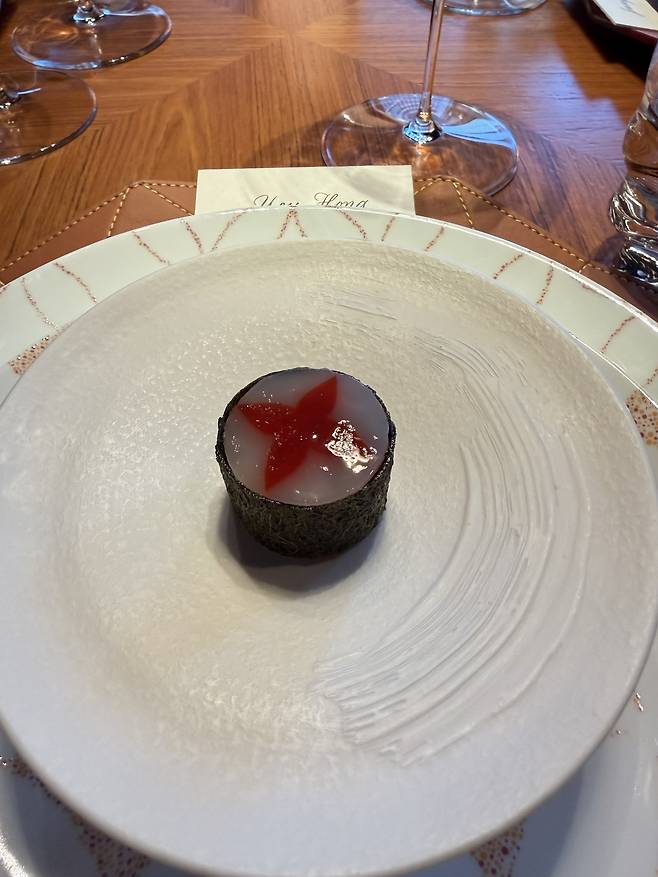
Park’s five-course Heritage Tasting Menu, priced at 280,000 won, begins with a series of tightly composed bites. A gamtae-wrapped beef tartare roll — topped with a red Louis Vuitton star motif — pairs the clean savoriness of hanwoo with the gentle acidity of baekkimchi.
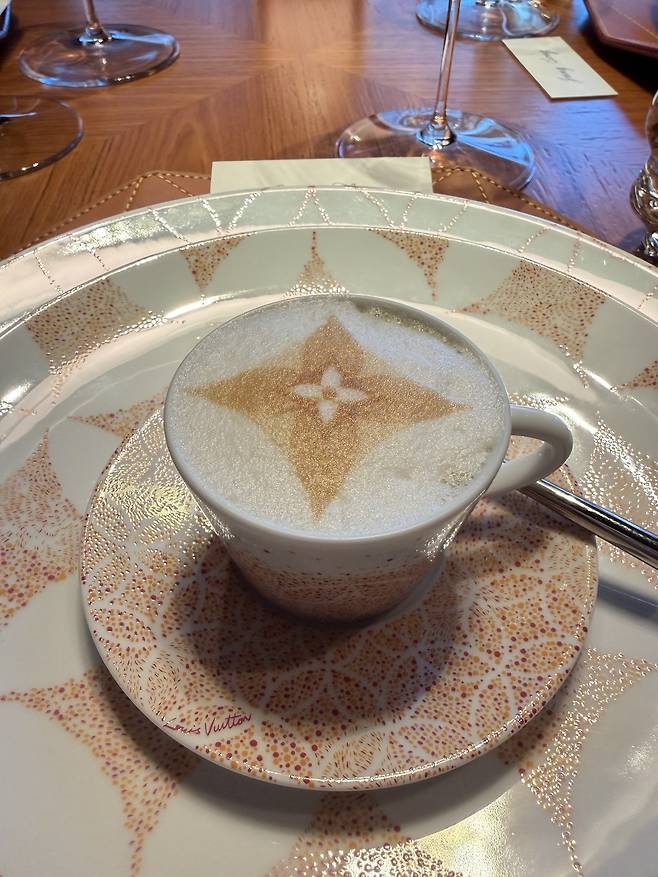
Though at first glance you may think you have been served a cuppachino, the next appetizer is in fact a seafood soft tofu course. Sweet raw shrimp deepens the dish’s marine sweetness, while a foie gras foam — again stamped with the Louis Vuitton star — adds richness without excess.
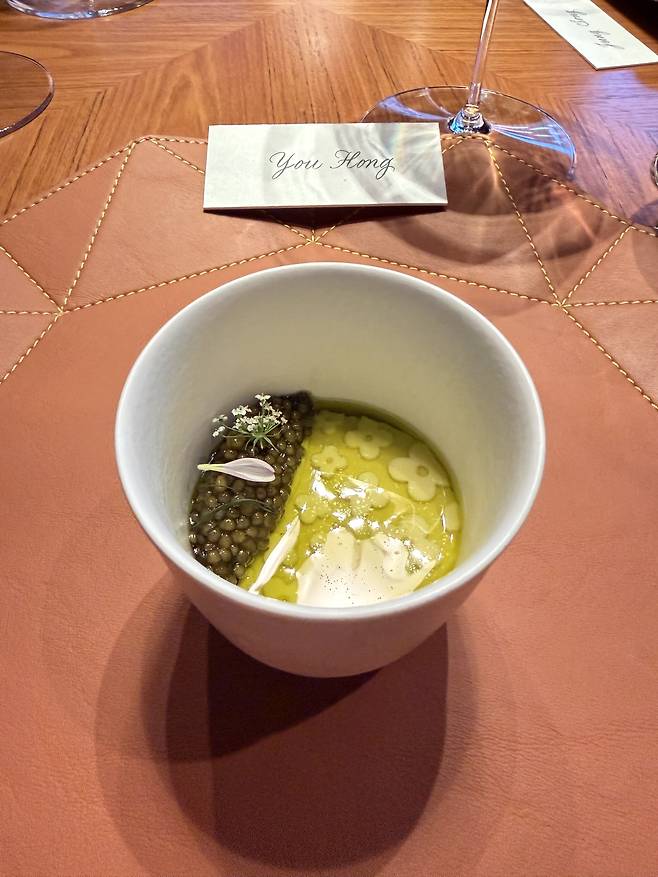
From there, Park chooses layering over intensity to build complexity. A dish of Kaluga caviar with cauliflower and perilla oil arrives in gradients of green, the nutty aroma of perilla oil anchoring the richness of the caviar. The composition feels unmistakably spring-driven: bright, aromatic, quietly luxurious.
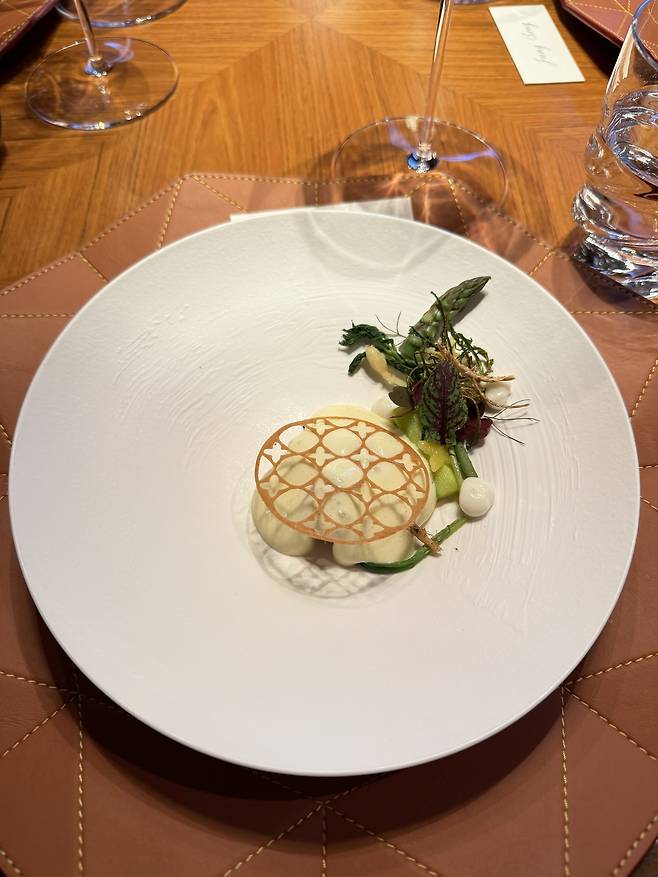
Green asparagus with seasonal vegetables and Comte continues the theme. Fragrant wild chives, crisp asparagus and a Comte foam are offset by a subtly acidic sauce and yuzu pickles, while a Parmesan tuile stamped with the brand’s monogram adds a playful visual cue.
Perhaps the most resonant dish is the abalone risotto with mussel and cheongju. Despite its Italian reference point, it reads closer to a refined Korean juk. The abalone is tender, the mussels clean and briny, and the rice — enriched with spinach and meat — delivers a comforting depth.
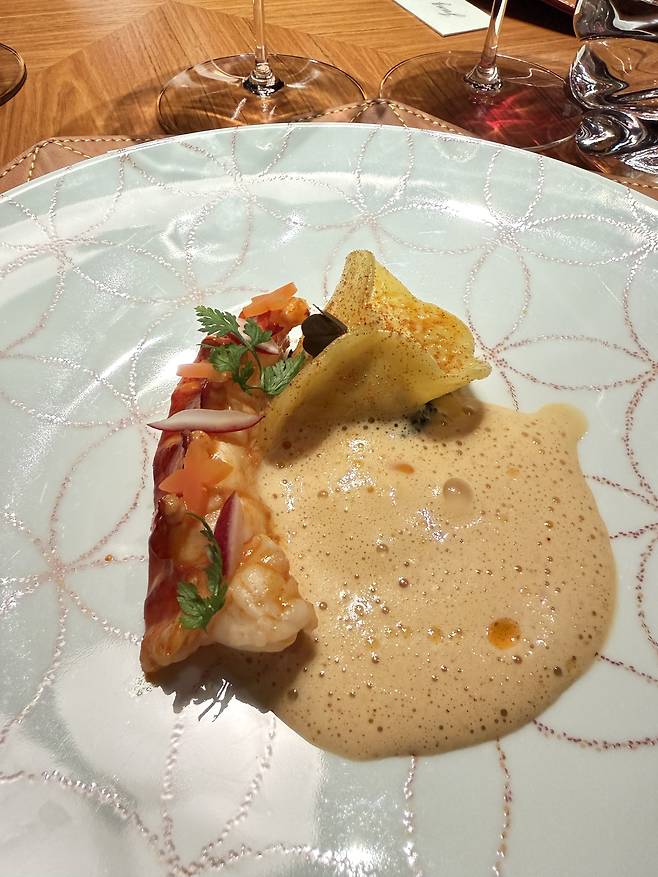
For the main course, diners choose between lobster with mustard and gochujang or hanwoo striploin with galbi sauce. The lobster, paired with a gently spiced gochujang foam, stands out for its balance — offering a subtle heat that cuts through the richness of the course progression.
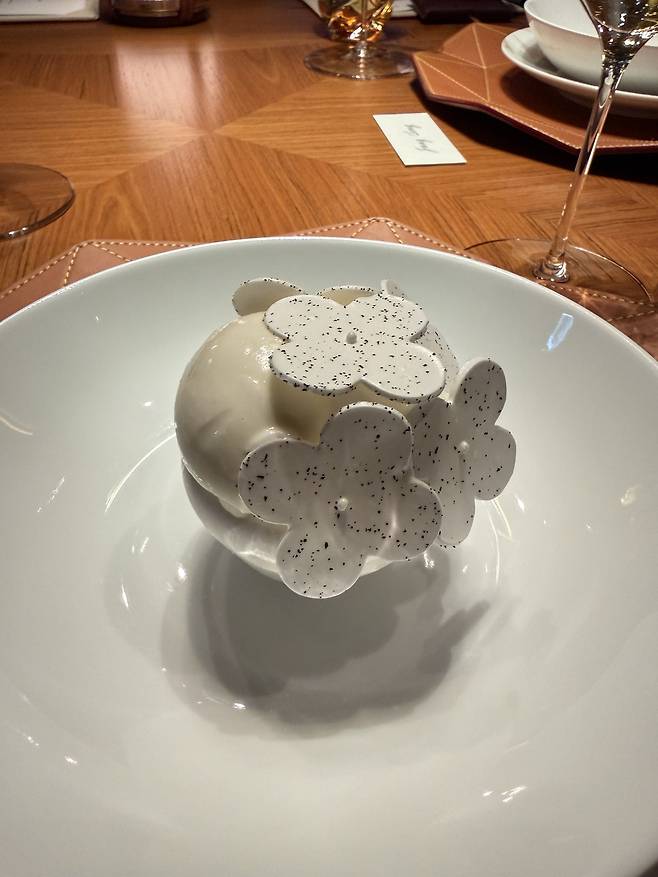
Dessert continues the dialogue between tradition and reinterpretation. The rice ice cream with pine shoot sorbet and makgeolli foam is presented like a porcelain vessel inspired by Korean baekja, with meringue forming both structure and texture. It is restrained in sweetness, calibrated for a Korean palate.
Louis Vuitton’s visual codes appear throughout the meal, turning the experience into a kind of culinary scavenger hunt. It is branding, but handled with a thoughtful touch.
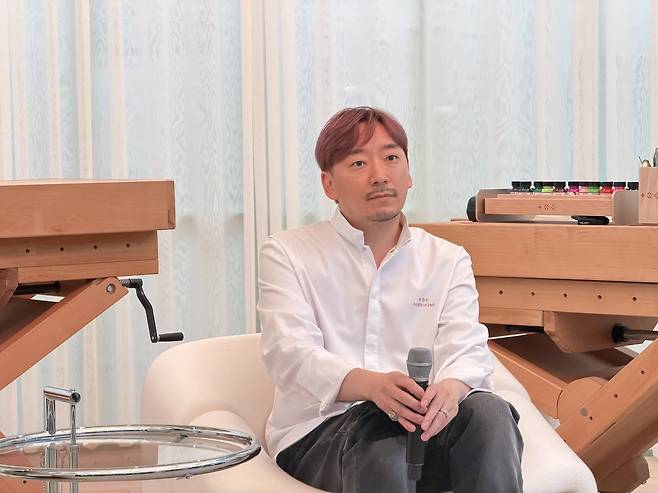
Park describes the project as a shift from his New York flagship.
“Here, I use as many Korean ingredients as possible, but I think carefully about what a more global language of taste and plating looks like,” he said during a menu preview in Seoul on Monday. “I wanted this to feel like a space that represents Seoul, but also one that is moving outward into the world.”
Balance, he added, is central to his philosophy.
“When we think of flavors like soy sauce or doenjang, they have very distinct characteristics. I try to keep those intact, but adjust temperature, texture and intensity so that more people can approach them comfortably,” he said. “Even for those unfamiliar with Korean food, I want them to feel both something new and something familiar at the same time.”
That sensibility defines the spring menu, which leans into the season’s visual and sensory cues.
“We tried to capture the vitality of spring — its colors, its energy,” Park said. “You’ll see more greens, more yellows, more vivid tones, with small touches of Louis Vuitton’s monogram woven in.”
Copyright © 코리아헤럴드. 무단전재 및 재배포 금지.