FM Cho heads to G7 meeting as Seoul navigates Hormuz pressure
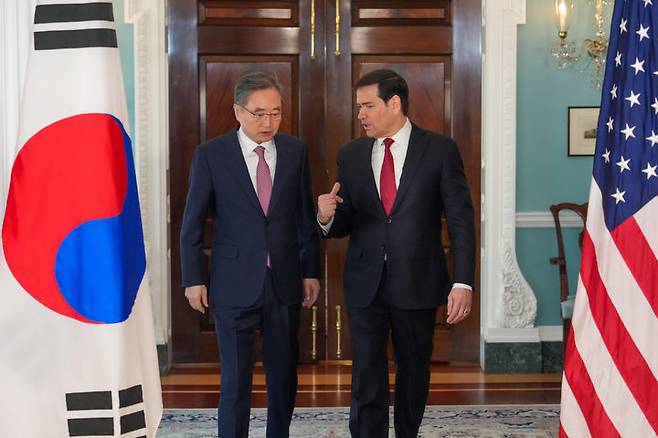
South Korean Foreign Minister Cho Hyun departed for Paris on Wednesday in apparent hopes of holding in-person talks with US Secretary of State Marco Rubio, as Seoul faces mounting pressure from Washington over a possible military role in the Strait of Hormuz.
Cho will remain in Paris through Friday to attend the first expanded G7 foreign ministers’ meeting of 2026, according to the Foreign Ministry in Seoul.
Rubio is set to meet with his G7 counterparts in France on Friday to discuss Russia’s war in Ukraine and developments in the Middle East linked to the US-Israel conflict with Iran, the US State Department said.
While a formal bilateral meeting between Cho and Rubio has not been confirmed, the two sides are coordinating a possible encounter, with an informal meeting being discussed.
“Arrangements are currently being made, and a number of bilateral meetings are expected. ... As for (South Korea-US) engagement, Secretary Rubio’s schedule remains highly fluid," a Foreign Ministry official, requesting anonymity, said Tuesday. "It is uncertain whether he will be able to attend, and even if he does, his stay may be limited to just a few hours, which could have an impact. We will provide updates as appropriate," the official added.
The anticipated meeting comes as tensions in the Middle East show signs of a temporary pause after US President Donald Trump delayed potential military strikes on Iran for five days, citing ongoing discussions with Tehran.
Against this backdrop, if the meeting is confirmed, the two ministers are expected to discuss Washington’s proposal regarding a possible South Korean military contribution to operations in the Strait of Hormuz, as well as the US assessment of the situation and its next steps. Cho is also expected to highlight Seoul’s efforts, including its decision to participate in a joint statement last week condemning Iran’s move to block the Strait of Hormuz.
The statement was issued by a group of major US allies and partners — including Japan and several European countries — amid growing concerns over disruptions to global energy supply routes. South Korea joined the initiative later than some of its counterparts.
For Seoul, a key question is whether Trump’s call for allied contributions remains active.
With the conflict involving the US, Israel and Iran expected to persist, analysts say it is unlikely that the issue will fade quickly.
Speaking at the White House on Friday, Trump, asked whether he still expects support from South Korea, said, “I love South Korea. We have a great relationship. We’re helping South Korea a lot.”
While Trump did not explicitly call for Japan’s military involvement during his recent summit with Japanese Prime Minister Sanae Takaichi, he emphasized the US military presence in Japan as a form of American contribution and said Tokyo should “step up,” also pointing to Japan’s heavy reliance on oil — remarks seen as signaling expectations for a greater role by allies.
During the summit, Takaichi cited constraints under Japan’s pacifist Constitution — particularly Article 9 — and related security laws that limit overseas troop deployments, underscoring the challenges of military involvement.
Instead, Tokyo highlighted economic cooperation. The two sides agreed on a second round of US-bound investment projects worth $73 billion, including small modular reactor construction, building on an initial $36 billion package. The two phases together account for roughly 20 percent of Japan’s broader $550 billion investment pledge made during trade talks last July.
Observers say South Korea, which is preparing to roll out its own investment plan following recent legislation, may draw lessons from Japan’s approach in managing alliance expectations.
Seoul has so far maintained a cautious stance, noting that no formal request has been made through official channels such as the US State or Defense Departments, and has avoided both outright endorsement and rejection.
However, there is broad consensus that such investments — part of separate bilateral agreements — should not be directly linked to the conflict in the Middle East, and should instead be framed as a means of maintaining stable relations with Washington rather than as a trade-off for rejecting military involvement.
Some analysts also argue that Seoul should avoid engaging Washington solely on a bilateral basis, noting that most countries facing similar requests have not responded positively and instead pursue a multilateral approach.
Park Won-gon, a professor of international studies at Ewha Womans University, said, “At this stage, it is important not to present any proactive proposal to the US. The most realistic approach is to align with multilateral frameworks, rather than handling the issue solely through bilateral channels.”
Separately, regarding Iran’s announcement that it would allow passage through the Strait of Hormuz only for “non-hostile vessels,” Cho said it is “too early to make a judgment,” despite having received Tehran’s basic position.
On Monday, Cho held a phone conversation with Iranian Foreign Minister Abbas Araghchi, requesting safe transit in the Strait of Hormuz for vessels from South Korea and other countries.
In response, Iran’s Foreign Ministry said Araghchi indicated that vessels from countries “not involved in the aggression” would be able to navigate the Strait without issue.
Speaking at a government briefing Wednesday morning, Cho said the key issue is whether safe passage can be guaranteed in practice, noting that multiple factors need to be assessed.
His remarks reflect Seoul’s cautious stance, even as Iran has indicated that vessels from countries “not involved in the aggression” may be allowed to navigate the Strait.
The Financial Times earlier this week reported that Iran informed International Maritime Organization member states it would permit transit only for pre-coordinated “non-hostile vessels,” excluding those linked to the United States, Israel and other countries involved in the conflict.
Copyright © 코리아헤럴드. 무단전재 및 재배포 금지.