Choosing jail over enlistment. One Korean man's pacifist stand
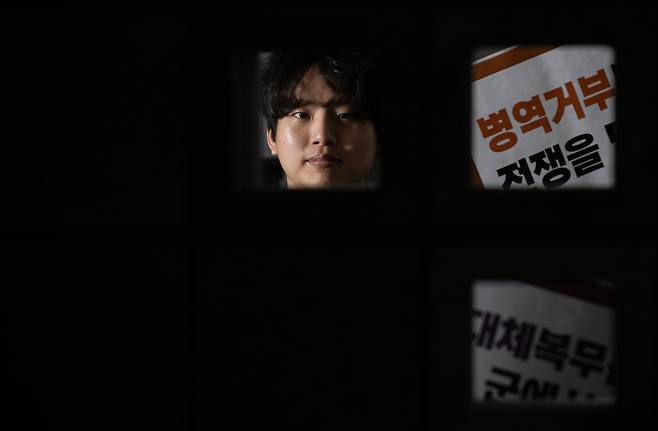
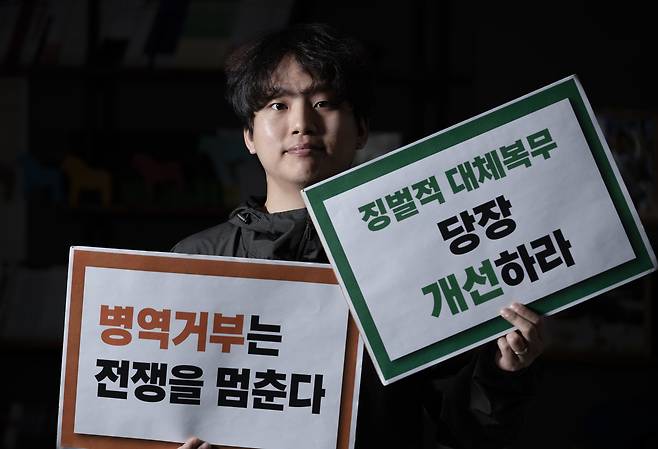
On Feb. 23, the day he was scheduled to enlist, Kim Min-hyung, 28, did not show up.
He refused not only military service, but also alternative service, a rare and consequential decision in South Korea, where all able-bodied men are required to serve.
Only a handful of Korean men, 12 so far, have ever refused both. All of them were Jehovah’s Witnesses, citing faith. Kim is different.
He is the first in Korea to publicly reject both military and alternative service on nonreligious, explicitly pacifist grounds. Under current law, he is expected to face up to 18 months in prison.
Why would someone knowingly choose jail?
For Kim, war was never an abstract concept.
Kim grew up in Munsan, Paju, a town near the border with North Korea. Just a 15-minute drive from the Demilitarized Zone — the most heavily fortified border in the world — military bases and training grounds surrounded his neighborhood and the roar of live-fire drills was a constant backdrop to everyday life there.
“As a child, I went to school hearing gunshots,” he said. “Sometimes, when inter-Korean relations worsened, it felt like the sounds became louder.”
War was a common topic among friends.
They joked about survival. “If war breaks out, where should we hide? In the mountains? But since we live so close to North Korea, we’d probably be dead before we even hear the news,” he recalled, reflecting on the conversations he had with friends about such scenarios.
Kim assumed this was normal — that all Koreans lived this way. It was only after he moved to Seoul for university that he discovered that was not the case.
“People didn’t talk about war in their daily lives,” he said. “That’s when I realized my experience wasn’t ordinary.”
Those early memories stayed with him, forming the foundation of how he viewed violence, security and fear.
Kim’s decision, however, did not come all at once.
He studied social welfare at university, where he learned about solidarity, social justice and caring for others. Gradually, his interest shifted toward peace activism.
“I started asking myself what peace really means,” he said.
That question led him to a controversial conclusion: Refusing military service could itself be a form of peace activism.
Global events reinforced his thinking. The war in Ukraine, widely covered in international media, left a deep impression on him.
“Seeing so many people die was shocking,” he said. “Killing is obviously wrong, but when it happens in war, people don’t question it the same way.”
“I didn’t want to train myself to kill.”
His views hardened further through his work with the Korea-Vietnam Peace Foundation. There, he met both Vietnamese civilians and Korean veterans affected by the Vietnam War (1955-1975). South Korean troops reportedly left as many as 9,000 Vietnamese civilians dead. Over 5,000 South Koreans died and more than 10,000 were injured.
Kim listened to stories of destroyed lives on both sides.
“War doesn’t just harm one group,” he said. “It leaves lasting pain for everyone involved.”
His decision became irreversible after witnessing a domestic political crisis involving martial law.
Former Yoon Suk Yeol declared martial law on Dec. 3, 2024, sending troops to the National Assembly. The declaration was opposed by both parties, and 190 legislators unanimously passed a motion to lift martial law despite the preventing actions by the soldiers thanks to the resistance from citizens and some soldiers refusing orders.
Seeing the incident, Kim began to question the nature of obedience in the military.
“If soldiers had the right to refuse unjust orders during the Vietnam War, would civilian massacres have happened?” he said.
Kim acknowledges that his choice is difficult for many to accept. Critics have asked: If everyone refuses military service, who will defend the country? What is the point of pursuing peace if adversaries remain armed? But Kim does not dismiss these concerns; he challenges the premise.
“War doesn’t start suddenly,” he said. “It builds from accumulated conflict.”
To him, peace is not merely the absence of war maintained by mutual threat.
“If people are pointing guns at each other, unable to attack because of fear, is that really peace?” he asked.
He points to history for support.
During the Vietnam War, tens of thousands of US soldiers resisted through desertion, refusal to fight and protest. Some scholars argue that such resistance contributed to ending the war.
“Peace is something we build across borders,” he said. “This movement isn’t just in Korea. It exists in the US, Turkey, Greece, Israel — everywhere.”
For now, Kim waits.
Under Korean law, refusing enlistment leads to criminal charges, investigation and trial, typically resulting in an 18-month prison sentence.
In the past, those convicted of conscientious objection were exempted from further service after serving time. But under revised regulations introduced in 2024, that exemption no longer applies. So, even after prison, Kim could still be required to serve.
Historically, some conscientious objectors in Korea spent years behind bars under dictatorships.
Still, he does not waver, and he is aware of what lies ahead. “I don’t believe that winning a war is the only way to achieve peace,” he said.
Copyright © 코리아헤럴드. 무단전재 및 재배포 금지.