'Travel is the fastest way to reach a dream'
전체 맥락을 이해하기 위해서는 본문 보기를 권장합니다.
"To me, traveling and writing are inseparable. Adventure is an extension of a dream, and writing is the continuation of that adventure. Travel is the structure of my life; writing is its echo."
"Seeking a balance between civilization and nature is a central concern of my work. Between the force of nature and the structures of society, there is a constant dialogue."
이 글자크기로 변경됩니다.
(예시) 가장 빠른 뉴스가 있고 다양한 정보, 쌍방향 소통이 숨쉬는 다음뉴스를 만나보세요. 다음뉴스는 국내외 주요이슈와 실시간 속보, 문화생활 및 다양한 분야의 뉴스를 입체적으로 전달하고 있습니다.
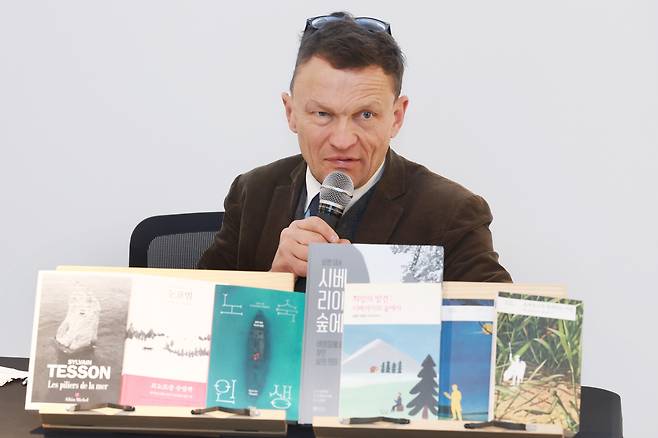
Travel is the fastest way to reach a dream through reality, and writing is the continuation of that adventure.
So said Sylvain Tesson, 53, the French author and traveler who has long blurred the line between his two identities.
“To me, traveling and writing are inseparable. Adventure is an extension of a dream, and writing is the continuation of that adventure. Travel is the structure of my life; writing is its echo.”
Tesson was in Seoul this month as the guest author for the fourth edition of the Goncourt Prize — Korea, also known as the Goncourt Choice of Korea. The initiative, jointly organized by the French Embassy and the Academie Goncourt, invites students studying French at high schools, universities and language institutes to read and debate the four shortlisted Goncourt Prize novels over five months before selecting a winner by majority vote. This year also marks 140 years of diplomatic relations between France and South Korea.
Since publishing his first book in his 20s, Tesson has drawn attention for journeys in extreme nature and for the writing that distills those experiences. Over the years, he has received many of France’s top literary honors.
He won the Prix Goncourt in 2009 for his short story collection “A Life Spent Sleeping Outdoors” (Une vie a coucher dehors), a set of 15 stories inspired by his travels across the world; the Prix Medicis in 2011 for his autobiographical essay “In the Forests of Siberia” (Dans les forets de Siberie); and the Prix Renaudot in 2019 for “The Snow Leopard” (La Panthere des neiges), which recounts an expedition across the Tibetan Plateau in search of the endangered animal.
“The connection between travel and literature, and a love of nature, are the themes that run through my work,” he said, speaking to reporters at the French Embassy in Seoul last Wednesday. The sensations, pleasures and questions encountered on the road, he added, form the raw material of his writing.
“Seeking a balance between civilization and nature is a central concern of my work. Between the force of nature and the structures of society, there is a constant dialogue.”
Tesson described his travels as a deliberate pursuit of exploration through movement. “If I knew the answer to why I venture into extreme landscapes, my travels would already be over,” he said. “I suppose I’ll have to walk a few more kilometers to find it.”
A dramatic turning point came in 2014, when he fell from a rooftop and suffered 26 fractures, requiring six months of hospitalization. “I wouldn’t say the accident changed my life,” he recalled. “But it strengthened my will to live. I tried to forget the misfortune and move forward as quickly as possible.”
For Tesson, travel and life share a common structure. “Through travel, we harvest beauty and danger, joy and sorrow — a wide range of emotions,” he said. “It is the process of standing firmly in reality while moving toward a dream.”
On technology and artificial intelligence, he struck a critical tone. “AI does not fill human deficiencies; it creates them,” he said. “We are entering an age in which humans are dragged along by AI. It is important to remain grounded in reality. And that is to travel.”
Travel, he insisted, is something uniquely human. “Within art and the beauty of nature, we are capable of happiness,” he said. “What humanity needs is a recovery of ancient wisdom and a renewed sensitivity to nature.”
Copyright © 코리아헤럴드. 무단전재 및 재배포 금지.