Korean consumers seek cheaper options as Iran war keeps the won weak against the dollar
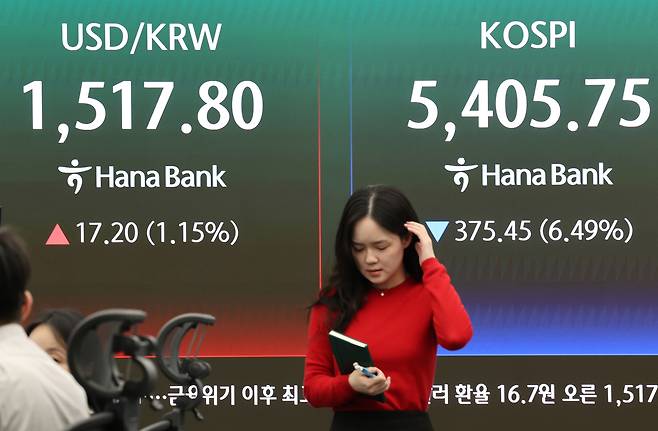
The ongoing Iran war is keeping the won significantly weaker against the dollar, and businesses are panicking. Not only are costs rising all over the place, but customers are opting for cheaper options across the market, leaving little room to breathe for business owners.
“When I started the business, the exchange rate was in the low 1,400 won [93 cent] range, so I set prices based on 1,450 won,” said the operator of a purchase-agency business for overseas direct buying for the past four years. “But as sharp jumps in the exchange rate have become more frequent recently, about 90 percent of orders are being canceled.”
After taking advance orders mainly for household goods and electronics from the United States and Europe, he purchases the products on the customers’ behalf. But when the price of a well-known imported shaver jumped from around 120,000 won to between 170,000 and 180,000 won, customers turned to much cheaper domestic alternatives.
As the dollar-won exchange rate in the 1,500 won range becomes the so-called new normal, changes are being felt throughout everyday life. Consumers are canceling overseas direct purchases and travel plans, while students studying abroad are facing sharply heavier tuition burdens. Rising costs for imported raw materials and logistics are also making broader increases in consumer prices all but inevitable.
In Seoul’s foreign exchange market on Tuesday, the won had edged up to 1,495.2 per dollar as of 3:30 p.m., rebounding from Monday's 1,517.3 won, the weakest daytime closing level in 17 years. The exchange rate has been swinging sharply and repeatedly setting record slips since the outbreak of the Iran war on Feb. 28.
As signs grow that the high exchange rate could last for a prolonged period, consumer behavior is also beginning to shift.
![The dollar-won exchange rate is displayed at a screen at a currency exchange in Incheon International Airport on March 17. [NEWS1]](https://img1.daumcdn.net/thumb/R658x0.q70/?fname=https://t1.daumcdn.net/news/202603/24/koreajoongangdaily/20260324170737132hstg.jpg)
“Even when overseas brands go on sale, the exchange rate is so high that department store prices in Korea can sometimes be cheaper,” said an office worker surnamed Kwon, who usually buys clothes through overseas direct purchasing. “If this high exchange rate environment lasts, I do not think I will use overseas direct buying for the time being.”
That trend is also clear in card companies’ data on sales at overseas online merchants. BC Card set online spending in the United States in January 2024 at 100 and turned it into an index, and the change over the past three months stood out. The index rose in December 2025 to 132.1 and in January 2026 to 133.7, but turned downward from February at 115.4.
“Sales rebounded at certain moments late last year, such as during Black Friday and Singles’ Day, but that was a temporary concentration of demand driven by discounts,” a BC Card representative said. “The broader trend will likely remain one in which exchange-rate pressure suppresses spending on overseas direct purchases.”
Subscriptions to AI and streaming services, such as ChatGPT and Netflix, have also become a growing concern for consumers. Because fees are set in dollars, a rise in the exchange rate alone increases the burden.
“I subscribe to three services as it is, but I am thinking of canceling two of them,” said an office worker surnamed Jang. “It feels like my monthly bill alone will rise by 10,000 won because of the exchange rate, and in this high-inflation environment, it is hard to justify keeping them.”
![Korean 50,000-won bills are stacked inside a bank in Seoul on Oct. 24, 2022. [YONHAP]](https://img3.daumcdn.net/thumb/R658x0.q70/?fname=https://t1.daumcdn.net/news/202603/24/koreajoongangdaily/20260324170737435kxut.jpg)
Students studying abroad are also under pressure. Assuming annual tuition and living expenses in the United States total 100 million won, every 100-won rise in the exchange rate adds more than 7 million won in costs.
“In the case of the United States, students are facing a heavier burden because visa issues have been added on top of the exchange rate,” said an official at a study-abroad agency in Seoul. “Some are choosing Australia instead, where the exchange-rate burden is relatively lighter, while others are postponing short-term language study abroad altogether.”
Posts have, in fact, continued to appear in online communities for international students, saying, “I changed my major from engineering to natural sciences because of the tuition burden,” and “I am looking for part-time work to ease the burden on my parents.”
As rising exchange rates are expected to feed into airline ticket prices with a lag, overseas travelers are also turning their attention back to domestic destinations. Major airlines plan to raise fuel surcharges on tickets by as much as more than threefold starting next month.
“It somehow feels unfair to buy plane tickets at prices so much higher than usual,” said Lee, who had planned a summer vacation to Phu Quoc, Vietnam. “Rather than waiting for the exchange rate to come down, I decided it would be better to find a good place to stay in Korea and book it quickly, so I changed my plans.”
![Foreign exchange rates are displayed at a screen at a currency exchange in Myeong-dong, Jung District, central Seoul, on March 4. [NEWS1]](https://img4.daumcdn.net/thumb/R658x0.q70/?fname=https://t1.daumcdn.net/news/202603/24/koreajoongangdaily/20260324170737789mopg.jpg)
A rising exchange rate also affects consumer prices at home. Higher international oil prices can push up import prices across the board. As prices rise for major imported raw materials such as wheat, beef, coffee beans and cocoa, food prices could also come under pressure.
NH Financial Group’s research institute forecast that if the effects of the war persist for more than three months, inflation could rise by 2 to 4 percentage points.
Experts say the high exchange rate is likely to persist for some time. Because the war has triggered both higher oil prices and a stronger dollar, they say the won is unlikely to stabilize unless geopolitical risks are fundamentally resolved.
“As the U.S.-Iran war has turned into an energy war, the risk of prolonged high oil prices is becoming a reality,” said Park Sang-hyun, a researcher at iM Securities. “With dollar strength continuing, developments in the Iran crisis and the path of oil prices will determine the direction of the foreign exchange market.”
This article was originally written in Korean and translated by a bilingual reporter with the help of generative AI tools. It was then edited by a native English-speaking editor. All AI-assisted translations are reviewed and refined by our newsroom. BY OH HYO-JEONG [kim.minyoung5@joongang.co.kr]
Copyright © 코리아중앙데일리. 무단전재 및 재배포 금지.
- BTS comeback: Bright lights and drone shows light up the sky as 'Arirang' finally arrives — as it happened
- Starbucks's new Sweet Milk Coffee sells more than 500,000 cups within three weeks of launch
- HYBE shares fall sharply following underwhelming turnout for BTS comeback performance
- Court orders release of Korean President Yoon Suk Yeol — as it happened
- 'KPop Demon Hunters' orchestral concert to tour across Korea
- Trump meets Korean President Lee Jae Myung — as it happened
- Stray Kids, G-Dragon and Jennie triumph at 40th Golden Disc Awards — as it happened
- Seoul city gov't to inspect '1,000 Won Bread' over excessive preservative use
- Tropical fruit production ripens as Korea's climate shifts
- Yoon Suk Yeol gets five years on abuse of power, obstruction charges — as it happened