Race, Class, and Discrimination as Seen from an American Slum
Editor’s note: Vacation, business travel, migrant labor, language study, study abroad, international marriage, immigration—many of us have such experiences of crossing national borders, and there are many immigrants living in our country. Ilda examines the emigrant sensibility we will need in order to live equally and peacefully in the age of globalization. This series is supported by the Korea Press Foundation’s Press Promotion Fund.
Seeing in its slums the true face of a country I had envied
In university, I received a scholarship that allowed me to participate in an exchange program in the United States. My school designated me a scholarship student so that I could get my student visa quickly. I got the visa after an easy interview at the embassy.
Eleven hours after leaving Korea, I touched down in Los Angeles. Nothing was familiar, but just because it was America, everything seemed awesome. My heart kept pounding in excitement at being in a city that I had previously only seen on TV.
My school’s dormitory was in a section of LA near the coast; it was a poor area in which many black people lived. The school provided us a 100-year-old building in a slum for our dormitory. It was a fifteen minute walk from the school. From the first day, teaching assistants at the university told us, “Don’t walk around in groups made up only of women, bring some male friends.” At first, I couldn’t understand why I should do that.
We had language class from 9 in the morning until noon, and then medicine-related classes from 1 to 8 p.m. When I came back to the dorm, I would review and do homework until 4 or 5 in the morning. Living so busily, I was chronically short of sleep, but because I wanted to enjoy this country called “America,” I would travel nearby when I had time.
In the neighborhood around the dorm, I saw many disabled people, and many morbidly obese people. But then, that must have been because it was a poor area. If you wanted to get a cheap meal at the supermarket, there was 2-serving pasta for 99 cents, two large pieces of fried chicken for $1, and 5 hot dogs for $3. Short on money, I ate that kind of thing too, and quickly started to gain weight.
But when I went to Beverly Hills or the rich areas on the coast, most people there clothed their slim bodies in tight workout clothes and went surfing or jogging with their iPhones on their arms. When I saw that, I realized that the gap between the rich and poor can create a difference in body type. People’s expressions, too, were different.
Embarrassing incidents are “my fault,” because of my poor English
If you walked for five minutes toward the coast from the dorm, there were expensive seaside restaurants, bars, clubs, and outlets. On Saturday nights, you could see people in dresses and suits, who looked like celebrities.
One weekend, my roommate and I went out to go shopping. Three black men who seemed around my age drove by in an old red car. Suddenly, they made a shooting gesture with their hands and catcalled us, before racing away. It happened so fast that we, shocked, didn’t have time to respond. We comforted each other by saying that they must have done that because they hadn’t been taught any better. They were definitely the black people who lived in the poor area around our dorm. People say that black people see Asians as beneath them, and at that time I started to think that this seemed to be true.
Despite what had happened, we went to a fast-food restaurant to fill our empty stomachs. We ordered hamburgers, but the young, white cashier said she couldn’t understand us and acted annoyed. Even when we said the number of the meal we wanted, she couldn’t understand. At this point we might have assumed that she was just pretending not to understand, but we didn’t have the guts to get angry, and instead thought it was our fault because of our poor English.
In the end, I ordered the only thing the cashier understood—a Whopper meal. After that, it became natural for me to order a Whopper meal. When I was not that hungry, I would order a Whopper Junior meal.
One weekend, we left the dorm at 7 in the morning to go on a trip. We were in a hurry, so we started to run. Immediately, a police car put its sirens on and headed toward us. I stopped and put my hands up, without even thinking about it. (Because guns are legal in the United States, you have to put your hands up if the police stop you, to show them that you don’t have a gun.)
The muscular white police officer briskly asked to see our IDs. All we had done wrong, if anything, was cross the street 10 feet outside of the crosswalk. Luckily, it was just a simple check, and the officer soon left. After thinking about it, I realized that there were often cop cars in the area. If you walked around in morning, you could see a lot of scrunched-up women’s underwear.
Though we were slightly scared by what had just happened, we got on the metro to continue our trip. A black man who seemed homeless was on it panhandling, and he shouted threateningly, “Look at my eye! I’m unfortunate! So give me 50 cents each!”
He then plucked out his glass eye, and started to shove it in people’s faces. Scared by my first sight of a glass eye and his shout that was almost a scream, I wanted to get off the train quickly. When Korean students travel in groups on the metro, there is always a police officer and drug-sniffing dog nearby, but they were nowhere to be seen when this man was screaming and threatening us.
What I learned from my experience crossing borders
During the four or so months I spent in America, most of the Americans I met were not friendly. But strangely, when I went to the wealthy areas, the people there were friendly. “Of course, how like a capitalist country,” I thought.
Supermarket workers were among the unfriendly people that I met, and so was Kathy, our language class teacher. Language class was divided by skill level. I was in the lowest-level class, but I was the best student in it, and sometimes Kathy would leave the instruction to me. When students couldn’t understand what she said, she would go silent and glare at them, and sometimes even end the class early. She, who was then 27 years old, said that teaching us was too hard and quit after a month.
The students from Korea, including me, were mostly young. I doubt that any of us had experienced such open rudeness in Korea. Also, most of the Korean exchange students were from wealthy families. Some had their own cars. But when they came to live in America, it was nearly guaranteed that they would be looked down upon from the get-go. They didn’t even express their anger at Americans. Clearly, they were unconsciously intimidated by this advanced country. I felt like I would be happy in America (because the scenery is beautiful) if only there were no Americans there.
|
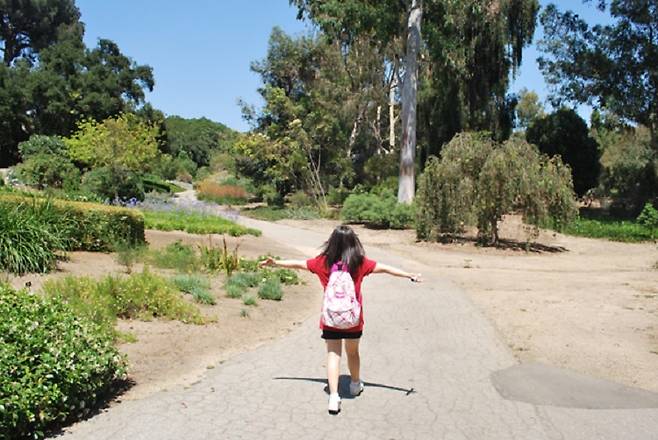
▲ At Huntington Gardens. Even when people were rude, the beautiful scenery made me feel happy. ©Jo Hyobi |
I soon finished my exchange program and returned to Korea. At my own university, there were many Chinese exchange students. Before I tried being an exchange student myself, I had wondered, “If they’re wealthy enough to study abroad, why did they come here?”—even as I had thought, “But China is not as cool as we are,” and “Chinese exchange students only hang out with each other and are guarded around others.” But these kinds of thoughts were similar to the discrimination that I had been subject to in the United States, and the Chinese exchange students were in a position similar to the one I had faced. So I guessed that that they were guarded because their experience of living abroad had included discrimination and feelings of intimidation that they couldn’t talk about.
Crossing a border and seeing a variety of races and experiencing the gap between the rich and poor made me a stronger person and widened my perspective. In particular, the ability to easily understand what the foreigners living in this country feel or how they are trying to settle down in this country is a gift. Doctors say that judging what is right or wrong is a natural function of the frontal lobe, but I think that we can learn how to see without prejudice through the experience of crossing a border.
My experiences began out of ignorant courage and ambition, but the fact that I developed a healthier way of thinking and more tolerance in that relatively short time is like a miracle to me. [Translated by Marilyn Hook]
*Original article: http://ildaro.com/7197 Published: August 8, 2014
◆ To see more English-language articles from Ilda, visit our English blog(https://ildaro.blogspot.com).
Copyright © ildaro.com