Galaxy S26 to bring on-device AI, smarter Bixby and brighter Ultra camera
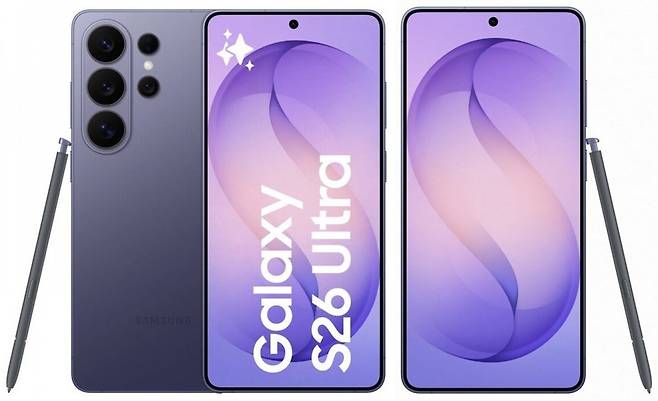
When Samsung Electronics unveils the Galaxy S26 in San Francisco next week on Thursday, the spotlight is expected to fall on AI that works directly on the phone, a more capable Bixby that adjusts settings in context and a brighter main camera on the Ultra, even as flagship prices rise for the first time in three years.
In South Korea, preorders are scheduled for Feb. 27 to March 5, with official sales starting March 11. According to telecom industry sources, the 256GB Galaxy S26 will start at 1.254 million won, or about $866, the S26 Plus at 1.452 million won and the S26 Ultra at 1.797 million won. Each is roughly 99,000 won ($68) higher than its predecessor.
The most meaningful shift is in how AI runs on the phone. Through “EdgeFusion,” which industry sources describe as a new on-device model, the S26 can generate and edit images without sending data to the cloud. Samsung’s press teasers on Wednesday showed AI filling in missing parts of a photo, blending multiple images and transforming sketches into stylized backgrounds, all through simple voice prompts.
Because the processing happens locally, the features are designed to work without a network connection and with minimal delay.
Samsung is pairing this with an upgraded Bixby voice assistant. On Thursday, the company launched a beta of a new Bixby version under One UI 8.5, describing it as a more intuitive device agent that interprets natural language in context. Instead of responding only to fixed commands, Bixby can check the phone’s current settings and suggest fixes. For example, if a user says incoming calls are not ringing, the assistant can identify that “Do Not Disturb” is enabled and offer to turn it off.
Under the hood, the Galaxy S26 and S26 Plus are powered by Samsung’s Exynos 2600, which the company says delivers 113 percent greater AI processing performance and 39 percent higher CPU performance than its predecessor. Built on a 2-nanometer process, the chip’s expanded neural processing unit is what enables image generation and editing to run locally rather than in the cloud.
Meanwhile, the S26 Ultra is expected to use Qualcomm’s Snapdragon 8 Elite Gen 5 across all markets.
On the hardware side, the clearest upgrade is reserved for the Ultra. The 200-megapixel main camera retains the same sensor as last year but adopts a wider f/1.4 aperture, up from f/1.7 on the S25 Ultra. In practical terms, that allows roughly 50 percent more light onto the sensor, improving low-light shots. A 50-megapixel ultrawide lens rounds out the setup, while the standard and Plus models largely carry over last year’s camera systems.
The S26 arrives as Samsung’s device business faces margin pressure. In its Jan. 29 earnings disclosure, Samsung reported record 2025 revenue of 333.6 trillion won, while fourth-quarter operating profit in the mobile division fell 10 percent year on year.
Copyright © 코리아헤럴드. 무단전재 및 재배포 금지.