What Is the Key to Breaking Down Fear and Division?
전체 맥락을 이해하기 위해서는 본문 보기를 권장합니다.
In high school, I had two phrases that kept me going through the worst of it: "volunteering abroad" and "never give up."
Before leaving our lodgings, we had to check our outfits. We had to avoid tight T-shirts and drape long scarves so that they covered our bodies. Even then, all eyes were on us when we went to the market. Everyone stopped what they were doing to stare at us. When I asked about this later, I was told they looked at us "because the whiteness of your faces is surprising."
이 글자크기로 변경됩니다.
(예시) 가장 빠른 뉴스가 있고 다양한 정보, 쌍방향 소통이 숨쉬는 다음뉴스를 만나보세요. 다음뉴스는 국내외 주요이슈와 실시간 속보, 문화생활 및 다양한 분야의 뉴스를 입체적으로 전달하고 있습니다.
*Editor’s note: Vacation, business travel, migrant labor, language study, study abroad, international marriage, immigration—many of us have such experiences of crossing national borders, and there are many immigrants living in our country. Ilda examines the emigrant sensibility we will need in order to live equally and peacefully in the age of globalization. This series is supported by the Korea Press Foundation’s Press Promotion Fund.
Right before graduation, opening up my bucket list file
In high school, I had two phrases that kept me going through the worst of it: “volunteering abroad” and “never give up.”
These two phrases shook up my young, high-school-girl heart. But everything about my present, as a student stuck in the bleakness and restrictions of the countryside, was stifling. I think it was because of that that my baseless self-confidence grew and I began to dream of a “scene change” in my life.
But four years later, I was on the cusp of graduating university without having done anything you could call a challenge. “If I get a job now, my life will have no place for reckless bravery!” I thought. One day, for the first time in a long time, I opened up my bucket list file. The words “volunteer abroad” jumped out at me. I immediately found some websites run by that kind of organization and began to fill out an application for long-term volunteering abroad.
Faster than I expected, I received the news that I had been accepted, and I went straight to a workshop held by organization A. But the workshop was different than I thought. For 3 days and 2 nights in the mountains in Gyeongsan, all we did was hold religious events, listen to endless speeches, and learn dance routines to Christian contemporary music. While I was doing the routines and wondering, “What is this?” though, I received word from organization B that I had been accepted for long-term volunteering at an overseas posting. I quickly had an interview with organization B and then participated in their orientation.
|
▲ I volunteered in India and Nepal for a year before graduating university. ©Jo Hyobi |
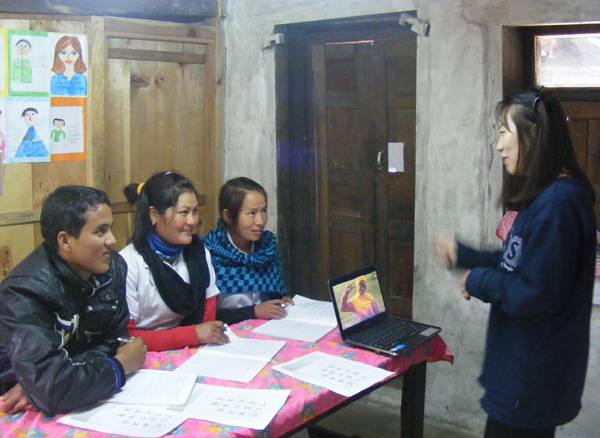
In June 2011, I went to Incheon Airport for my flight to southern India. I smiled as hard as I could in front of my parents, but really I was anxious. It wasn’t until then, as I was actually leaving, that I felt worried about the situations I was about to face and really thought about the attitude necessary for volunteering. Had my optimism stabbed me in the back? But, like the perfect example of an optimist, when I couldn’t figure out what to do about it, I fell into a deep sleep.
The two faces of the first Indian I met at the airport
I got off the plane in Bangalore and went through Immigration. A friendly-looking officer saw the U.S. student visa in my passport and spoke to me in English. But when I, flustered, couldn’t understand what he said and gave answers that didn’t fit his questions, his expression suddenly changed. Saying he needed to check whether my passport was forged, he immediately placed several calls. And he shouted, “If you don’t have anything that can verify your identity, go back immediately! If you don’t, our police will take you away!”
Scared by this unanticipated situation, I couldn’t even look the officer in the eye. A co-volunteer with a lot of experience abroad, who had finished the immigration process before me, spoke up quickly. “She was only in the U.S. for 4 months, so don’t judge her based on the student visa. People feel uncomfortable and can’t speak well when they meet a foreigner. You know what I mean, right?”
At that, the officer’s manner became friendly again, as if nothing had happened, and he stamped my passport. I’ll never forget the impression made by the first Indian I met, who showed two faces within seconds. We were standing only a meter apart but it seemed like there was a glass wall between us.
Thus intimidated, I went to the southern Indian countryside. It was a place where caste divisions and gender discrimination were still powerful. Groups of two to three of us would be sent to four areas in an Untouchable town about 30 minutes from the place we were staying, and we would teach art, music, and physical education. I wanted to change my impression of India to a positive one. Knowing I would be there for a year made this change crucial.
Before leaving our lodgings, we had to check our outfits. We had to avoid tight T-shirts and drape long scarves so that they covered our bodies. Even then, all eyes were on us when we went to the market. Everyone stopped what they were doing to stare at us. When I asked about this later, I was told they looked at us “because the whiteness of your faces is surprising.”
But where were the young women? I could see only men and middle-aged women. In the marketplace, there were many people chewing tobacco. Chewing tobacco makes your tongue red. People with blood-red lips and eyes that were yellow and bloodshot. The fear that I had started feeling at the airport continued, stopping me from breaking down boundaries.
Volunteering is like the one million volts of joy that flow from Pikachu
In the afternoon, I looked around the Untouchable village where I would be teaching. The people there gave off different vibes than those in the marketplace. In the houses, mothers and children were playing innocently.
Though they were mothers, they seemed to be my age or younger. I drank every drop of the chai tea that they kindly gave me. The feelings of anxiety and division that I had had since I arrived in India evaporated in the narrow-alleyed village.
|
▲ Me in India. Being helpful gave me unimaginable joy ©Jo Hyobi |
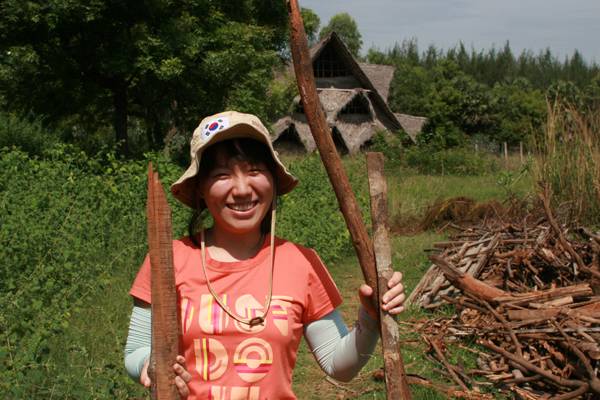
In class, the students were obedient, even though we couldn’t communicate with each other well. There was no trace of dishonesty in their faces. In addition, the children and their parents always showed concern for me, asking if I had any problems. I think it was because they knew that we were there just to help them, without putting religious pressure on them. I wanted to give everything to these villagers. I wanted to help with anything that I could.
During those two months, I felt that volunteering was something inexpressible, much more than simply heartwarming. It had a power like Pikachu’s, sending out a million volts of joy and illuminating everything all the way into space. The villagers’ warm demeanor, the stars at night, the sound of the prayers said at the temple, the fragrances and atmosphere were more than I had been able to imagine. The cockroaches and mice that roamed around our lodgings were no more than momentary surprises.
The India-Nepal border, where cows and people slowly come and go
But that only lasted for a short while before the Indian police started to bring us in to the police station. We were notified that our applications for residence had been denied, and so were ordered to return to Korea. My sense of regret at finding out that we had to return to Korea after two months, just when the volunteering was starting in earnest, was unspeakably deep. I went to the area where we had been teaching in order to say goodbye. When I saw the people, who greeted me warmly and asked me why I had been away for the past few days, I began to cry.
We went to the big city and waited a month for our residence permits to be approved. But the situation didn’t get better, so in the end we were transferred to Nepal. I took my large rolling suitcase and my 45-liter backpack and got on the train [with the others]. It was a 48-hour trip, and I was worried because in addition to sitting in coach class with the locals, I had a lot of luggage. I chained my bags to a pole, put a padlock on anything that had a place for one, and, on my guard, slept fitfully.
On the morning of the second day to begin in the train, a family across the aisle offered me something to eat. At the locals’ friendliness, my vigilance started to melt away again. The dark and dirty train no longer felt stifling. After getting off the train that had held us for 48 hours, we slept for a night in Gorakhpur, India. We didn’t know anything about the area, so an Indian college student that had been sitting next to us on the train helped us. The young man called people he knew in order to find a cheap, clean hotel, and even carried some of our luggage as he showed us the way.
We soon arrived at the town of Sonauli, which marks the border between India and Nepal. Picturing, at the word “border,” the border between North and South Korea (the 38th Parallel), I had a strange anxiety that there would be landmines and wilderness, but it turned out to be a totally different landscape. A seemingly-free coming-and-going across the border, the slow movement of cows and people. We were just in time for the festival of Dashain, and so people appeared to be enjoying themselves.
At a roadside office that was hardly more than a pyeong [35 square feet], we were admitted into Nepal after attaching tourist visas to our passports and getting stamped. There was no search of our bags or inspection of our passports. There was only a friendly introduction to the rickshaw that could take us to the bus terminal so we could go to Pokhara, Nepal’s second-largest city.
Reflecting on the sense of superiority felt by the “helper”
There were no buses because of the festival, so we took a van from the border to Pokhara; later we found out that the price we paid was a rip-off. From Pokhara we took two buses, and arrived at a village in northwestern Nepal with an altitude of 8,500 feet. A completely vacant desolation approached. As our body temperatures slowly dropped, shingled roofs with holes here and there came into view. Finding ourselves here so soon after India’s high, humid temperatures, we thought first not of volunteering but of surviving.
We did homestays there. The mother and grandmother I lived with kept cooking for me just in case I was hungry. They also made traditional Nepalese clothes for me. I wanted to adjust to this new place quickly, in order to show my gratitude for this kindheartedness.
In order to raise our body temperatures when we woke up in the morning, I did stretches with my homestay family in the yard. We could see travelling Westerners pass by. One of them, a German woman, came to me and said, in a friendly way, “I want to give you a present. It’s a nice ballpoint pen.”
I froze. Did she think that I was a person who didn’t have a ballpoint pen?! While I was just staring at her, my homestay father said, with exaggerated gestures and intonation, “Thank you. Could we have one more?” He soon sent them on their way.
My face flushed. Seeing that German woman was like looking at myself. I went back to my room and thought for quite a while. I wondered if I’d done anything to the locals that would make them feel so disrespected. Whether I hadn’t been acting out of a sense of superiority that I hadn’t been aware of... I suspected that I had. I was ashamed. I had been giving as much as I could to help the locals, whether they were child or adult, but I really had no idea how they saw me.
Changing the way I look at foreigners
|
▲ In art class at a school for children of Nepal’s lower castes. In India and Nepal, caste is still strongly in operation culturally, so the right to education and the freedom to choose one’s work are limited. ©Jo Hyobi |
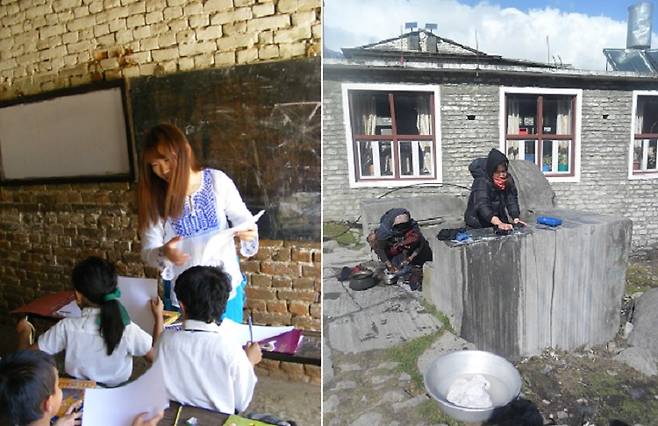
Around the time that I was inspired to think deeply about the attitudes of those who came to poor countries to do volunteer work, the people in the village started to move south for the winter. Eventually, we also decided to move to a southern village. As a place where the weather was milder and there was plenty of food, development and aid were becoming well-established there. A local school principle and the Korea International Cooperation Agency helped us get settled. I quickly started teaching arts classes at a school for students of lower castes and one for disabled students.
But that was also for a short time, as conflict sprung up between us and the NGO that had sent us. Not only would they not take responsibility for the safety of those they had dispatched, but they announced that they would not be giving us the 3 million won they had promised for our living and working expenses. As the friction continued, I worried that I was losing the warm heart with which I had started my volunteer work. So for the remaining time, I did my work not as part of an NGO but independently. That motivated me to think about the true meaning of volunteer work. I also started to reconsider the activities of international aid organizations that play on people’s emotions in order to attract donors.
After finishing my year of volunteer work and returning to Korea, I visited my parents’ house in Yangju, Gyeonggi Province. The foreign laborers in the area caught my eye. Even just at the market in front of their house, there were many Nepalese people. Watching them discussing dried laver for kimbap, salted dried laver, dried green laver, and dried kelp, I was reminded of myself when I was shopping in Nepal and trying hard to fit in.
The mental borders that these people from a poorer country were feeling must be much higher than those that I had experienced. In my experience, the thing that can break down mental borders is no other than the expression of the other person. Everyone feels scared and isolated in an unfamiliar place. More so when they can’t speak the local language. At that time, someone’s attitude has the capacity to terrify and daunt us, or it can melt fear away in moments. So I have started greeting foreigners with a smiling face, hoping they can break down their mental borders about this place as quickly as possible.
My experience volunteering in India and Nepal didn’t just show me several paths that my life could take, it also changed considerably the way I look at foreigners and my attitude towards them. [Translated by Marilyn Hook]
*Original article: http://ildaro.com/7189 Published: August 6, 2015
◆ To see more English-language articles from Ilda, visit our English blog(https://ildaro.blogspot.com).
Copyright © ildaro.com