Diriyah Biennale seeks to engage, not antagonize
RIYADH, Saudi Arabia — The 30-minute drive from King Khalid International Airport to Riyadh is lined with signs announcing the upcoming 2030 World Expo taking place in the Saudi capital. With construction sites and tower cranes looming over the desert horizon, there is a palpable sense of transformation.
The transformation is being driven by Saudi Vision 2030, launched in 2016, which seeks to transform the oil-dependent kingdom into a modern, inclusive state with sustainable development and technology as its driving force.
A key component of the transformation is the development of culture and tourism sectors, and the Diriyah Contemporary Art Biennale, established in 2021 amid the global COVID-19 pandemic, is a cornerstone of that effort.
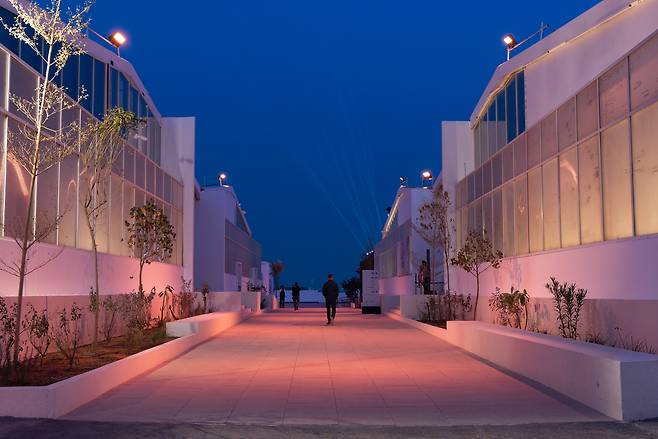
The third edition of the biennale kicked off Jan. 30 in the JAX District, a district of repurposed warehouses that now serve as artist studios, galleries and other cultural spaces, in Diriyah, a historic city some 25 kilometers from Riyadh.
This year’s biennale, entitled “In Interludes and Transitions,” is led by co-artistic directors Nora Razian, deputy director at Art Jameel in Jeddah and Dubai, and Sabih Ahmed, project adviser at the Ishara Art Foundation in Dubai, who saw the world as a multitude of processions, inspired by the journeys of nomadic communities in the Arabian Peninsula.
“Processions have produced relations and forms in this region. The movement of winds and the flow of trade, migration, and exile are carriers of stories, songs, and languages, producing rhythms and poetic meters,” said the co-artistic directors in opening the third edition of the Diriyah Contemporary Art Biennale.
The biennale features works by 68 artists from 37 countries and includes 22 new commissions, according to the co-artistic directors, encompassing paintings, installations, films, aural and oral works as well as architectural pieces and writing.
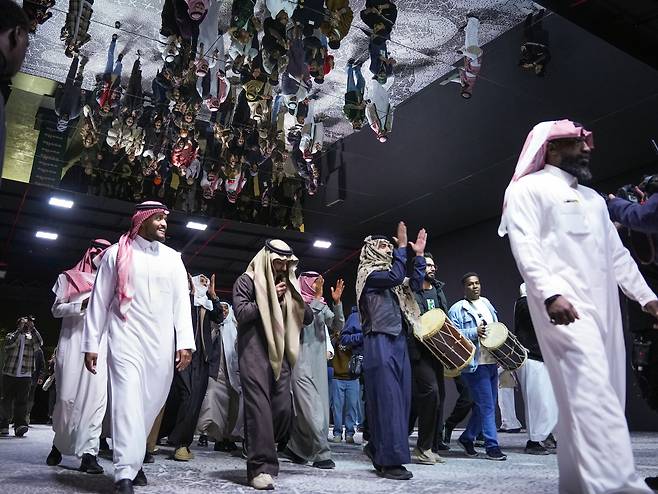
The tradition of oral and aural transfer of knowledge is underscored in the prominence of musicality at the latest edition of the biennale. The opening night featured a specially commissioned procession by Saudi artist Mohammed Alhamdan (7amdan), titled “Folding the Tents” (2026). A procession of SUVs and camels moved through the Wadi Hanifah valley and the JAX District, concluding with a performance by the musical group Miniawy Trio that had the crowd erupting into impromptu dancing.
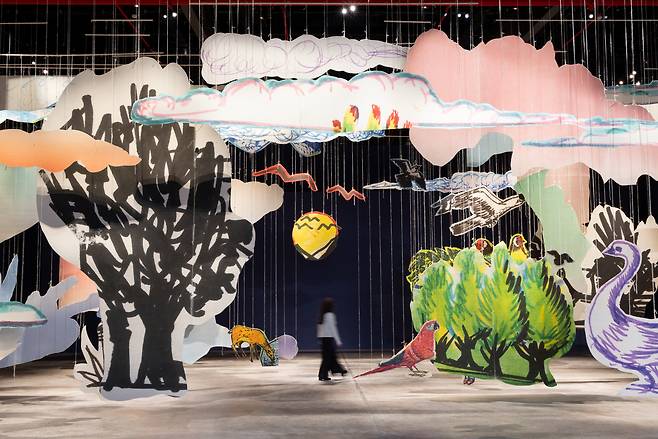
An individual’s history as part of a larger collective history is the focus of the first exhibition hall, “Disjointed Choreographies,” which opens with “Very volcanic over this green feather” (2021), a large-scale installation by the Kosovo-born multidisciplinary artist Petrit Halilaj.
Colorful, fantastical birds and scenes of nature suspended from the ceiling recall a happy childhood, but walking around the large felt pieces, one sees on the reverse side scenes of violence and bombings. The work revisits the artist’s drawings made as a 13-year-old refugee of the Kosovo War (1998-1999) as part of a therapy program for children in a refugee camp in Albania.
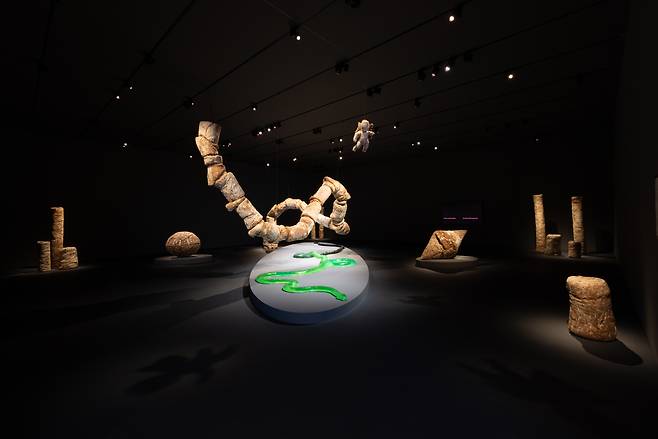
The second exhibition hall, entitled “A Hall of Chants,” is filled with voices, songs, rhythms and languages. “Dafine Phono” (2024) by Nour Mobarak, an Egyptian-born artist working in Los Angeles, emanates the sounds of “La Dafine,” the world’s oldest known opera, as she interprets it. While the original 16th-century score to the opera inspired by the ancient Greek myth of Apollo and Daphne has been lost, the libretto survives.
Mobarak’s multichannel sound installation is animated by 15 “singing” sculptures of mycelium, the roots of fungi. Mobarak had the original Italian libretto translated into English and then into Abkhaz, San Juan Quiahije sign language, Eastern Chatino, whistled language Silbo Gomero, click language !Xoon and Latin, drawn to languages with the largest numbers of phonemes, or distinct units of vocal sounds. With the work, Mobarak draws parallels between fungal networks and linguistic systems — both repeat decay and regeneration.
“A Collective Observation,” the title of the third exhibition hall, sums up the nature of the works presented — maps that disorient rather than orient, images that resist instant capture and works that connect to the stars in the night sky.
The “Remnants” series by Taysir Batniji, an artist who often draws from his experiences as a Palestinian, as well as current and historical events.
Batniji began the “Remnants” series in 2024 following the outbreak of the Israel-Gaza war. Working in Paris, the artist follows news of his hometown daily on messaging and social media apps. Images and videos often download with a lag and Batniji captures, in oil paintings, the blurred images, moments of fearful anticipation of the unknown.
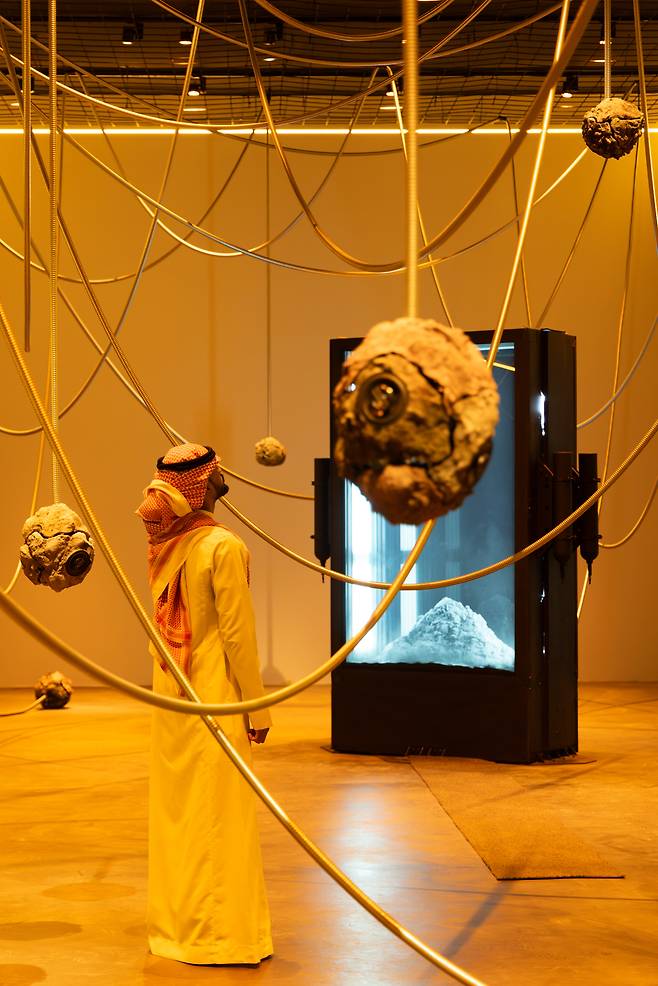
The last exhibition hall, “A Forest of Echoes,” returns to the biennale’s focus on sound and poetry. Here, the sound of animal-like screeches may jolt one out of deep rumination. Oscar Santillan’s “Anthem” (2026), commissioned by the biennale, is inspired by the voice of a Peruvian singer who incorporated bird sounds and chants in her music.
Long cables connect microcomputers to four suspended devices, cast from hollowed tree burls, which contain speakers and microphones. Stand in front of a device and make an animal-like sound and one will hear animal noises in response, activated by a machine learning system.
Elsewhere around the biennale, there are outdoor installations that invite visitors to engage with them.
Buenos Aires-born, Amsterdam-based Augustina Woodgate’s commissioned site-specific installation “The Source” (2026) examines the power and politics of water. During a 2025 field research in Al Ahsa, the world’s largest oasis, Woodgate became interested in the historical archives of Al Ahsa’s gravity-based irrigation network, which was over 2,000 years old. The network was managed collectively, with the right to water allocated in time slots regulated by sundials.
Composed of circular modules, the installation references aerial views of an irrigation system in which crops are watered in circles by long, rotating sprinklers. A distinctive feature of agriculture in Saudi desert regions, this method draws on deep groundwater from part of the Arabian Aquifer System. The water fountain delivers drinking water and the wastewater routed via separate pipes is used for irrigation.
While the Diriyah Contemporary Art Biennale remains largely a regional affair with many of the participating artists hailing originally from the region and most of the visitors being Saudis, it remains a valid platform to view what is happening here and now in the international art scene.
On the challenges of organizing a contemporary art biennale in Saudi Arabia, Razian said the real challenge was the compressed time. “Every context has its own cultural values and norms that you need to respect. But, I think for us, generally, we had no issues at all…We know how to navigate the context. We understand it very well and we’ve worked in the Gulf,” she said.
A role of a biennale is to “actually inspire conversations and complex conversations” among the public, according to Ahmed.
“Artists ask the most interesting and strange questions and, based on their research, those questions get resolved or remain unresolved in the artworks that then have a ripple effect for later on,” he said.
Copyright © 코리아헤럴드. 무단전재 및 재배포 금지.