Tourists' wallets revive Seoul’s flagship department stores
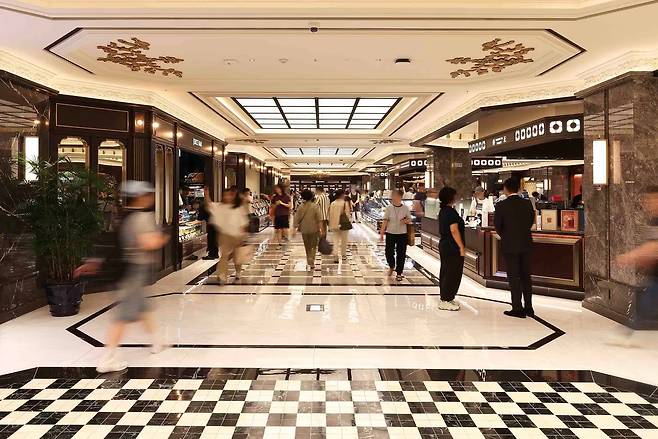
South Korea’s department stores are finding relief from a prolonged domestic spending slump as foreign tourists pick up the slack, accounting for a larger share of sales than ever before.
Sustained global enthusiasm for Korean culture, coupled with a weaker won, ushered in a fresh influx of visitors, and the spending that followed, industry officials explain. According to the Korea Tourism Organization, Korea welcomed nearly 19 million foreign visitors in 2025, the highest annual total on record.
Nowhere is the shift clearer than in Myeongdong, one of Seoul’s busiest tourist districts, where Lotte and Shinsegae’s flagship department stores loom large in the shopping scene.
In the fourth quarter, foreign customers accounted for 19 percent of sales at Lotte Department Store’s Myeongdong branch, up 4 percentage points from a year earlier, and foreign spending there has grown about 40 percent annually over the past three years.
For the full year 2025, foreign sales reached a record 700 billion won (480 million dollars), according to Lotte Shopping. Its department store division reported sales of 3.21 trillion won and operating profit of 491 billion won, up 22.5 percent on-year.
At Shinsegae Department Store’s flagship in Myeong-dong, the share of foreign customer sales jumped from about 7 percent in 2023 to 18.5 percent last year, with foreign customer spending reaching the mid-600 billion won range for the full year — roughly 3.5 times the 2023 figure.
Shinsegae saw foreign spending on luxury goods rise 67 percent in the second half of last year, while overall luxury sales grew by less than 20 percent.
“Unlike in the past, when tourists mainly shopped at duty-free stores, they are now more likely to head to department stores, as the weaker won has made prices feel cheaper,” an industry official said. “At the same time, retailers are rolling out foreigner-only memberships, discounts and translation services to attract tourists.”
In December, Lotte introduced a tourist-only membership card combining shopping discounts and transit functions, issuing more than 25,000 cards within two months of launch. The retailer also installed about 400 instant tax refund kiosks at its Myeong-dong flagship to enable immediate tax refunds after payment.
“Lotte plans to bolster its position as Korea’s leading shopping complex by expanding services so visitors can experience both shopping and Korean cultural offerings,” a company official said.
Alongside membership perks and tax refund services, Shinsegae plans to draw in more Chinese tourists through partnerships with payment platforms such as WeChat Pay and Alipay.
Hyundai has introduced transit tour programs for layover passengers to shop and dine during short stays. At The Hyundai Seoul, Hyundai Department Store’s landmark mall in Yeouido, foreign shoppers accounted for an estimated 20 percent of sales last year, up from 3.3 percent in 2022 and about 15 percent in 2024.
Earnings at department store chains are expected to continue improving, backed by recovering domestic consumption, rising asset prices and foreign tourist spending, industry insiders forecast.
According to Yanolja Research, foreign tourist arrivals to Korea are projected to reach 20.36 million this year, led by visitors from China, Japan, Taiwan and the United States. “Rising tensions between China and Japan could further redirect Chinese tourists to Korea,” said a senior researcher from Yanolja.
Copyright © 코리아헤럴드. 무단전재 및 재배포 금지.