[Book Review] Tracing long game behind SK hynix’s HBM play
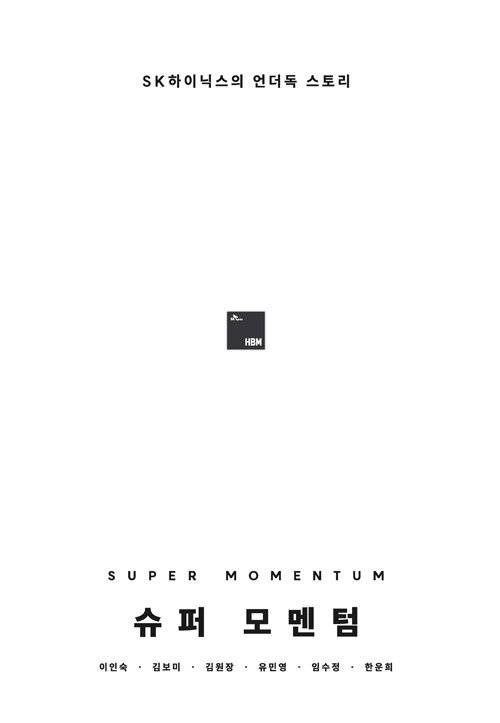
SK hynix’s emergence as a pivotal player in the global artificial intelligence semiconductor market is the result of long-term strategic planning anchored in high bandwidth memory (HBM), according to "Super Momentum," a new book chronicling the chipmaker’s internal transformation.
Rather than portraying HBM as a singular technological breakthrough, authors Lee In-sook, Kim Bo-mi, Kim Won-jang, Yoo Min-young, Lim Soo-jung and Han Woon-hoe present it as the outcome of sustained investment, organizational overhaul and a deliberate pivot toward engineer-driven decision-making. Memory development is framed as one thread in a broader narrative of corporate realignment and industry evolution.
Structured in eight chapters, the book draws on extensive interviews with senior leadership and engineers directly involved in the early stages of HBM development. Among those quoted are SK Group Chairman Chey Tae-won, SK hynix CEO Kwak Noh-jung and former Vice Chairman Park Sung-wook. Engineers who led the initial development efforts also contribute, offering visibility into internal dynamics and long-term planning that typically remain behind closed doors.
The authors frame SK hynix’s strategic shift as beginning not with HBM, but with SK Group’s 2012 acquisition of the company. At the time, SK hynix was operating under creditor management. Through a consortium led by SK Telecom, SK Group acquired a 21.05 percent stake for about 3.4 trillion won ($3 billion). The move marked a turn away from short-term financial oversight toward long-term strategic control. It came at a time when global memory markets were mired in stagnation and uncertainty.
The early chapters focus on the immediate aftermath of the acquisition. Facing a difficult market, SK Group chose not to pursue quick returns. Instead, it resumed halted fab investments and reopened funding for process and packaging improvements. According to the book, this period also marked the rise of a “one-team” culture inside SK hynix — one that emphasized collective problem-solving, minimized blame and placed engineering judgment ahead of financial calculations.
HBM development, the book explains, was seeded during a period of structural change in global memory demand. By the mid-2000s, demand for PC- and mobile-focused DRAM had begun to plateau. In response, SK hynix launched early-stage research into high-performance memory for server and compute-heavy applications.
The company began investigating through-silicon via technology in 2016 — a bold step, taken before market demand or commercial viability were assured. Momentum accelerated in 2008 through a collaboration with AMD. That partnership produced early internal prototypes known as “HBM0.”
Progress, however, was not linear. The second-generation HBM2 chips fell short of performance targets, prompting a full-scale redesign across architecture, process and packaging. The resulting HBM2 Gen2 laid the foundation for the third-generation HBM2E chips.
Subsequent development cycles led to the fourth-generation HBM3 and fifth-generation HBM3E chips. Each contributed to SK hynix’s ascent as a key supplier of AI accelerator memory. As outlined in the book, the roadmap reflects a series of technical challenges and investment decisions that steadily expanded the company’s capabilities across five HBM generations.
The authors also describe the scale and risk behind this growth. From 2011 to 2022, SK hynix invested about 860 billion won in HBM-related research and development and around 1.5 trillion won in facilities and equipment. Much of this outlay occurred during market downturns. Even when the business case remained unclear, the company continued to fund development. In retrospect, these decisions enabled SK hynix to move early and decisively as AI-related demand accelerated.
In later chapters, the book recasts HBM not simply as a memory product but as a strategic asset that reshaped industry dynamics. Unlike conventional DRAM, which remains tied to commodity cycles, HBM has become central to AI infrastructure and performance. That shift has disrupted the balance of power across the semiconductor value chain.
A prominent example is the sixth-generation HBM4 supply partnership involving Nvidia, TSMC and SK hynix. The collaboration highlights how vertically integrated ecosystems are becoming crucial to unlocking next-generation computing performance. HBM, in this context, is no longer just a component — it is an enabler of platform-level differentiation.
The book closes with an interview with Chey, who describes the company as having “stood at a crossroads” during the rise of AI. He stops short of calling it foresight. Rather, he notes, SK hynix had already developed the technical maturity and manufacturing capacity needed to respond when the opportunity came. The ability to act, he says, was not improvised — it was built.
"Super Momentum" avoids sweeping claims of inevitability. Instead, it details a series of early decisions made under conditions of uncertainty and the institutional discipline required to sustain them. SK hynix’s lead in HBM, the book suggests, came not from perfect timing but from a willingness to invest and persist before recognition was guaranteed. It’s not just a story of memory technology. It’s a blueprint for how companies position themselves ahead of structural change and hold that position until the world catches up.
About the authors and Platform 9 3/4
"Super Momentum" brings together six writers from diverse corners of journalism, government and strategic communications. Many are now affiliated with Platform 9 3/4, a consultancy focused on campaign strategy, crisis response and CEO branding. Lee In-sook, a former reporter at The Kyunghyang Shinmun, also worked in the presidential office’s public communication planning team. She currently serves on the board alongside Lim Soo-jung, who spent years as a National Assembly aide and later held roles in digital and PR strategy at the presidential office. Yoo Min-young, who once led the Chunchugwan Press Center and served as secretary for public communication planning, now heads the organization as CEO. Kim Bo-mi, with 18 years of newsroom experience, oversees editorial planning and production. Kim Won-jang, a longtime KBS journalist and anchor, launched Economics Lab after retiring in 2024. Han Woon-hoe, who previously worked at Yonhap News Agency’s Media Lab and NCSoft’s corporate strategy division, advises the firm on technology and media. Pamphlet, a series of compact, issue-driven reports spotlighting companies shaping the AI era such as Nvidia, OpenAI, TSMC, Tesla, AMD and Palantir has been published by Platform 9 3/4 since 2025.
Copyright © 코리아헤럴드. 무단전재 및 재배포 금지.