Revisiting Park Wan-suh, 'the auntie next door'
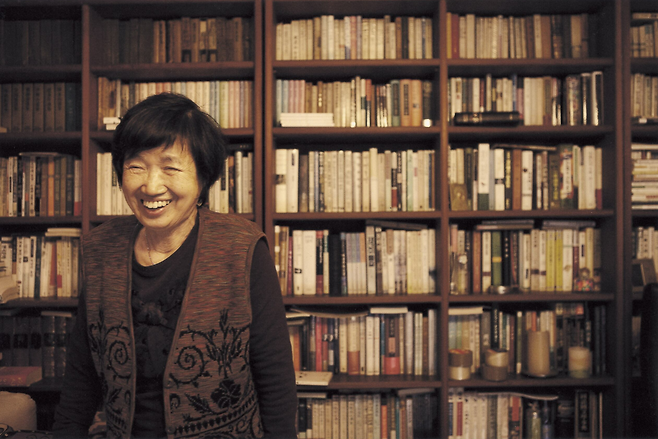
Every January, as the cold hardens and the year begins in earnest, Korean readers return to the quiet warmth embedded in Park Wan-suh’s stories.
Thursday marked the 15th anniversary of the death of a central figure in modern Korean literature. Park was born in 1931, during Japan’s colonial rule of Korea (1910-1945), and died in 2011 at 80 from gallbladder cancer.
The anniversary has prompted publishers and readers to return to her work, with new editions and commemorative volumes drawing renewed attention to writing that has yet to recede into history.
Park entered the literary world relatively late, at 40, and went on to produce a substantial body of work marked by breadth and sustained intensity. Over four decades, she published 15 novels and more than 100 short stories and essays.
Her alma mater, Seoul National University — where Park studied before being forced to abandon her education during the Korean War (1950-1953) — has also taken steps to preserve her legacy. The Digital Museum of Park Wan-suh, bringing together her writings, photographs and archival videos, opened last year. In addition, the university’s library is set to unveil the Park Wan-suh Archive next month, cataloguing nearly 3,000 related items as part of its SNU Heritage collection.
"For 40 years she bestowed on her readers sharp critiques leavened with gentle satire on how the ethics, values and norms of the Korean family have been overturned by the experiences of the colonial period, the division of the nation and war," writes Kwon Young-min, a professor emeritus of Korean language and literature at Seoul National University, in "The Penguin Book of Korean Short Stories," which features Park’s 1975 short story “Winter Outing.”
"What distinguishes her narratives above all else is her colloquial style, which imbues her fiction with an almost palpable empathy that earned her the affectionate nickname "the auntie next door."
Below, we revisit two of her most enduring novels — works translated into English and other languages that continue to serve as points of entry to her fiction for readers abroad.
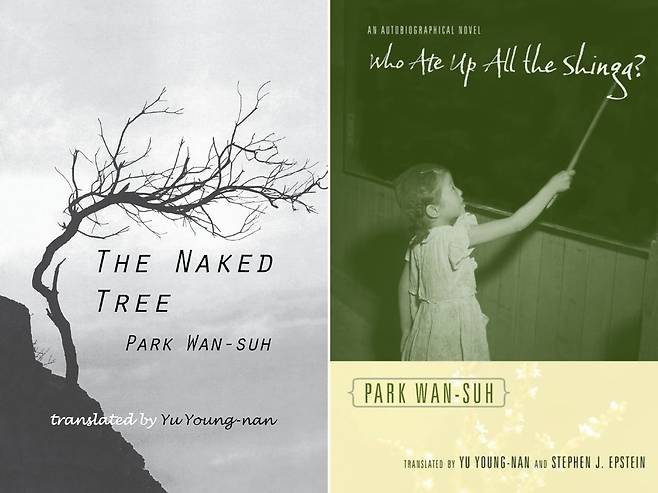
'The Naked Tree'
The Naked Tree is Park’s debut novel. Published in 1970 after winning a long-form fiction prize in a literary contest run by a newspaper magazine, it was written when she was nearly 40 and living as a housewife.
The story of her unexpected debut has since become part of Korean literary lore: editors reportedly visited her home to confirm that such a novel could indeed have been written by an unknown woman with no literary resume.
Set in the winter following the outbreak of the Korean War, shortly after Seoul was retaken, "The Naked Tree" unfolds in and around a portrait shop catering to American soldiers. Its narrator, a young painter, moves between survival and artistic aspiration, observing the uneasy distance between art and life in a city still marked by hunger, loss and moral uncertainty.
Park based the painter on the real-life artist Park Soo-keun, whom she knew while working alongside him at a US military PX souvenir shop — located on the site of what is now a major department store in central Seoul.
The novel is often described as the work Park herself valued most, and it has remained a staple of school curricula.
In recent years, "The Naked Tree" has reached new readers through an acclaimed graphic-novel adaptation by Keum Suk Gendry-Kim.
'Who Ate Up All the Shinga?'
“Who Ate Up All the Shinga?” (1992) is often read as Park’s most personal and autobiographical novel, drawing on her childhood memories of the 1930s and her early adulthood in war-ravaged Korea in the 1950s.
The coming-of-age narrative centers on a family: a strong-willed mother with fierce pride, a sensitive and fragile older brother and a daughter who quietly mirrors her mother’s resilience.
The narrator and her family move to Seoul from Gaepung in North Korea so that her brother can attend school. She is initially dismayed by the city’s grim and crowded streets. Over time, the family settles in: the brother graduates, finds work and marries, while the narrator immerses herself in books. That intellectual awakening deepens after Korea’s liberation in 1945 and leads her to enter Seoul National University in 1950 — just months before the outbreak of the Korean War. The war shatters that fragile stability. Branded a leftist, the brother is taken away, and the family endures fear, interrogation and deprivation, hiding in an emptied Seoul.
The “Shinga” (Koenigia) of the title refers to a tart wild plant the narrator once enjoyed eating.
Selling more than 1.7 million copies, the novel remains one of Park’s most widely read works. Its story continues in her later novel, "Was That Mountain Really There?" which picks up where Shinga ends.
Copyright © 코리아헤럴드. 무단전재 및 재배포 금지.