SyntekaBio Enters ‘Assetization Phase’ for AI Asset Program
[Song Young Doo, Edaily Reporter] SyntekaBio, Inc., an AI-driven drug discovery company, said on the 21st that antibody candidates identified through its proprietary AI asset program have formally entered the assetization phase.
The company said it is conducting stepwise experimental validation of antibody candidates designed using its antibody optimization AI platform, Ab-ARS, with the goal of securing antibody drug assets suitable for license-out or co-development. The project goes beyond simple hit identification, focusing on building a virtuous cycle that links validation, assetization, and AI advancement.
Last year, SyntekaBio used the Ab-ARS platform to design 13 distinct antibodies by modifying parts of the amino acid sequence of an anti–PD-L1 antibody, and conducted experimental validation through a domestic CRO. As a result, 12 antibodies demonstrated binding performance comparable to or better than existing antibody therapeutics, while some successfully activated immune cell signaling pathways.
These results demonstrated that the AI antibody platform can function effectively in real experimental settings, internally validating that SyntekaBio’s AI antibody technology has reached a commercially viable level.
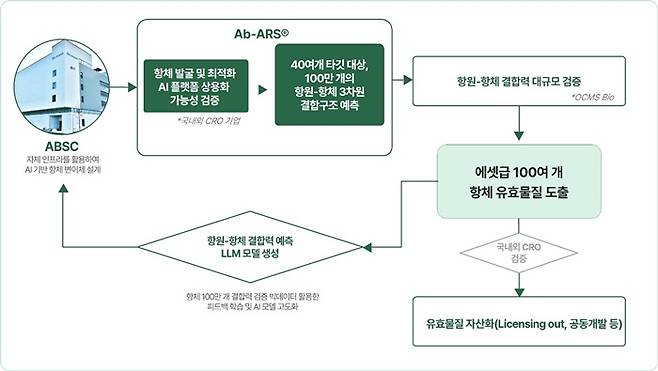
Building on this validation, SyntekaBio is expanding its asset program to launch a large-scale verification project covering more than 40 targets, aiming to secure around one million antigen–antibody binding data points. The goal is to derive approximately 100 asset-grade antibody leads with strong binding affinity and stability.
The project will proceed in stages. Candidate antibodies will first be generated through AI computation using roughly 2,000 servers at SyntekaBio’s in-house ABS (AI Bio Supercomputing) Center. Following large-scale validation, additional testing will be conducted through domestic and overseas CROs. Antibody candidates produced through this process are expected to be leveraged as new drug assets eligible for license-out or joint development.
As part of the large-scale validation effort, SyntekaBio plans to soon sign a contract with U.S.-based OCMS Bio for antigen–antibody binding validation. OCMS Bio has capabilities in high-throughput screening using antibody libraries and next-generation sequencing (NGS) analysis, enabling SyntekaBio to systematically secure extensive antigen–antibody binding datasets.
SyntekaBio also plans to reuse the one million binding data points generated through the project to retrain its AI models. By enhancing an LLM-based AI model that learns antigen–antibody interactions from large experimental datasets, the company aims to further improve the accuracy of future antibody design. In effect, data accumulated during assetization are fed back into AI performance enhancement.
Through this large-scale antibody screening initiative, SyntekaBio expects not only to build its own drug pipeline as assets, but also to more actively pursue license-out and co-development discussions with global pharmaceutical companies, centered on experimentally validated compounds. The company views the move as a key inflection point in its mid- to long-term growth strategy, marking a transition from candidate discovery to tangible value creation.
“An asset program does not end with AI-based antibody design,” a company official said. “It creates drug assets through experimental validation, and the data generated in that process are reused for AI training. By simultaneously advancing validated antibody assets and AI model sophistication, we plan to continuously strengthen our competitiveness.”
송영두 (songzio@edaily.co.kr)
Copyright © 이데일리. 무단전재 및 재배포 금지.
- '제아무리 AI 덤벼도' 끄떡없는 업종 1위, 바로 '이것'
- 임성근, 전과 5범이었다…“음주 3번” 고백 영상 삭제
- "호텔에 2주 머물면 2000만원"…베트남서 팔려다닌 20대
- “남편 상간녀가 연프 출연” 폭로…당사자 “법적 대응“
- 성매매 요구 거절에 격분…종로 여관에 불 질러 7명 목숨 앗아갔다[그해 오늘]
- "국민은 누굴 믿냐"…소 타고 경찰서 찾아간 60대
- 송가인, 1인 기획사 미등록 무혐의… '사내이사' 친오빠 검찰 송치
- ‘돈맥경화’ 징조일까…현대건설, 벌어도 현금이 안 쌓인다
- 73세 푸틴, 올해도 얼음물 깨고 입수 건강 과시 "허세 아냐"
- '흑백요리사2' 정호영, 최강록과 특별한 인연 "日 생선가게 자리 물려줘"