Creating fiction rooted in non-fiction
Rarely does an architecture exhibition achieve such popularity that its scheduled run is extended.
“Fiction Non-Fiction: In Search of the Forms of Our Lives” by Guga Urban Architecture has achieved just that: Originally slated to run Oct. 10-Nov. 11, the exhibition has been extended to Nov. 23 due to high demand.
It is apparent from the very start that this architecture exhibition is unlike most such shows.
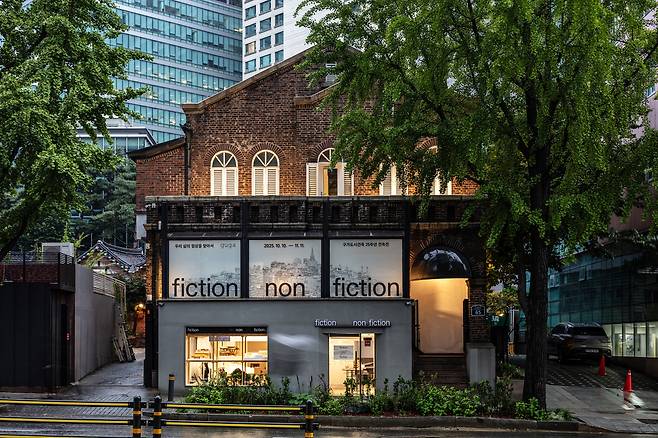
As soon as you enter the exhibition venue, a three-story red brick building in Gyeonji-dong, Jongno-gu, Seoul, built in 1936 by Korea’s pioneering architect Park Gil-ryong, you are invited to experience a jjokbang. The name of this tiny room that barely accommodates one person is derived from the practice of splitting space to create several very small rooms or living spaces. Jjokbangchon, an entire neighborhood of such housing, is just one of the many facets of Seoul that Guga Urban Architecture head Cho Jung-goo has explored every Wednesday for 25 years.
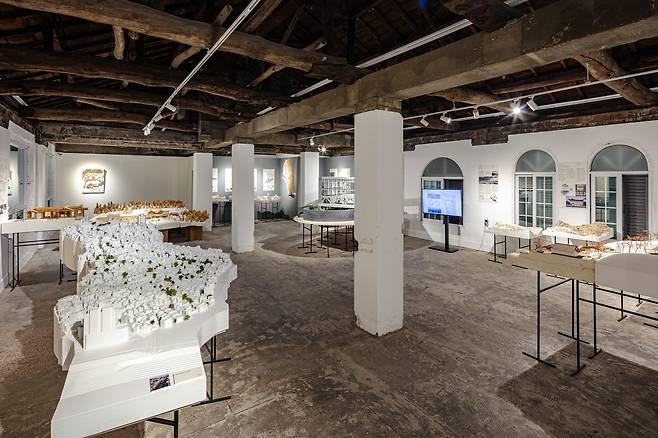
The “Guga’s Foundation” section on the first floor is dedicated to the findings of these "Wednesday field studies” that began at Jongmyo on Nov. 29, 2000. So far, 1,108 such field studies have been conducted, covering 105 administrative districts and showing how people have adapted to the challenges of living in a rapidly modernizing capital.
At the center of the floor is a table featuring “Seogyo 365,” a model of a long line of 2- or 3-story buildings. If you think it looks like a train, you are not very wrong. The buildings were built next to a section of rail that stretched from Danginri to Yongsan, over which coal-carrying trains ran. Today, the tracks are gone, but the buildings remain, facing a strip of road popularly called “Hongdae juchajang-gil.”
Cho may be described as an anthropologist-architect: He records field studies — there are over 2,000 pages of sketches of the neighborhoods surveyed — and creates an archive of now-lost objects as well. Signboards and knick-knacks found in the old neighborhoods around Sewoon Plaza — where planned redevelopment fuels heated debates between Seoul City and the Culture Ministry for its potential impact on the UNESCO-listed Jongmyo Shrine — as well as a video of interviews with residents on display, reveal the depth and breadth of Guga Urban Architecture’s field studies.
In fact, the exhibition title “Fiction Non-Fiction” is derived from the firm’s practice. Recording the city, as if “scanning it,” to use Cho’s words, constitutes the non-fiction part of the show, while the projects inspired by the discoveries made in the field studies constitute the fiction.
The section on the second floor, “Houses Built by Guga,” showcases many of the firm’s realized projects such as houses with madang, or a central courtyard; hanok-like houses that evoke the feeling of living in a traditional Korean house; and evolving hanok to meet the needs of contemporary lifestyle by reinterpreting some of its essential elements: the courtyard, eaves and balcony.
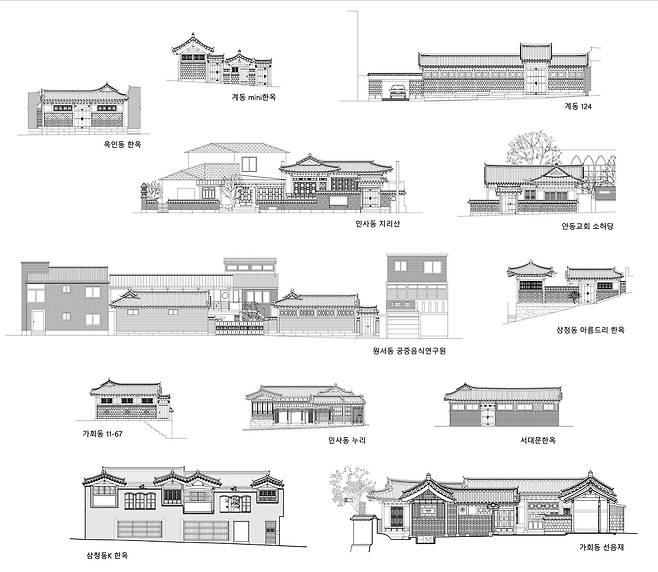
One notable presentation is that of Cho’s house, a hanok built in Seodaemun in 1958 that served as a starting point for his architectural practice and where he has lived for 20 years.
“In Search of a New Form of Life,” presented on the third floor, showcases public architecture projects and religious spaces. These include the country's first hanok hotel: Ragung Hotel in Gyeongju, North Gyeongsang Province, the ancient capital of the Silla Kingdom (57 BC-AD 935). It incorporates elements of urban hanok, such as a private madang in each unit, with units clustered together for efficient operation of the hotel.
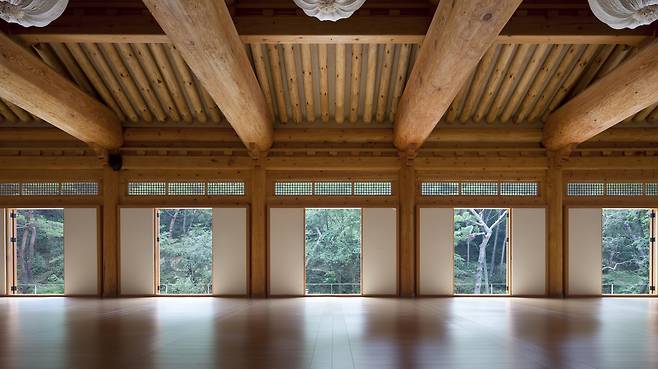
Cho also worked on many of the new buildings at Jingwansa, a Buddhist temple in Eunpyeong-gu, Seoul, presenting a new form of temple architecture set in nature. This includes Hamwol-dang, a contemporary architectural space and an example of a meeting of hanok, which is used for temple stay programs.
Immediately drawing attention with its meticulous detail is the 4 by 1.5 meter model of Hannam-dong Hill. The landscape of 1,500 homes offers a bird’s eye view of the area soon to be lost to urban redevelopment projects, illustrating how people have adapted their houses to meet the challenges of the terrain as they carve out a life on a hillside, each building as individual and unique as the families occupying them.
Many of the discussions and programs that run alongside the exhibition are being held at "guzi," a 1:1 scale pavilion outside the exhibition building and the third pavilion built by Guga Urban Architecture. Others include its hanok presentation at the 2010 Venice Biennale Korean Pavilion, as well as "Jitda," presented at 2023 Seoul Biennale of Architecture and Urbanism. "Jitda" is on view at this year's biennale as well and can be viewed at Songhyeon Green Plaza, a five-minute walk from the Guga exhibition venue.
Copyright © 코리아헤럴드. 무단전재 및 재배포 금지.