Spotify sees Korea as global test bed for 'ubiquitous' music future
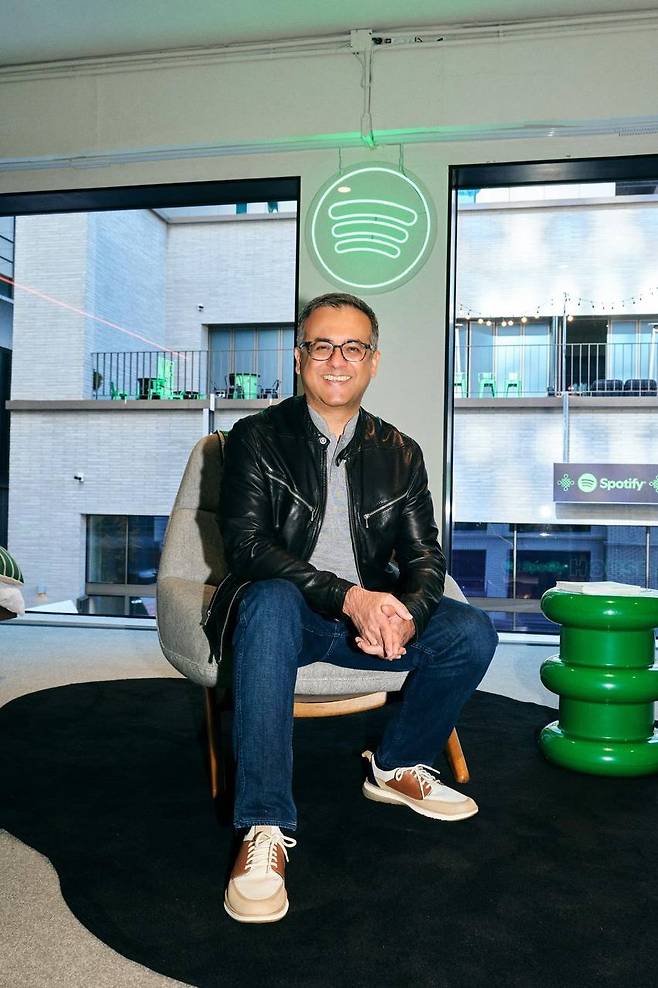
Spotify’s recent return to Seoul with an expanded edition of Spotify House signals more than a pop-up; it reflects the company’s view of Korea as one of the world’s most influential creative hubs — and a ground to see how music discovery and personalization will evolve globally.
“Korea is one of the most influential cultural capitals in the global music industry,” said Gautam Talwar, Spotify’s general manager for Asia-Pacific, during an interview with The Korea Herald at Spotify House Seoul in Seongsu-dong on Friday. “It’s a creative hub for music, and we all know the significance of K-pop in today’s zeitgeist.”
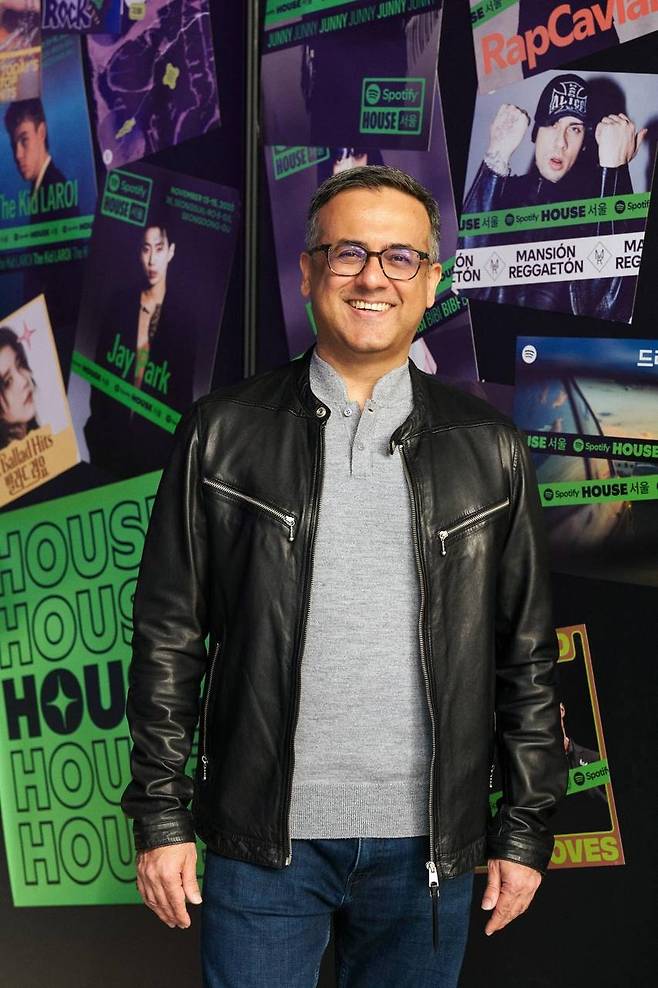
Talwar, who has spent more than seven years at Spotify overseeing one of its fastest-growing regions, said Seoul’s role as a trendsetter is precisely why the company chose it for its biggest Spotify House in the Asia Pacific. The three-day experience is designed as a “physical manifestation” of what he calls the home of a “true music lover” — a space that mirrors how people soundtrack every moment of their day.
“We wanted to create a living, breathing space that reflects what the home of a true music lover would look like,” he said. “True music lovers have taste — they’re keen to go deeper with artists, their music and the cultures they represent.”
That philosophy aligns with Spotify’s push into what Talwar describes as the “ubiquitous era” of listening. The platform already sees users spending about 2.5 hours a day on the app. Its goal now is to integrate even more fluidly into personal routines, moods and social interactions — especially in Korea, where listeners are among the world’s most engaged.
“With over 700 million users and 281 million subscribers, we understand listening habits deeply,” he said. “Korean users are true music lovers. They want deeper access, more ways to engage, connect and share. We want to give them the power and control to do that.”
K-pop and beyond
Talwar emphasized that K-pop’s rise has reshaped music consumption worldwide — and Spotify’s own strategy.
“K-pop acts are seeing borderless growth across continents thanks to our collaboration,” he said, pointing to streaming momentum not just in the US and Europe but in Southeast Asia, Latin America and India.
But the trend is not limited to idol pop. Korean indie rock, hip-hop and R&B are also traveling faster and further than before.
“Indie rock is having a breakout moment on the platform, with major streams in Taiwan, Thailand and Indonesia,” he said. “Hip hop is big right now. They speak to the soul of many listeners — not just in Korea, but across Asia.”
Spotify is now investing heavily in rising Korean artists through curated playlists like “Indie Korea” and “Krown,” as well as programs such as “Radar,” which has supported musicians like Hanroro, Junny and earlier acts including Babymonster and Le Sserafim. “We’re committed to celebrating Korea’s full musical diversity,” Talwar said.
Hyper-personalization
Underlying all of this is Spotify’s effort to personalize listening at a level that Talwar says no other platform matches. Features like “Daylist” — which updates four times a day based on a user’s listening patterns — illustrate Spotify's aim to become a constant companion.
“Daylist reflects how you move through your day,” he said. “This morning my ‘Daylist’ was ‘Friday Classical’ — something chill to start the day. In the evening, it changes as my son and his friends play more upbeat, party music.”
These hyper-personalized tools are paired with editorial judgment from local tastemakers.
“When new artists debut, our editors help introduce them before the algorithm can — because with no history, technology can’t detect potential yet,” he said. “Human curators spot that spark early.”
Power of fandoms
For a market defined by organized, hyperactive fandoms, Spotify is also leaning into communal listening features. The app's new “Jam” feature allows users to build a shared playlist in real time, while “Blend” combines two listeners’ tastes.
“Music today is defined by powerful fandoms,” Talwar said. “These features help users not only connect with artists they love, but also with other fans who share those passions.”
He added that these tools play directly into the “freemium” model that has fueled Spotify’s global growth. “About 60 percent of our 280 million subscribers started as free users,” he said. “We’re seeing strong growth in both free and paid users in Korea.”
Copyright © 코리아헤럴드. 무단전재 및 재배포 금지.