South Korea’s young job seekers fear shrinking age window for entry-level work
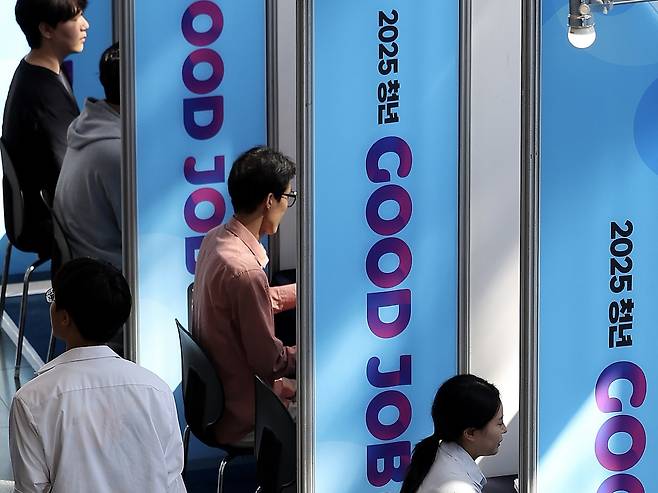
Job seekers in South Korea say the window to land an entry-level full-time job is shrinking, despite needing more time to prepare.
A survey released Monday by HR platform Incruit found that Koreans believe the “appropriate” age for a university graduate to start work has risen slightly. However, the perceived maximum age companies would accept for an entry-level hire has dropped.
According to the survey, the age Koreans consider appropriate to begin a career is 30.4 for men and 28.2 for women, inching up 0.4 and 0.3, respectively, from last year. At the same time, the cut-off age respondents believe companies will accept for entry-level hires has fallen to 32 for men and 29.6 for women, both a year younger than in 2024.
These figures do not reflect official hiring rules. Rather, they reflect prevailing social expectations: what job seekers and employers believe is the “right” age for someone to be seen as a "proper" new hire in Korean society.
Explicit age limits are banned under the Act on the Prohibition of Age Discrimination in Employment, which forbids employers from setting age-based qualifications in job postings, except in narrowly defined cases such as safety requirements or mandatory retirement ages.
This contradiction captures the dilemma facing many young Koreans. The road to employment is lengthening not only because of factors such as mandatory military service for men, but also years spent earning extra qualifications and repeated attempts at company recruitment drives. Yet cultural and corporate expectations still demand that workers enter their first job in their late 20s, leaving those who fall outside the range fearful of missing their chance altogether.
In Korea, the term “new hire” carries a social meaning that extends beyond work experience. Traditionally, large firms conducted mass recruitment rounds once or twice a year, bringing in large cohorts of fresh graduates. These new employees would then rise through the ranks together under a seniority-based promotion system.
Although many companies now prefer position-based hiring that favors experienced workers, the old expectation that a new hire should be young and fresh from university has not gone away.
This helps explain why more than 80 percent of Incruit’s respondents said age strongly affects hiring outcomes. The actual average age of new employees is already higher than the “appropriate” benchmark, at 31.9 for men and 29.5 for women, showing how prolonged preparation collides with the perceived age ceilings.
Most participants (71.6 percent) in the Incruit survey said there should be no implicit age ceiling, arguing that ability has little to do with birth year. Among the 28.4 percent who felt such an unwritten limit was necessary, the most common reasons cited were worries that older recruits might "unsettle existing staff," "have difficulty fitting in with younger peers," or "be perceived as starting their careers too late."
The Incruit survey was conducted from Sept. 12 to 23 among 701 respondents.
Copyright © 코리아헤럴드. 무단전재 및 재배포 금지.