Won weakens to 2-month low on foreign sell-off, US uncertainty
전체 맥락을 이해하기 위해서는 본문 보기를 권장합니다.
Although the Fed lowered its benchmark interest rate by 25 basis points earlier this month, markets predicted that the US central bank may take a more cautious stance toward further cuts. Fed Chair Jerome Powell added weight to this perspective, saying equity prices are "fairly highly valued."
"Should the investment be executed in a short period, the rapid outflow of foreign currency is expected to drive the exchange rate more than 100 won higher."
이 글자크기로 변경됩니다.
(예시) 가장 빠른 뉴스가 있고 다양한 정보, 쌍방향 소통이 숨쉬는 다음뉴스를 만나보세요. 다음뉴스는 국내외 주요이슈와 실시간 속보, 문화생활 및 다양한 분야의 뉴스를 입체적으로 전달하고 있습니다.
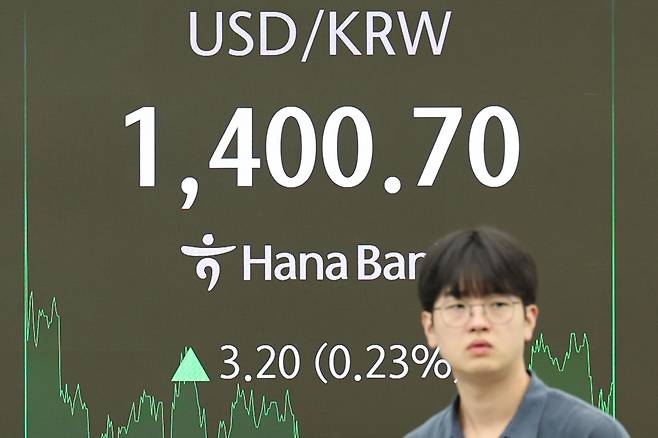
The Korean won slumped to its weakest level against the US dollar in about two months on Thursday, amid a lull in foreign inflows into the local stock market. Lingering uncertainties surrounding US tariff negotiations and monetary policy further weighed on the currency.
The won was quoted at 1,400.6 won per dollar as of daytime trading closing, losing value by 3.1 won from the previous session. The closing marked the won's weakest level in nearly two months since it wrapped up trading at 1,401.4 won per greenback on Aug. 1.
The devaluation follows the won-dollar overnight close of 1,403.8 won, which marked the first time since May 16 that the won’s value depreciated to worse than 1,400 in after-hours closing.
While after-hours trading accounts for only a limited share due to its restricted volume, the won’s continued depreciation during daytime trading underscores its broader weakness.
The local currency’s depreciation partly stems from foreign investors' shift in the stock market.
“The shift of foreign investors to net selling has left the market without meaningful inflows to support the won,” Woori Bank economist Min Kyung-won said.
Having snapped up investments on the Korean stock market since May, foreign investors turned to a net selling stance on Wednesday, dumping shares amounting to 503 billion won ($358.9 million).
On the benchmark Kospi, offshore investors offloaded 250 billion won of shares on the day. While the selling spree on the Kospi extended out to early Thursday morning, the investors turned to a net buying stance later in the day and raked up shares worth 185 billion won.
Foreign buying had served as a key driver of the Kospi, but with the activity stalled, the index has remained flat over the past couple of days, ending its record-breaking streak just shy of a historic 3,500 points. On Thursday, the Kospi closed at 3,471.11, down 1.03 points or 0.03 percent from the previous session.
The sharp devaluation of the Korean won also prices in lingering uncertainty over the US Federal Reserve’s policy outlook following its September meeting.
Although the Fed lowered its benchmark interest rate by 25 basis points earlier this month, markets predicted that the US central bank may take a more cautious stance toward further cuts. Fed Chair Jerome Powell added weight to this perspective, saying equity prices are “fairly highly valued.”
Reflecting the concern, the US dollar index, a key gauge that measures the greenback’s value against six major currencies, climbed from the low-97 range to the upper-97 range, meaning the dollar’s value has strengthened.
Rising uncertainty surrounding tariff negotiations with the US is also adding to the pressure on the local currency's valuation. US demands for a $350 billion cash investment have negatively affected the won’s valuation.
“Concerns over the investment negotiations with the US are exerting downward pressure on the won. President Lee Jae Myung has warned that yielding to US demands could trigger a crisis akin to a foreign exchange meltdown, amplifying market anxiety,” commented Moon Da-un, a researcher at Korea Investment & Securities.
“Should the investment be executed in a short period, the rapid outflow of foreign currency is expected to drive the exchange rate more than 100 won higher.”
Seoul has been pressing for an unlimited currency swap arrangement as a safeguard against foreign exchange volatility. On Wednesday, both Lee and Finance Minister Koo Yun-cheol held separate meetings with US Treasury Secretary Scott Bessent on the sidelines of the UN General Assembly to discuss the swap.
Copyright © 코리아헤럴드. 무단전재 및 재배포 금지.