Samsung’s leadership dilemma, Nvidia’s generational shift: Inside the chip giants’ boardrooms
![From left, Samsung Electronics Chairman Lee Jae-yong, Nvidia CEO Jensen Huang and SK Group Chairman Chey Tae-won converse during a roundtable meeting with Korean and U.S. business leaders at a Washington hotel in Washington on Aug. 25. [YONHAP]](https://img4.daumcdn.net/thumb/R658x0.q70/?fname=https://t1.daumcdn.net/news/202509/23/koreajoongangdaily/20250923070228822jtgu.jpg)
[CHIP REPORT ⑤] In the high-stakes world of semiconductors, where fortunes hinge on trillion-won investments and the razor-thin edge of technological leadership, one question increasingly looms over the industry’s giants: Who should lead them?
Should it be the visionary owners who have long made audacious bets that reshaped entire industries? Or the disciplined professional managers expected to deliver steady, rational decisions?
As the landscape convulses under the twin pressures of artificial intelligence and geopolitics, five titans — Samsung Electronics, Intel, SK hynix, Micron and TSMC — are experimenting with radically different models of governance. There may be no universal model. Yet one thing is clear: In a business where a single decision can move billions, the composition of the boardroom has become just as important as the design of the chip.
Conglomerate at a crossroads Few companies embody the drama of owner-led leadership as vividly as Samsung.
Bong Wook, the newly appointed senior presidential secretary for civil affairs under the Lee Jae Myung administration, knows this firsthand. A former prosecutor, Bong spent two years starting in 2020 as a member of Samsung’s first compliance monitoring committee, chaired by former Supreme Court Chief Justice Kim Ji-hyung. That committee coaxed two historic promises from Samsung Electronics Executive Chairman Lee Jae-yong: That he would not hand over management control to his children, and that Samsung would abandon its entrenched no-union policy.
![Samsung Electronics Chairman Lee Jae-yong speaks during a press conference following U.S. President Joe Biden's visit at the Samsung Electronics Pyeongtaek Campus in Pyeongtaek, Gyeonggi, in May 2022. [EPA/YONHAP]](https://img2.daumcdn.net/thumb/R658x0.q70/?fname=https://t1.daumcdn.net/news/202509/23/koreajoongangdaily/20250923070230297mtop.jpg)
Reflecting on that experience, Bong remarked that decisions at Samsung often transcend individual affiliates — and that the law and corporate charters leave such cross-entity decisions in a gray zone. Seoul National University Professor and corporate governance expert Kim Woo-jin echoed this in the committee’s report, arguing that systems must allow companies to function without the owner’s direct grip, while warning — citing Posco and KT — that ownerless companies can fall prey to political interference.
Yet in semiconductors, Samsung has long thrived precisely because of its owners’ audacity. Founder Lee Byung-chul’s 1983 Tokyo declaration to leap into semiconductors and deceased former Chairman Lee Kun-hee’s 1993 Frankfurt declaration to “change everything except your wife and children” were turning points that outsiders might have deemed reckless, but they defined Samsung’s future dominance.
That owner-driven model, however, has more recently grown fragile. After Lee Kun-hee’s collapse in 2014 and the state corruption scandal that saw Lee Jae-yong imprisoned, Samsung’s owner-led command structure cracked. The Future Strategy Office, which had coordinated group-wide strategy, was disbanded in 2017. It was replaced by three smaller task forces, but they could not resolve the rivalries, silos and friction that festered inside the vast electronics empire.
“During hard times, the most crucial thing is strong leadership,” said former Samsung Electronics Chairman Kwon Oh-hyun in 2020. “It is not easy for a professional manager to propose an investment of several trillion won when the business is in the red.” Even Kwon, hailed for taking Samsung semiconductors to their zenith, acknowledged the limits of professional managers.
Lee Jae-yong himself once pledged there would be no fourth-generation succession. That makes a transition to professional management likely in the long term — but as Samsung’s semiconductor profits sag, doubts have flared about whether such managers can deliver the bold, timely decisions the business demands.
In February, acquitted on appeal in his merger and accounting case, Lee rebuked his executives, saying Samsung had “lost its inherent tenacity” and urging them to face crises with “a do-or-die resolve.” Some saw it as a signal of a return to stronger owner-driven leadership.
Meanwhile, Samsung’s has begun recalibrating the composition of its board. In March, it added several semiconductor experts: Seoul National University professor Lee Hyuk-jae as an outside director, and Device Solutions chief Jun Young-hyun and Chief Technology officer Song Jai-hyuk as internal directors. Now, three out of nine board members — and two out of three internal directors — are semiconductor specialists.
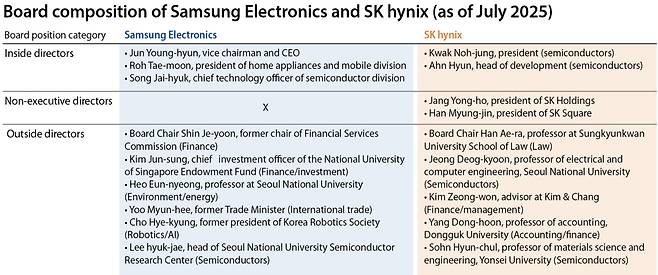
Intriguingly, for the first time since 2013, no chief financial officer sits on the board, breaking a decade-long tradition. Observers say this reflects an effort to shift away from a perception that the board was dominated by bureaucrats and finance officers.
Samil PwC adviser Cho Yong-doo argues that owner-led systems, though criticized as “chaebol,” excel at sustaining a long-term vision. By contrast, U.S. firms that pioneered professional management now complain of managers obsessed with quarterly earnings. Cho proposes a hybrid “Korean model”: Creative owners, loyal professional managers and a strong, independent board.
Nvidia’s next generation At this January’s CES 2025, Nvidia dominated the global stage, unveiling a torrent of new artificial intelligence technologies and products that captured the spotlight. Yet among the high-powered announcements, a quieter but striking storyline emerged: the unexpected debut of founder and chief executive Jensen Huang’s children as visible project leaders in the company’s AI push.
![CEO of Nvidia Jensen Huang speaks as he takes part in a panel discussion with Britain's Prime Minister Keir Starmer during the London Tech Week, in London, on June 9. [AFP/YONHAP]](https://img3.daumcdn.net/thumb/R658x0.q70/?fname=https://t1.daumcdn.net/news/202509/23/koreajoongangdaily/20250923070233146wglq.jpg)
His daughter, Madison Huang, took the stage to present “Omniverse,” an industrial robotics platform designed to orchestrate complex physical automation. Madison is no newcomer to brand building: She crafted luxury marketing strategies at the Louis Vuitton Group before joining Nvidia, where she now serves as Senior Director of Physical AI Platform and Technology Marketing. An MBA graduate of the London Business School, she has become one of the company’s leading voices on bringing AI to the physical world.
Meanwhile, Jensen Huang’s son, Spencer Huang, unveiled the blueprint for “Isaac Gr00t,” a humanoid robotics development tool kit, positioning Nvidia as a critical enabler of next-generation robotics. Spencer is currently a Robotics Product Manager at Nvidia. He completed a one-year MBA program at New York University, and interestingly, ran a cocktail bar in Taiwan before shifting into the tech world.
Intel: A bureaucracy in revolt If Samsung epitomizes owner-driven audacity, Intel has been a case study in the perils of professionalized caution.
Lip-Bu Tan, who resigned as director of Intel’s foundry business in August 2024, said at the time that Intel had fallen into a risk-averse, bureaucratic culture and that he was disappointed by its sluggish artificial intelligence strategy.
Seven months later, Tan was back — this time as chief executive. The board had fired Pat Gelsinger in December after massive foundry losses deepened Intel’s crisis.
![Intel CEO Lip-Bu Tan delivers remarks at an event celebrating Intel's 40th anniversary in Taiwan held at Le Méridien Taipei Hotel on May 19. [INTEL]](https://img2.daumcdn.net/thumb/R658x0.q70/?fname=https://t1.daumcdn.net/news/202509/23/koreajoongangdaily/20250923070234585layp.jpg)
At his debut event, Intel Vision 2025 in April, Tan declared that under his leadership, Intel would once again become an engineering-driven company.
His first act was people. He elevated network chip head Sachin Katti to chief technology officer and chief artificial intelligence officer, and poached semiconductor and interconnectivity veterans from Apple and Google to inject fresh technical firepower.
His second priority was pruning. He cut through layers of hierarchy, made core business units report directly to him and emphasized that team size would no longer be treated as a performance metric. He argued that Intel had to reduce bureaucracy and inefficiency — not simply add talent — if it hoped to regain technological leadership.
Even bolder, he shifted strategy: Instead of ramping up production on Intel’s 1.8-nanometer process due at year-end, he reportedly redirected resources to accelerate the even more advanced 1.4-nanometer node.
This revolution was possible only because the board finally reformed. For prior two decades, Intel’s board had been notorious for its CEO choices. This ranged from marketing man Paul Otellini to finance man Bob Swan, and even manufacturing expert Brian Krzanich, who was slammed for fixating on cost cuts and short-term results. A key reason: The board was dominated by finance figures like former chair Andy Bryant, while lacking technical expertise. In 2005, it even rejected a proposed Nvidia acquisition as too expensive.
By late 2024, seven of Intel’s eleven directors had no semiconductor experience. That changed last December when the board added industry veterans Eric Meurice, a former ASML CEO, and Steve Sanghi, a former Microchip CEO, and then appointed Tan this past March. In parallel, three directors from non-tech fields — a medical-device CEO, a university dean and an anthropologist — announced retirement. Their successors are expected to be semiconductor experts.
Whether Tan can rescue Intel remains uncertain. But the boardroom revolution that enabled him is already reshaping the company.
Capital as destiny: SK hynix, Micron SK hynix faces a different challenge — not governance, but finance.
In March 2023, it appointed its first female board chair, law professor and former judge Han Ae-ra, who is noted for her independence. SK Chairman Chey Tae-won has promoted “Board 2.0,” defining the board’s role as setting long-term direction, cross-checking management decisions and monitoring execution.
![SK Group Chairman Chey Tae-won takes questions from employees during the closing session of the Icheon Forum 2025 at SK's Seorin building in central Seoul on Aug. 20. [SK]](https://img1.daumcdn.net/thumb/R658x0.q70/?fname=https://t1.daumcdn.net/news/202509/23/koreajoongangdaily/20250923070236036hhyx.jpg)
But money has been the real headache. Through 2022 and 2023, amid a memory market slump, doubts swirled about whether SK hynix could pay the remaining balance for its 2021 acquisition of Intel’s NAND business Solidigm. The company’s debt ratio soared to 87.5 percent by late 2023.
Then the high bandwidth memory (HBM) boom hit. By early 2025, SK hynix had slashed borrowings from 29 trillion to 23 trillion won ($16.5 billion), boosted cash from 5.4 trillion won to 13.6 trillion won, and cut its debt ratio to 52.2 percent. It also completed the Solidigm payment. In the first quarter, it even overtook Samsung in DRAM market share for the first time.
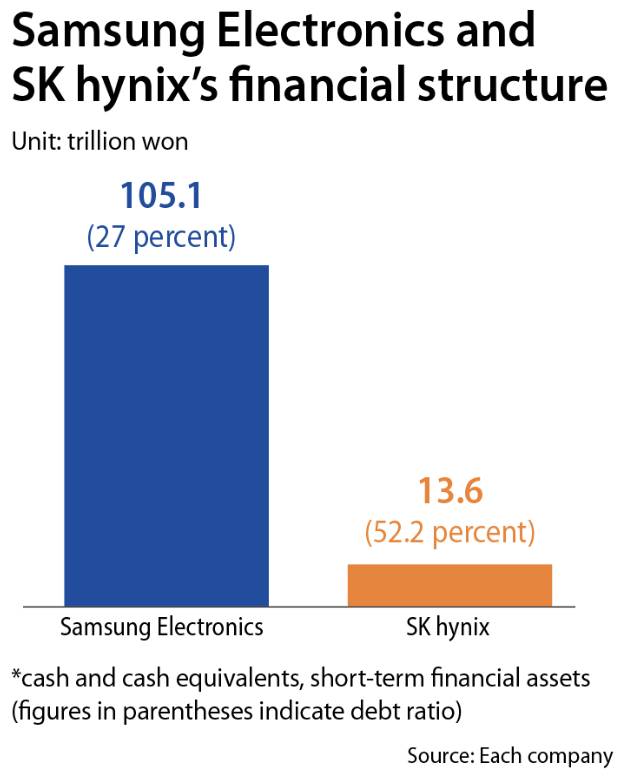
Yet Samsung’s financial might still dwarfs it, with over 105 trillion won in cash and short-term investments and just 27 percent debt. Because semiconductors require constant capital spending, SK hynix faces a tough equation: keeping up in technology while staying solvent.
Micron, the No. 3 memory maker, is chasing SK hynix in HBM. It posted $9.33 billion in revenue and $2.49 billion in operating profit last quarter and expects even more this quarter. Chief executive Sanjay Mehrotra says HBM sales are rising 50 percent each quarter and are fully booked through fiscal 2025. Yet Micron is holding 2024 capital spending steady at $14 billion, insisting on caution.
That conservatism stems from its ownership: Micron’s largest shareholders are institutional investors like Vanguard, BlackRock and Capital Research — entities disinclined to sanction risky bets. To offset that, Micron added former TSMC chairman Mark Liu to its board in March to guide its artificial intelligence expansion.
Geopolitics add additional challenges In May 2023, China’s internet security regulator banned critical infrastructure operators from buying Micron memory, citing security risks.
For shareholders, the contrasts are striking. Over the past five years, Intel has offered the highest average dividend yield at 2.76 percent, followed by Samsung at 2.58, SK hynix at 1.19, Micron at 0.33 and Nvidia at 0.07. Yet Nvidia, despite its minuscule dividends, has seen its stock price soar over 3,000 percent in five years, topping $4 trillion in market capitalization in July 2025. For fast-growing firms, raising market value can be a better way to reward shareholders than dividends — a reality SK hynix shareholders pointedly raised in March, when the company modestly raised its dividend despite trumpeting a “renaissance.”
TSMC: Engineering succession At the other end of the spectrum sits TSMC, the world’s top foundry, and perhaps the most methodical of all.
In February 2024, it named senior vice presidents Yuh-Jier Mii, head of research and development, and Yung-Pei Chyn, head of overseas business, as co-chief operating officers. Three months later, chief executive C.C. Wei became the company’s third chairman, succeeding Mark Liu.
It was a deliberate echo of 2012, when founder Morris Chang appointed Wei, Liu, and Shang-Yi Chiang as co-COOs in a kind of succession trial. Many see the 2024 reshuffle as grooming not just the next chairman but the “next-next” one.
TSMC’s formula is clear: Nurture leaders internally for decades, and empower a board unafraid to challenge them. The Taiwanese government’s stake has fallen from 48 percent at TSMC’s founding to about 6 to 7 percent today, but it still remains the largest shareholder.
As of mid-2025, seven of TSMC’s 10 directors are outsiders, and only one is Taiwanese — former premier Chuan Lin. The rest include global heavyweights: former NXP chairman Peter Bonfield, former Applied Materials CEO Michael Splinter, former Xilinx CEO Moshe Gavrielov, MIT’s Rafael Reif and former Xerox CEO Ursula Burns. By contrast, eight of Samsung’s nine directors are Korean. Morris Chang has said only people whose achievements match or exceed TSMC’s chief executive can serve on its board. It is a standard that has kept the company fiercely technocratic — and remarkably stable.
Yet even TSMC faces the unknown. For decades, Morris Chang was its backstop — returning as chief executive in 2009 during the global financial crisis after retiring in 2005. But now in his 90s, he can no longer be the firefighter. TSMC must prove its leadership system can endure without its founding patriarch.
This article was originally written in Korean and translated by a bilingual reporter with the help of generative AI tools. It was then edited by a native English-speaking editor. All AI-assisted translations are reviewed and refined by our newsroom. BY LEE JAE-LIM [lee.jaelim@joongang.co.kr]
Copyright © 코리아중앙데일리. 무단전재 및 재배포 금지.
- [WHY] The mystery behind all those Trader Joe's bags in Korea
- 25 fraud ring members who stole $15M arrested in Thailand
- Korea's oldest tiger-magpie painting goes on view at Leeum
- President Lee criticizes 'submissive mindset' of people who believe Korea needs foreign troops
- Incheon Airport packed as union launches strike
- Prosecutors demand death penalty for teacher indicted for murdering 7-year-old student
- Kim Soo-hyun's Gold Medalist logs unusually low payouts to actors, outlet finds
- President Lee departs to New York for the UN General Assembly
- Jun Ji-hyun faces backlash in China
- Gyeonggi passes local laws to ban racial discrimination, ensure refugee rights, recognize undocumented children