Lee Geum-yi completes trilogy on Korean women's diaspora with 'Gap of Sorrow'
전체 맥락을 이해하기 위해서는 본문 보기를 권장합니다.
One of Korea's most prominent writers of children's and young adult books, Lee Geum-yi, has brought a 10-year literary passion to a close with her latest novel, "The Gap of Sorrow."
"But right now, I feel at peace knowing I've finally brought out what I was carrying in my heart into the world as a book. More than a triumph, it's the satisfaction of keeping the promise I made to myself — to write a trilogy on the diaspora of Koreans under Japanese rule."
이 글자크기로 변경됩니다.
(예시) 가장 빠른 뉴스가 있고 다양한 정보, 쌍방향 소통이 숨쉬는 다음뉴스를 만나보세요. 다음뉴스는 국내외 주요이슈와 실시간 속보, 문화생활 및 다양한 분야의 뉴스를 입체적으로 전달하고 있습니다.
Celebrated children and young adult author brings decade-long passion to close
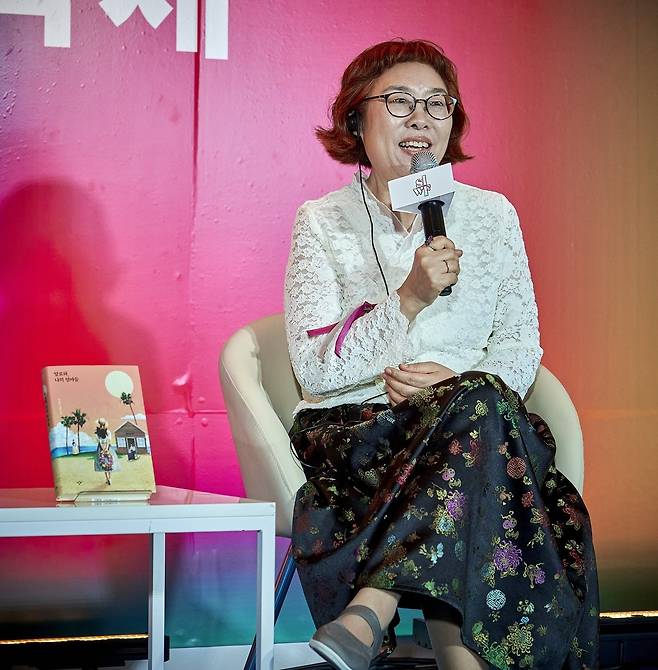
One of Korea's most prominent writers of children's and young adult books, Lee Geum-yi, has brought a 10-year literary passion to a close with her latest novel, “The Gap of Sorrow.”
The book completes a trilogy on the Korean women’s diaspora under Japanese colonial rule (1910-1945), following “Can’t I Go Instead” (2016) and “The Picture Bride” (2020). Together, the three novels trace the overlooked lives of Koreans through the eyes of young female characters scattered across the Pacific and Eurasia in the first half of the 20th century.
Speaking at a Seoul International Writers’ Festival book talk in Seoul on Saturday with Swedish novelist Jonas Hassen Khemiri, Lee said she felt relief above all else in fulfilling a long-held promise to herself.
“When you have an idea in your heart that is intangible, you have to get it out, not knowing if it will succeed or where it will lead you. So you feel rather nervous as you go into writing,” Lee said.
“But right now, I feel at peace knowing I’ve finally brought out what I was carrying in my heart into the world as a book. More than a triumph, it’s the satisfaction of keeping the promise I made to myself — to write a trilogy on the diaspora of Koreans under Japanese rule.”
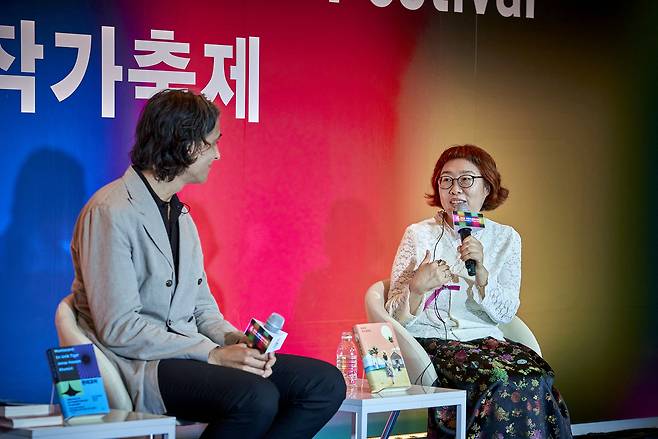
Lee made her literary debut in 1984 with the short story “With Younggu and Heukgu,” and has since become an indispensable presence in Korean children's and young adult literature. Over the past four decades, she has published more than 50 books across a wide range of topics and genres. In 2024, she became the first Korean writer shortlisted for the Hans Christian Andersen Award in the writing category.
The shift to “Can’t I Go Instead,” the first book in the trilogy, which follows the lives of a Korean nobleman’s daughter and her maidservant in the early 20th century, marked a departure from Lee’s earlier work, which had largely centered on the everyday realities of children’s lives: schools, friendships and classrooms.
Lee had never set out to write a diaspora trilogy; the stories simply carried her along.
Her imagination, however, had always stretched beyond those boundaries. Growing up in the '60s and ’70s, when children’s books were scarce in Korea, she was raised in a home lined with volumes collected by her father — a man who would bring back a book for her even when there was no rice at home.
As a child, she devoured these stories set in the colonial era, in which characters journeyed through forbidden landscapes across what is now North Korea and on to China and Russia. And it was the geography, vast and unreachable setting, that left the deepest impression on her.
“I would invent my own protagonists, and whenever I read foreign books, I would journey with them into those distant worlds,” Lee said. “I first dreamed of becoming a writer in third grade. Even then, I promised myself that if I ever became a novelist, I would write works set in expansive worlds.”

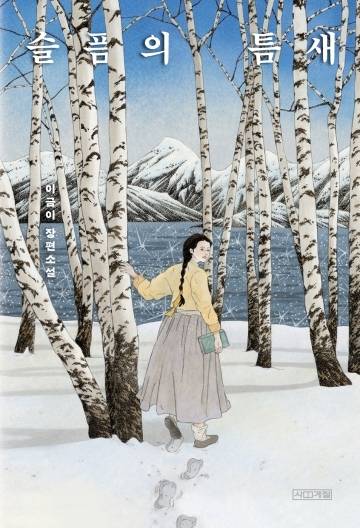
Her latest novel, “The Gap of Sorrow,” is set on Sakhalin Island in the 1940s. Its protagonist, Dan-ok, follows her father, who has been conscripted to work in the coal mines. When he is seized again under a second round of forced mobilization, Dan-ok must forge a life in a community that would remain stranded there for decades, unable to return home even after Korea’s liberation in 1945.
“Their lives were marked by unimaginable hardship,” Lee said. “But I wanted to show not only their sorrow. Even in the cracks of that sorrow, they found dignity, joy and hope. That’s why I chose the title ‘The Gap of Sorrow’ — to speak of respect and consolation, not pity.”
With the trilogy now complete, Lee is preparing a new project: a novel about a Korean adoptee raised in Sweden.
“Can’t I Go Instead” (2016) and “The Picture Bride” (2020) are available in English, translated by An Seon-jae.
Copyright © 코리아헤럴드. 무단전재 및 재배포 금지.