Incheon marks 75th anniversary of pivotal Korean War battle
전체 맥락을 이해하기 위해서는 본문 보기를 권장합니다.
In the words of U.S. Navy Commander Arlie G. Capps, Incheon presented "every natural and geographic handicap."
"The Incheon landing is a feat of military genius that saved this country and ensured its prosperity," said Lee. "We should take pride in this history."
이 글자크기로 변경됩니다.
(예시) 가장 빠른 뉴스가 있고 다양한 정보, 쌍방향 소통이 숨쉬는 다음뉴스를 만나보세요. 다음뉴스는 국내외 주요이슈와 실시간 속보, 문화생활 및 다양한 분야의 뉴스를 입체적으로 전달하고 있습니다.
![Incheon Mayor Yoo Jeong-bok, third from left, and Navy Deputy Chief of Staff for Personnel Park Tae-kyun, center, take part in a wreath laying ceremony to honor soldiers killed carrying out Operation Chromite in Incheon on Sept. 12. [INCHEON METROPOLITAN GOVERNMENT]](https://img2.daumcdn.net/thumb/R658x0.q70/?fname=https://t1.daumcdn.net/news/202509/15/koreajoongangdaily/20250915070304716kham.jpg)
Historians often speak of battles that changed the course of a war, but rarely has one fit that description as completely as the Incheon landing of Sept. 15, 1950.
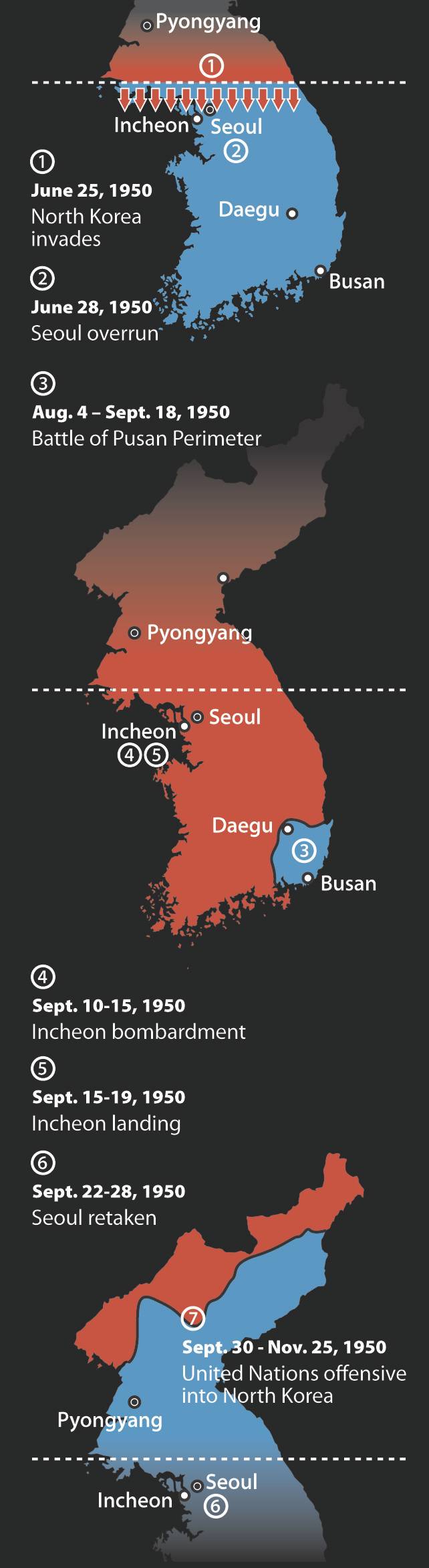
Code-named Operation Chromite, the amphibious landing unfolded four months into the 1950–53 Korean War, when invading North Korean troops held most of the peninsula except for the southeastern pocket within the Pusan Perimeter, which was being defended by the United Nations Command (UNC).
Against this bleak backdrop, Gen. Douglas MacArthur proposed what many regarded as a near-suicidal plan: landing 75,000 South Korean, U.S. and other allied troops via 261 ships on the shores of Incheon to cut off the invaders' supply lines.
The improbable success of MacArthur's plan is celebrated annually by the Incheon Metropolitan Government, which has organized a week of commemorations to mark the 75th anniversary of the operation on Monday.
Against all odds
The logistical hurdles to landing a large-scale offensive force deep in enemy-held territory were staggering.
According to Lee Sang-ho, a research fellow at the South Korean Defense Ministry's Institute of Military History, the tidal range at Incheon is the second most extreme in the world.
Tides at Incheon rose and fell by an average of 30 feet, narrowing suitable approaches to just two passages. Ships that strayed from these routes ran the risk of running aground on the shallow mudflats that surrounded the port or colliding with underwater seamounts.
Lee noted that there were only two days in September when the waters would be deep enough for large landing craft to approach the shores of Wolmi Island in the city's east, where U.S. strategists planned to establish the first beachhead.
To these natural hurdles, the North Koreans added their own. Soviet-made naval mines were sown across the waterways, while seawalls — towering nearly 20 feet — lined the harbor and stretched to Wolmi Island.
In the words of U.S. Navy Commander Arlie G. Capps, Incheon presented "every natural and geographic handicap."
Some military planners calculated the odds of success at less than one in 5,000, said Kim Yong-ho, a professor of politics and diplomacy at Yonsei University.
Yet MacArthur's gamble worked. Over four days, allied forces seized Incheon and broke out of the Pusan Perimeter, driving North Korean troops into retreat and liberating Seoul within weeks.
Festivities to relive history
Seventy-five years on, Incheon is better known for its airport, shipping facilities and skyline of new high-rise towers than for the tidal flats that once defined its wartime geography. But each September, the city turns its attention back to its past, organizing commemorations that honor the troops who came ashore in 1950 and the residents whose lives were changed by the battle.
The first commemorations took place on Tuesday at Yeongheung Island, where a ceremony was held to honor 14 special operations officers who had laid the groundwork for Operation Chromite.
On Friday — the first official day of the Incheon government's commemorative week to mark the 75th anniversary of Operation Chromite's success — the first of five performances of a musical based on the Incheon landing held its opening night at the Bupyeong Arts Center, bringing the drama of Operation Chromite to life on the stage.
![Children pose for photos with soldiers on an armed vehicle in an event to commemorate the 75th anniversary of Operation Chromite in Jung District, Incheon, on Sept. 14. [YONHAP]](https://img2.daumcdn.net/thumb/R658x0.q70/?fname=https://t1.daumcdn.net/news/202509/15/koreajoongangdaily/20250915070307627abpt.jpg)
The following day, Arts Center Incheon hosted a Cantata of Peace concert by the Little Singers of Paris, a boys' choir recognized for its repertoire of Gregorian and Palestrinian music.
The French choir was the first of 35 local and foreign choirs to perform songs with the theme of world peace in Incheon from Tuesday of last week through Friday of this week.
Historian and broadcaster Choi Tae-seong also gave a lecture on Operation Chromite at the Incheon Global Campus in Songdo, home to several international university branches, on Saturday, with a second lecture scheduled for Tuesday.
The most visible public commemoration took place on Sunday, when the city, together with the Korean Navy and Marine Corps, staged a downtown parade that started at the south plaza of Dongincheon Station.
From there, an estimated 2,000 participants — including Korean War veterans, invited dignitaries and residents — marched about a mile to the Jung District Office alongside flagbearers from the South Korean Defense Ministry, Navy, Marine Corps, the 17th Infantry Division and the U.S. Eighth Army Band.
The march concluded with a reenactment of the October 1950 ceremony in which UN forces formally declared they had recaptured Incheon from North Korean troops.
![Flagbearers from the Defense Ministry, Navy, Marine Corps and the Army's 17th Infantry Division march in a parade from the south plaza of Dongincheon Station to the Jung District Office in Incheon on Sept. 14. [YONHAP]](https://img3.daumcdn.net/thumb/R658x0.q70/?fname=https://t1.daumcdn.net/news/202509/15/koreajoongangdaily/20250915070309128fzxu.jpg)
That same day, approximately 200 international students studying at universities in the city participated in the UN Incheon Peace Camp.
The students, who came from the 22 countries that contributed troops to South Korea during the Korean War, took part in a cultural exchange program that included trying on hanbok, or traditional Korean dress, K-pop dance lessons and visiting a street fair near the Jung District Office.
Honoring veterans and the dead
With the conclusion of the weekend's festivities, the city is set to mark the 75th anniversary of Operation Chromite on Monday with a series of solemn commemorations to honor veterans and those who lost their lives to ensure the landing's success.
In the presence of around 100 veterans and representatives of UNC member states, officials from the Incheon Metropolitan Government and the South Korean military will lay wreaths at three sites: the statue of Gen. MacArthur at Freedom Park, a memorial to Wolmi Island residents who were killed during Operation Chromite and a monument dedicated to members of the South Korean Naval Intelligence Unit who died in action.
The commemorations will continue with the unveiling of a new sculpture in Wolmi Park, located on the beach where the first UN forces came ashore in September 1950. Shaped like a drop of water, the sculpture is dedicated to veterans of the Incheon landing and to those who lost their lives during the campaign.
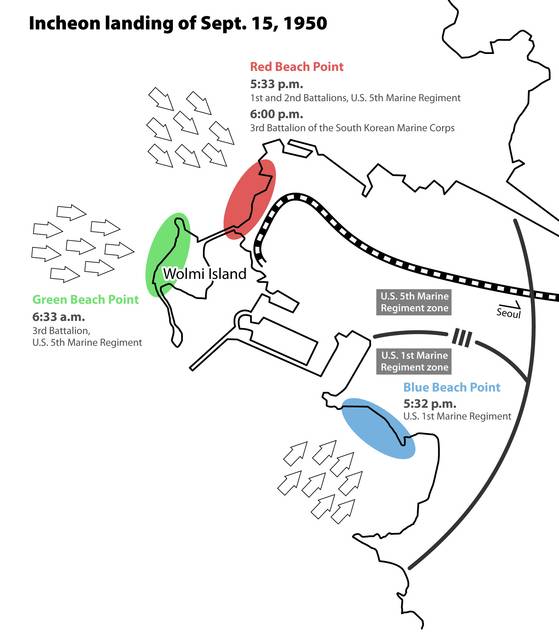
Later in the afternoon, the South Korean Navy will salute Incheon's central place in the Korean War with landing ships and amphibious assault vehicles that will reenact the fateful landing in waters off the city's inner harbor. The demonstration is expected to draw an audience of about 1,500, including veterans and residents.
Monday also marks the opening day of the International Peace and Security Forum, organized by the Incheon Institute and the Caen Memorial Museum in France.
The forum, which features nine speaker sessions and approximately 100 panelists through Tuesday, will highlight Incheon's global role as an International City of Peace and host discussions about regional peace and security, according to organizers.
The conference represents the city government's commitment to preserving the memory of Operation Chromite for future generations.
"The Incheon landing is a feat of military genius that saved this country and ensured its prosperity," said Lee. "We should take pride in this history."
BY MICHAEL LEE [lee.junhyuk@joongang.co.kr]
Copyright © 코리아중앙데일리. 무단전재 및 재배포 금지.
- Trade talks with U.S. could get ugly as experts warn against taking Trump's raw deal
- Rooney, Maicon, Park Joo-ho score as Shield United wins Icons Match in Seoul — as it happened
- Progressive, conservative groups hold rallies in Seoul over U.S., Korean gov't actions
- Voice actor mocks 'Bon Appétite, Your Majesty' star Jo Jae-yoon for poor Chinese pronunciation
- Accept the deal or face tariffs, Lutnick says as trade talks remains in deadlock
- Super Junior's Choi Si-won deletes tribute to Charlie Kirk from Instagram
- U.S. politician who reported the LG-Hyundai plant to ICE faces online backlash
- U.S. trade negotiations hit impasse as Seoul bristles at outsized investment scheme
- Marine sergeant's death raises alarms about military mental health services
- Football legends arrive in Korea for Icons Match