Why is Korean bread the most expensive in Asia?
전체 맥락을 이해하기 위해서는 본문 보기를 권장합니다.
"I started with a profit margin of 15 to 18 percent. I've managed to maintain that margin, but only at a high cost — constantly developing new types of bread, each of which typically takes about a month to create — because I can't just raise the prices of my existing products overnight."
"I once stood in line for around 20 minutes just to get my hands on doughnuts from Old Ferry Donut in Yongsan [District, central Seoul], back before it turned into the common franchise it is today," said Yoo Hee-ju, a 32-year-old office worker based in Incheon. "Sure, the price tag was steep — currently up to 6,500 won for a single doughnut — but I didn't care. It wasn't an everyday treat. It was something special."
이 글자크기로 변경됩니다.
(예시) 가장 빠른 뉴스가 있고 다양한 정보, 쌍방향 소통이 숨쉬는 다음뉴스를 만나보세요. 다음뉴스는 국내외 주요이슈와 실시간 속보, 문화생활 및 다양한 분야의 뉴스를 입체적으로 전달하고 있습니다.
![[GETTY IMAGE]](https://img3.daumcdn.net/thumb/R658x0.q70/?fname=https://t1.daumcdn.net/news/202509/11/koreajoongangdaily/20250911183318765jeaz.jpg)
At Whitelier, a high-end bakery franchise, a loaf of sliced bread is priced at a hefty 11,000 won ($8), with the softer “Fleur” variety climbing to 13,000 won.
The same type of bread is more affordable at Paris Baguette, the largest bakery franchise in Korea, which sells it for roughly 4,000 won. But still, the product is costlier than a roll of gimbap (seaweed rice rolls), which averages 3,600 won per meal in Seoul.
"The price is ridiculous sometimes, especially for industrial ones that use cheap flour," said 42-year-old Olivier, a French chef who has been living in Korea for 15 years. Such breads are sold at both supermarkets and bakeries, he says.
“In France, everything would cost at least half the price for breads that taste better, are cheaper and are higher in quality,” he added.
The rising price of bread drew public attention in August when popular YouTuber Syuka opened a pop-up store that sold bread for nearly a third of the price bakeries typically charge.
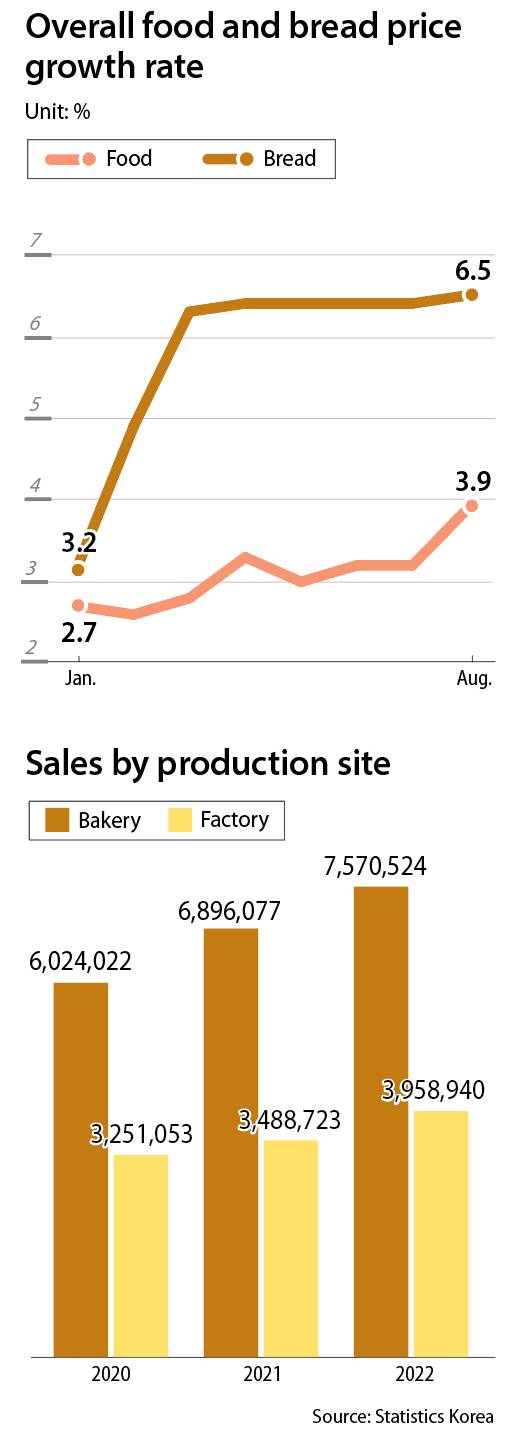
Bread prices have been rising by over 6 percent for the past six consecutive months, far outpacing the headline inflation that has hovered around 2 percent. The trend has grown evident along with Koreans’ increasing bread consumption, which grew 17.6 percent to 21.4 grams (0.75 ounce) per individual in 2022 compared to 2012.
According to Numbeo, an online database, Korea has the highest prices for a loaf of fresh white bread among all Asian countries, averaging $2.99. Globally, it ranked 10th.
Both financial and psychological factors are driving up bread prices in Korea — from the rising cost of basic ingredients to expansion of premium bakery market on younger generation’s low resistance to price hikes at popular bakeries.
![Breads are displayed in a supermarket in Seoul on Feb. 13. [YONHAP]](https://img4.daumcdn.net/thumb/R658x0.q70/?fname=https://t1.daumcdn.net/news/202509/11/koreajoongangdaily/20250911183320291vjim.jpg)
Essentials get expensive Bread ingredients typically include flour, sugar, eggs, butter and milk.
While the price of flour has stabilized since its 2022 peak — when it surged 45.5 percent due to Russia's war against Ukraine — other ingredients have continued to rise.
The average consumer price of a carton of 30 eggs jumped 10 percent in September compared to the same month the previous year, due to an extreme heat wave that killed many chickens. According to Ministry of Interior and Safety, some 1.7 million poultry died from May 20 through Sept. 2nd.
Dairy prices also climbed. The three largest dairy providers — Seoulmilk, Maeil Dairies and Namyang Dairy Products — raised their product prices by an average of between 7.5 and almost 9 percent in the first half of this year, citing rising raw material prices and a weak won.
Some say market distortion is to blame for the inflation of sugar, another key ingredient for bread and pastries.
The Fair Trade Commission (FTC) classified the refined sugar industry as both a monopoly and an oligopoly in 2021, a status the sector has received in five consecutive terms since 2011. CJ CheilJedang, Samyang Corporation and TS Corporation account for more than 90 percent of the sugar manufacturing market share.
Their competition against overseas brands is also limited as the government imposes a 30 percent tariff on refined sugar compared to a 3 percent tariff on raw sugar, which the market leaders import and refine domestically.
The combined impact of these factors has pushed bread prices up, especially hurting small bakery businesses.
“Since I started the business five years ago, everything — from ingredients to rent and labor — has nearly doubled,” said Chef Jang, who runs a small bakery in Gangnam District, southern Seoul.
“I started with a profit margin of 15 to 18 percent. I've managed to maintain that margin, but only at a high cost — constantly developing new types of bread, each of which typically takes about a month to create — because I can’t just raise the prices of my existing products overnight.”
![Customers line up buy bagels in London Bagel Museum in Jamsil, southern Seoul. [LOTTE DEPARTMENT STORE]](https://img2.daumcdn.net/thumb/R658x0.q70/?fname=https://t1.daumcdn.net/news/202509/11/koreajoongangdaily/20250911183321902csjf.jpg)
Style meets dough Over the past years, certain breads and pastries that have trended — often targeting the premium market — have also contributed to rising prices, experts say.
In the past decade, pastries like Schneeballen (a crispy German pastry ball), Taiwanese castella cake, sweet red bean butter bread, croffles (croissant-waffle hybrids), chunky macarons and salt bread have all captured public attention — often thanks to their rich fillings and Instagram worthy appearances.
Most recently, bagels have been booming in popularity, with the London Bagel Museum in the lead. A flavored bagel at the store costs up to 5,500 won, while a bagel sandwich with bacon, jam and mashed potatoes costs as much as 14,800 won.
Yet fans don’t mind waiting hours for a taste. On the opening day of the London Bagel Museum’s Jamsil branch in southern Seoul in 2023, a sign read, "Expected wait time from this point: approximately five hours.”
This culture of queuing for trendy pastries isn’t new, especially among younger consumers, but the featured items change with the times.
“I once stood in line for around 20 minutes just to get my hands on doughnuts from Old Ferry Donut in Yongsan [District, central Seoul], back before it turned into the common franchise it is today,” said Yoo Hee-ju, a 32-year-old office worker based in Incheon. “Sure, the price tag was steep — currently up to 6,500 won for a single doughnut — but I didn’t care. It wasn’t an everyday treat. It was something special.”
The demand for premium bread is reflected in spending patterns.
In 2022, sales at bakery specialty stores totaled 7.57 trillion won, up 26 percent from 2020, while mass-produced bread generated 3.96 trillion won, up 22 percent and representing just 34.3 percent of total bread sales, according to a report that Kongju National University’s Industry-Academic Cooperation Foundation compiled for the FTC.
“Consumers’ strong willingness to boldly spend on premium bread and pastries is making them increasingly insensitive to price, driving growth in the high-end market,” said Suh Yong-gu, a business professor at Sookmyung Women’s University. “This spending pattern reflects a broader shift in the food and beverage industry, which is beginning to mirror the fashion world, where certain venues become essential destinations.”
BY JIN MIN-JI [jin.minji@joongang.co.kr]
Copyright © 코리아중앙데일리. 무단전재 및 재배포 금지.
- U.S. politician who reported the LG-Hyundai plant to ICE faces online backlash
- Flight returning detained workers to Korea being held up, Foreign Ministry says
- Trump reportedly halts Koreans' repatriation to suggest they could help train U.S. workforce
- Want the sold-out 'KPop Demon Hunters' noodles? Another batch is coming — here's how to get it.
- Convicted for biting off tongue of attempted rapist, Choi Mal-ja is acquitted 60 years after
- Georgia raid costs Korean firms millions as work grounds to a halt
- '3,000 people a day': Quotas set by Trump's 'immigration mastermind' may be behind Georgia ICE raid
- Hyundai will become first Korean department store to launch pop-up in Taiwan
- Flight to repatriate Koreans detained in Georgia plant raid unexpectedly delayed
- Dam closed 24 years ago due to poor water quality could be used to aid drought-stricken Gangneung