Warsaw's 'Polonization' is powered with partners in Korea
전체 맥락을 이해하기 위해서는 본문 보기를 권장합니다.
But Kielce this year was not just about imports. It was about localization and partnership, as Polish officials describe with two words: "Polonization" and "Europeanization."
"This is an extraordinary moment — Poland is gaining further capabilities to produce military equipment," Kosiniak-Kamysz said. "Not only do we import goods from abroad, but thanks to these contracts, we also bring production into the country. We will develop very strongly in Polish private companies."
이 글자크기로 변경됩니다.
(예시) 가장 빠른 뉴스가 있고 다양한 정보, 쌍방향 소통이 숨쉬는 다음뉴스를 만나보세요. 다음뉴스는 국내외 주요이슈와 실시간 속보, 문화생활 및 다양한 분야의 뉴스를 입체적으로 전달하고 있습니다.
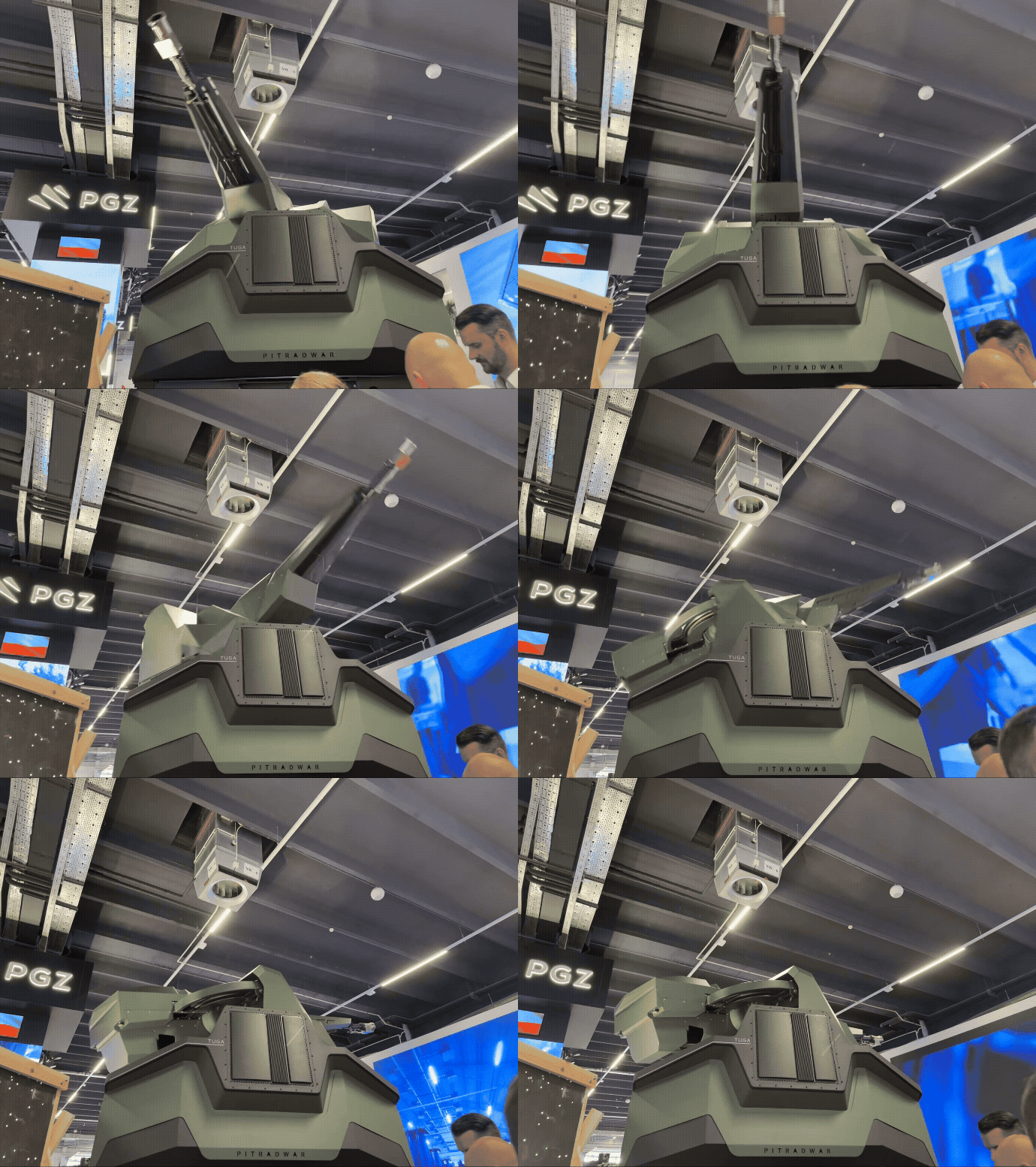
KIELCE, Poland — The quiet provincial city of Kielce became, for one week, the beating heart of Europe’s defense industry, with a mix of Polish national pride and a spotlight on Korea as an emerging top-tier supplier.
The 33rd International Defence Industry Exhibition (MSPO) unfolded from last Tuesday to Friday, attracting more than 811 companies from 35 countries.
The Korea JoongAng Daily queued for nearly two hours with industry insiders and foreign delegations to catch a glimpse of armored vehicles towering over spectators, rocket launchers jutting skyward and crowds clustered around interactive displays on radar, drone and communications gear. Outside, soldiers and contractors put systems through live demonstrations, reminding visitors that the MSPO is more than a showroom and a field-oriented fair.
This year, the spotlight fell squarely on Korea, already Poland’s largest weapons supplier through record-breaking contracts covering K2 tanks, K9 self-propelled howitzers, FA-50 fighters and Chunmoo rocket launchers.
But Kielce this year was not just about imports. It was about localization and partnership, as Polish officials describe with two words: “Polonization” and “Europeanization.”
![Long lines form outside the Targi Kielce exhibition hall on the opening day of MSPO 2025 in Kielce, Poland, on Sept. 2 [SEO JI-EUN]](https://img4.daumcdn.net/thumb/R658x0.q70/?fname=https://t1.daumcdn.net/news/202509/08/koreajoongangdaily/20250908120216620rthy.jpg)
From buyer-seller to joint production
In a ceremony that attracted much buzz at the expo, Hanwha Aerospace and Poland’s leading private defense company, WB Group, signed a joint venture agreement to produce guided rockets for the Homar-K multiple launch rocket system in Poland.
Defense Minister and Deputy Prime Minister Władysław Kosiniak-Kamysz, who attended the signing, called it a milestone.
“This is an extraordinary moment — Poland is gaining further capabilities to produce military equipment," Kosiniak-Kamysz said. "Not only do we import goods from abroad, but thanks to these contracts, we also bring production into the country. We will develop very strongly in Polish private companies.”
“The agreement signed today allows us to move from a simple purchase to a partnership — we analyze, make decisions and develop technology together," Deputy Defense Minister Cho Hyun-ki, who attended the event as the representative of the Korean government, said.
![From left, Hanwha Aerospace CEO Son Jae-il, Polish Deputy Prime Minister and Minister of National Defence Władysław Marcin Kosiniak-Kamysz and WB Group Chairman Piotr Wojciechowski attend the signing of an agreement to establish a Polish-Korean special purpose vehicle to produce ammunition for HOMAR-K launchers and develop new missiles, during MSPO 2025 in Kielce, Poland, on Sept. 2. [HANWHA AEROSPACE]](https://img1.daumcdn.net/thumb/R658x0.q70/?fname=https://t1.daumcdn.net/news/202509/08/koreajoongangdaily/20250908120217022lldu.jpg)
The new company will begin by producing CGR-080 guided rockets with an 80-kilometer (50-mile) range, but its mandate is broader: Over time, it aims to design new missiles in Poland, using Polish engineers and supply chains.
“With Korea, we took the first historic steps — founding a joint venture and moving into co-production of guided munitions," said WB Group Communication Director Remigiusz Wilk.
![WB Group Communication Director Remigiusz Wilk speaks with a delegation of Korean reporters at the WB Group booth during MSPO 2025 in Kielce, Poland, on Sept. 2. [SEO JI-EUN]](https://img4.daumcdn.net/thumb/R658x0.q70/?fname=https://t1.daumcdn.net/news/202509/08/koreajoongangdaily/20250908120218556rmbz.jpg)
He added that integration was already deep: While certain electronics remain Korean, WB’s Topaz fire-control system and Fonet communications fully connect Homar-K launchers in NATO-standard networks.
“Think of it as Korean technology wrapped in a Polish systems ‘shell,’ fully integrated with our C4ISR and NATO network,” Wilk said.
The WB executive representative said this is "just the beginning" of the cooperation, outlining contingency plans in which Polish and Korean factories back each other in wartime — Polish plants producing ammunition for Korea if conflict breaks out in Asia, and vice versa.
“So the possibilities for cooperation are really, really huge," added Wilk.
![Visitors take photos of Hyundai Rotem’s K2 tank on display at MSPO 2025 in Kielce, Poland, on Sept. 2. [SEO JI-EUN]](https://img2.daumcdn.net/thumb/R658x0.q70/?fname=https://t1.daumcdn.net/news/202509/08/koreajoongangdaily/20250908120220056hkyg.jpg)
Korean hardware in Polish service
The Korea Pavilion was one of the busiest corners of the MSPO for visitors, media and military delegations, featuring major players like Hyundai Rotem, Korea Aerospace Industries (KAI) and Hanwha affiliates all present.
Hyundai Rotem displayed a K2 Black Panther tank already in service in Poland. By the end of 2025, all 180 of the first batch ordered will be delivered, with 133 already delivered.
Seo Jun-mo, senior vice president of Hyundai Rotem, noted that the K2 had impressed during multinational exercises like Dragon 2023 in Poland and Anakonda 2024 in Sweden, performing reliably in mud, snow and extreme cold.
Rotem's resident 50-person support team keeps Poland's K2s running at near 100 percent readiness — a point Seo emphasized as crucial to Warsaw's satisfaction. On that foundation, a contract in July launched domestic production of K2PLs from 2026 under PGZ, Warsaw's state defense corporation, with joint production with Slovakia also under discussion.
"Europe has a demand for the replacement of over 1,000 aging tanks," Seo added. "If Poland’s K2PL program succeeds, it will open the door to further European exports.”
He dismissed recent rumors of financing troubles in Korea–Poland arms cooperation as “groundless,” noting that credit arrangements by the state banks were progressing smoothly.
“This is a massive project, so there are bound to be external attempts to sow doubt,” he emphasized.
![Polish Deputy Prime Minister and Minister of National Defence Władysław Kosiniak-Kamysz, left, listens as KAI Senior Executive Vice President Cha Jae-byoung, third from left, explains systems at the KAI booth during MSPO 2025 in Kielce, Poland, on Sept. 3. [KAI]](https://img4.daumcdn.net/thumb/R658x0.q70/?fname=https://t1.daumcdn.net/news/202509/08/koreajoongangdaily/20250908120221528uyjv.jpg)
At the KAI booth, a model of the FA-50 light combat aircraft stood on display.
After donating its Soviet-era MiG-29 and Su-22 fighters to Ukraine, Poland urgently filled its gap with FA-50s. Twelve have already been delivered, with more arriving through 2028.
“When Polish forces actually operated the FA-50, they evaluated its maneuverability and avionics as comparable to their existing F-16s," said Cho Woo-rae, KAI executive vice president.
The Block 20, an upgraded version of the FA-50 for Poland, had been advanced from “light attack” to “light fighter” and would become “a core asset for Eastern European air defense," Cho said.
Polish interest now extends to the KAI’s KF-21 next-generation fighter. Ahead of the MSPO, the Polish air force chief of staff test-sat a KF-21 prototype in Korea and a Polish delegation toured the KAI’s Sacheon factory.
Warsaw’s new fighter program in the late 2020s could see the KF-21 become a contender.
“The KF-21 will be actively discussed soon," Cho said. "For now, we are engaging in early marketing to raise awareness [among potential customers like Poland.]"
![Hanwha Systems, together with Hanwha Aerospace and Hanwha Ocean, participates in MSPO 2025, Eastern Europe’s largest defense exhibition, in Kielce, Poland, on Sept. 3. [HANWHA SYSTEMS]](https://img4.daumcdn.net/thumb/R658x0.q70/?fname=https://t1.daumcdn.net/news/202509/08/koreajoongangdaily/20250908120222998tlbg.jpg)
Dark horse in Poland’s submarine program
Another Korean company worked more quietly at the MSPO: Hanwha Ocean, competing in Poland’s $6 billion Orka submarine project — expected to be decided later this year — to replace four outdated vessels with three new ones. Germany’s Thyssenkrupp Marine Systems' 212CD class and the Korean firm's KSS-III Batch-II are the main contenders.
Hanwha Ocean used the MSPO to highlight the KSS-III’s advantages and an unusually bold offer.
“We worry that Poland might face political pressure to choose a European submarine due to the European Union’s decision-making environment, making cooperation with EU suppliers almost unavoidable," said Senior Executive Vice President of Naval Ship Global Business Department Steve SK Jeong.
Hanwha Ocean pitched its KSS-III Batch-II as the world’s first conventional submarine equipped with submarine-launched ballistic missiles, albeit non-nuclear. The KSS-III is also a larger 3,000-ton platform than the German 2,500-ton 212CD, offering more upgrade margins and better crew habitability for long deployments, according to Jeong.
Jeong stressed the importance of "strong deterrence" for countries like Poland, which is surrounded by great powers.
"We emphasize our submarine’s multi-domain capabilities [...] it’s not just for undersea warfare, it can support land operations as a conventional deterrent," the executive said.
He also promised fast and accurate delivery, with the first unit scheduled to be delivered in six years at the earliest.
Jeong presented Hanwha Ocean’s pledge of a "maritime development fund" worth about $100 million for Poland.
This package includes modernizing local shipyards, transferring submarine maintenance, repair and operations skills and creating a domestic supply chain — calling it "Make Polish Shipbuilding Great Again" in a play on Korea's initiative in the United States.
“No competitor has ever made such an offer," Jeong said.
Hanwha Ocean also proposed a stopgap transfer of a retired Korean Navy 209-class submarine to Poland as an interim asset during the six-year wait for new subs.
"Abroad, 209-class submarines are operated for 30 to 40 years," Jeong said. "We can refurbish one we have already used and provide it to Poland as a gap-filler. If we receive cooperation from the Defense Ministry, we could deliver it to Poland around 2028."
![Arkadiusz Tarnowski, deputy director at the Polish Investment and Trade Agency (PAIH), left, and Piotr Placha, key expert for the export goods sector at PAIH, speak during MSPO 2025 in Kielce, Poland. [SEO JI-EUN]](https://img4.daumcdn.net/thumb/R658x0.q70/?fname=https://t1.daumcdn.net/news/202509/08/koreajoongangdaily/20250908120224456zcsx.jpg)
Partnership made through 'Polonization'
Like Hanwha Ocean's submarine pitch, what distinguishes the Poland–Korea story is a philosophy that goes beyond simple procurement.
According to Arkadiusz Tarnowski, deputy director at the Polish Investment and Trade Agency (PAIH), Warsaw sought not just a supplier but a true partner ready to co-develop and localize.
“That was the openness, and that’s what I believe stands for a strong partnership," Tarnowski said.
"It’s not that I’m just buying from you, but we are partners," he continued. "You bring something, I bring something, and then we have a joint [research and development] facility and look at what we can make out of your product combined with our ideas. I would say that’s one of the strongest advantages of Korean technology and partnership with Korea."
The openness contrasts with other suppliers, such as Japan and Israel, according to PAIH officials, which have "very strict rules" on exporting defense technologies.
“In the future, not only 'Polonization' can be taken into account but 'Europization,'" Piotre Placha, key expert for the security and dual-use goods sector at PAIH, added. "That’s why Poland’s idea is to build itself as a hub for the Europeanization of Korean tanks, for example — not only dedicated to the Polish market but also adapted for the specificity of the European theater.”
BY SEO JI-EUN [seo.jieun1@joongang.co.kr]
Copyright © 코리아중앙데일리. 무단전재 및 재배포 금지.
- U.S. politician who reported the LG-Hyundai plant to ICE faces online backlash
- Tensions rise as North Korea continues sending water into South from border dam
- Trump to 'look into' ICE raid as 300 detained Korean workers expected to return home
- Georgia facility where Koreans are detained has history of health and safety violations
- Korean community in U.S. angry, on edge after Georgia ICE raid
- Seoul's night sky glows with 'KPop Demon Hunters' drone magic — in pictures
- Faster to fire: Hanwha’s K9 takes aim at U.S. Army's artillery modernization
- Seoul's slow response to detained Koreans in Georgia exposes diplomatic cracks
- Applications for 2026 Global Korea Scholarship opening soon for international students
- Trump hints that U.S. needs more foreign battery workers: 'Let some people come'