2-year inflation record averted with 1.7%, but food prices keep rising
전체 맥락을 이해하기 위해서는 본문 보기를 권장합니다.
"Consumer price growth will likely rebound to around 2 percent in September, once the one-off drop in telecom fees is removed," said Kim Woong, BOK deputy governor, during a price trend review on Tuesday. "Inflation is expected to hover around 2 percent for the time being."
Prices for agricultural, livestock and fisheries products rose 4.8 percent on year in August, driven by a heat-induced surge in fresh food prices — a phenomenon dubbed "heatflation."
이 글자크기로 변경됩니다.
(예시) 가장 빠른 뉴스가 있고 다양한 정보, 쌍방향 소통이 숨쉬는 다음뉴스를 만나보세요. 다음뉴스는 국내외 주요이슈와 실시간 속보, 문화생활 및 다양한 분야의 뉴스를 입체적으로 전달하고 있습니다.
![Shoppers browse for groceries at a traditional market in Seoul on Sept. 2. [NEWS1]](https://img2.daumcdn.net/thumb/R658x0.q70/?fname=https://t1.daumcdn.net/news/202509/02/koreajoongangdaily/20250902175715594afhq.jpg)
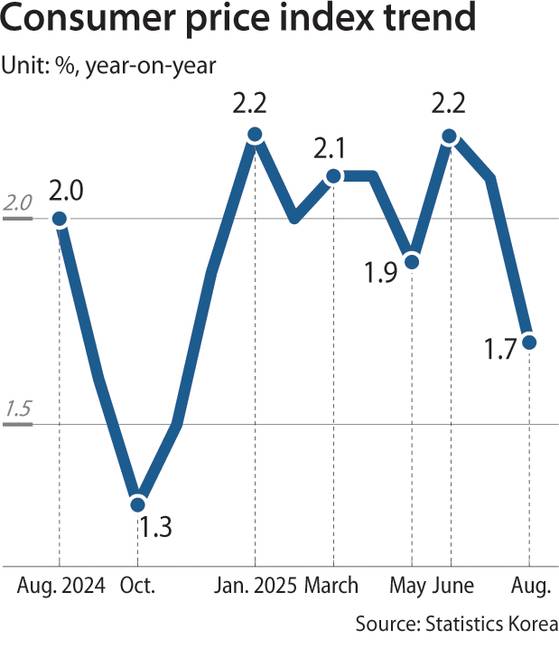
Korea’s consumer prices rose 1.7 percent on year in August, the slowest increase in nine months, with a temporary cut in mobile phone charges staving off an inverse outcome of the biggest jump in over two years as food prices continued to soar.
The 1.7 percent rise in the consumer price index marked a 0.4 percentage point slowdown from July’s 2.1 percent, according to Statistics Korea on Tuesday. The last time inflation was this low was in November 2023, when it stood at 1.5 percent.
Without a discount scheme by SK Telecom, the inflation rate would have stood at around 2.3 percent, according to the statistics agency. That would have been the biggest jump since July 2023, when it reached 2.6 percent.
The mobile carrier halved the monthly bills for every single one of its more than 20 million subscribers during August as a one-time measure to compensate for a hacking incident earlier this year. Telecommunications prices fell 13.3 percent on year, dragging down the overall inflation rate by 0.59 percentage points.
Despite the slowdown, the Bank of Korea (BOK) warned that the decline was temporary.
“Consumer price growth will likely rebound to around 2 percent in September, once the one-off drop in telecom fees is removed,” said Kim Woong, BOK deputy governor, during a price trend review on Tuesday. “Inflation is expected to hover around 2 percent for the time being.”
Excluding the telecom discount, inflationary pressures remained visible, especially in food prices.
Prices for agricultural, livestock and fisheries products rose 4.8 percent on year in August, driven by a heat-induced surge in fresh food prices — a phenomenon dubbed “heatflation.”
![A shopper selects vegetables at a traditional market in Seoul on Sept. 2. [NEWS1]](https://img3.daumcdn.net/thumb/R658x0.q70/?fname=https://t1.daumcdn.net/news/202509/02/koreajoongangdaily/20250902175717128xefz.jpg)
That marked the steepest climb since July of last year, when it hit 5.5 percent. Prices rose across the board, with agricultural products gaining 2.7 percent, livestock 7.1 percent and fisheries 7.5 percent.
Mackerel saw the largest on-year jump at 13.6 percent, followed by rice at 11 percent, pork at 9.4 percent, Korean beef at 6.6 percent and eggs at 8 percent.
Livestock prices rose as reduced slaughter volumes limited supply, while demand increased due to the summer holiday season and the government’s consumption coupon programs, according to Statistics Korea.
Korean beef saw its sharpest price rise since January 2022, while Korean pork recorded its biggest increase since July 2022.
Fish prices surged due to reduced catches caused by high sea temperatures. The price of mackerel, meanwhile, rose despite a bigger overall haul as consumers favored larger fish, which became harder to find.
The heat wave also took a toll on fresh produce.
The fresh food index — which tracks items most affected by seasonal and weather factors — rose 2.1 percent on year and 7.8 on month in August. Fresh vegetable prices rose 19.3 percent compared to July, marking the biggest month-on-month increase in five years since August 2020, when the rate reached 24.4 percent.
Paprika jumped 52.1 percent, napa cabbage 51.6 percent, spinach 50.7 percent and tomatoes 35.9 percent, compared to July.
Processed food prices also saw persistent inflation, rising 4.2 percent on year in August after increasing by more than 4 percent every month since April. The processed food price index hit an all-time high of 124.82.
![Shoppers browse for groceries at a large supermarket in Seoul on Sept. 1. [NEWS1]](https://img1.daumcdn.net/thumb/R658x0.q70/?fname=https://t1.daumcdn.net/news/202509/02/koreajoongangdaily/20250902175718638wtjd.jpg)
Bread rose 6.4 percent, coffee 14.6 percent, kimchi 15.5 percent and ham and bacon 11.3 percent, making them some of the processed foods with the most notable price increases.
“A number of discounts ended for some items, pushing prices higher than in July, when the increase was 4.1 percent,” a Statistics Korea official said.
With the Chuseok harvest holidays approaching in October, the government has stepped up efforts to curb food price inflation.
First Vice Minister of Economy and Finance Lee Hyoung-il presided over a meeting with vice ministers to review countermeasures. The government plans to release additional reserves of napa cabbage and coordinate with retailers to offer discounts on items with high holiday demand.
“Mobilize every available tool — from reserve supplies to discount support — to ensure price stability for food items,” Lee said during the meeting.
The government will announce a broader economic relief package, including measures to stabilize prices for essential holiday goods, later in September.
This article was originally written in Korean and translated by a bilingual reporter with the help of generative AI tools. It was then edited by a native English-speaking editor. All AI-assisted translations are reviewed and refined by our newsroom. BY AHN HYO-SEONG,PARK YU-MI [paik.jihwan@joongang.co.kr]
Copyright © 코리아중앙데일리. 무단전재 및 재배포 금지.
- Man charged with raping niece over several years files appeal with top court
- Woman arrested on suspicion of attempting to break into Jungkook's house
- Record-high 2,500 officers, NCOs apply for early discharge as complaints grow about work conditions, burnout
- Exports to U.S. tumble by double digits as Trump tariffs catch up
- North Korean troops choosing suicide over capture by Ukraine, boasts Pyongyang's state media
- HYBE confirms that BTS's Jimin dated actor Song Da-eun 'many years ago'
- 10 Air Force personnel disciplined after entering Japan unauthorized
- Tattoo artists near end of fight for legitimacy in Korea
- Military officer found dead near Suseong Lake in Daegu
- New Tottenham Hotspur No. 7 named: 'It is a big responsibility'