Atlas 2 vs. Optimus: Hyundai, Tesla battle for humanoid edge
전체 맥락을 이해하기 위해서는 본문 보기를 권장합니다.
"In contrast, the LBM approach not only governs decision-making but controls physical robot behaviors by modeling and training large-scale representations of physical actions, which are then integrated to execute complex tasks efficiently."
Han Jae-kweon, a robotics professor at Hanyang University, offered a more conservative view: "Hyundai Motor (Boston Dynamics) has only just leveled the playing field with Tesla, after previously trailing behind the EV maker. Since there are no standardized benchmarks or evaluation criteria, it is still difficult to say whether the Atlas 2 has the upper hand over Optimus or vice versa."
이 글자크기로 변경됩니다.
(예시) 가장 빠른 뉴스가 있고 다양한 정보, 쌍방향 소통이 숨쉬는 다음뉴스를 만나보세요. 다음뉴스는 국내외 주요이슈와 실시간 속보, 문화생활 및 다양한 분야의 뉴스를 입체적으로 전달하고 있습니다.
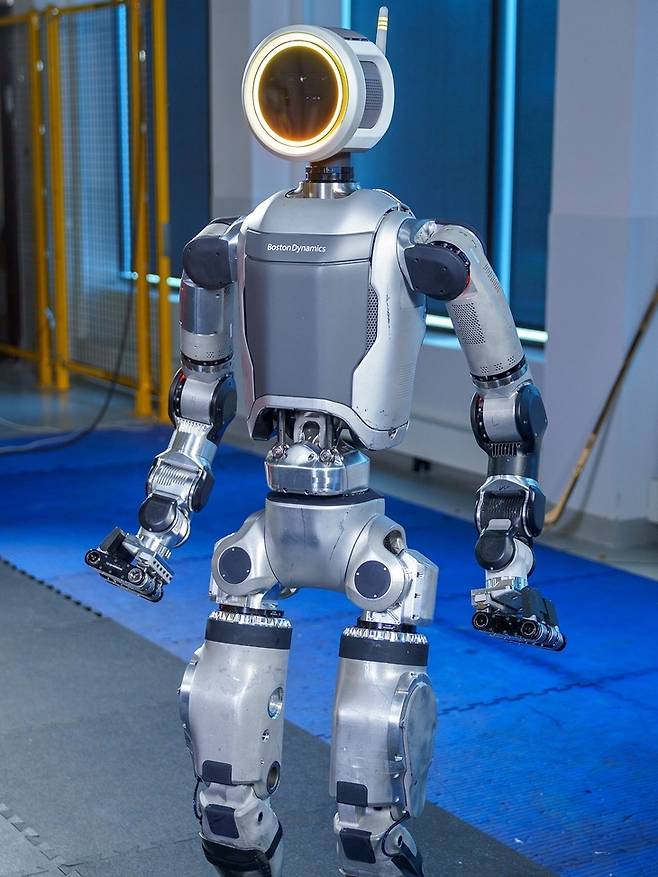
Boston Dynamics, Hyundai Motor Group’s robotics subsidiary based in Massachusetts, recently created buzz after releasing a video clip featuring its Atlas 2 humanoid robot, developed in partnership with Toyota Research Institute.
The spotlight is on the Atlas 2 as the first humanoid robot to fully integrate Large Behavior Models that control its entire body, enabling stable, flexible movements to effectively navigate unpredictable industrial tasks.
This innovation raises the question of whether the Atlas 2 can surpass its rival, Tesla’s Optimus, another leading general-purpose humanoid robot pioneering mass deployment in vehicle assembly and other industrial environments.
Boston Dynamics’ YouTube video released earlier in the month highlights the Atlas 2’s ability to adapt and solve unexpected problems instantly, without any hesitation.
For example, a human demonstrator interrupted the robot several times, using a hockey stick to remove a toolbox from which the robot was retrieving robotic parts. Unfazed, Atlas 2 continued its task, pulling the toolbox closer and opening the lid to get back to work.
When the demonstrator placed the parts on the ground, the robot acknowledged the change, moved the toolbox aside to gain better access, and then placed them into the box.
Industry insiders say that the LBM powers Atlas 2’s real-time adaptive skills — a key feature for humanoid robots — potentially narrowing the gap with Tesla’s Optimus.
“Data-driven robot control methods relying solely on Large Language Models face inherent limitations, making effective robot control challenging,” said Kim Ui-kyum, a mechanical engineering professor at Ajou University.
“In contrast, the LBM approach not only governs decision-making but controls physical robot behaviors by modeling and training large-scale representations of physical actions, which are then integrated to execute complex tasks efficiently.”
Unlike the Atlas 2, Optimus is powered by a hybrid robotics architecture that combines LLMs with specialized neural networks. The LLMs enhance language understanding and interaction, while the neural networks — adapted from Tesla’s Full Self-Driving technology — manage perception, motion planning and physical control.
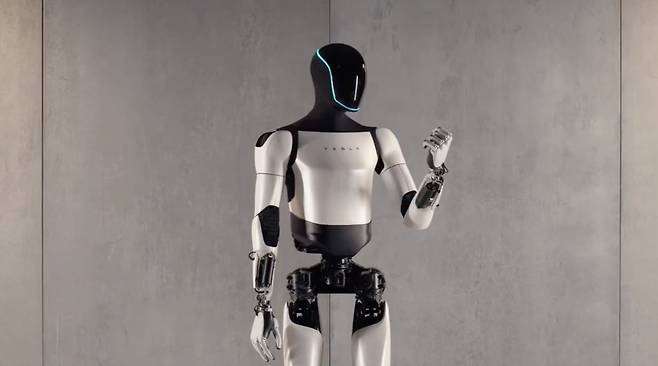
The question of whether the LBM method or Tesla’s hybrid approach is more advanced is arguable. However, Kim noted that Hyundai Motor has made significant strides in challenging Tesla’s lead in the burgeoning robotics industry.
“In my opinion, the Atlas 2 stands out as a more advanced humanoid robot due to its greater potential for improvement and adaptability, enabled by a behavior model trained on a significantly larger and more comprehensive dataset compared to the Optimus,” said Kim.
Han Jae-kweon, a robotics professor at Hanyang University, offered a more conservative view: “Hyundai Motor (Boston Dynamics) has only just leveled the playing field with Tesla, after previously trailing behind the EV maker. Since there are no standardized benchmarks or evaluation criteria, it is still difficult to say whether the Atlas 2 has the upper hand over Optimus or vice versa.”
However, in terms of cost optimization targeting mass production, the Optimus seems to have a more competitive edge. Tesla’s strategy for Optimus is an unmatchable price that goes below $20,000, a price significantly lower than other humanoid robots focused on scalability, noted Kim.
“During the early stages of humanoids’ real-world deployment, especially in industrial sites, including car manufacturing plants, it may be more practical for Optimus to assist with limited roles at affordable prices” rather than handle entire tasks independently, he added.
Despite its groundbreaking advancements, Kim believes that Atlas 2 still needs enhanced hand manipulation capabilities to perform industrial tasks with precision and skill comparable to human hand movements.
“From the video, Atlas 2 demonstrates the ability to grasp and place objects while precisely controlling and maintaining grip strength,” said Kim. “However, more complex and unstructured manipulations (tasks performed in unpredictable environments) — such as rotating, repositioning and inserting objects — still require further development.”
The Atlas 2 is scheduled to be deployed for pilot operation at Hyundai Motor Group Metaplant America in Georgia by year-end. According to Daol Securities, among the five assembly processes — press, body, painting, trim and inspection — the humanoid robot is expected to be deployed primarily in the trim stage, where it is anticipated to boost the unit-per-hour production rate by over 10 percent.
Tesla CEO Elon Musk pledged to roll out 5,000 Optimus robots at the company’s manufacturing sites by 2025, but media reports suggest that the company has fallen behind this goal, producing only a few hundred units by mid-2025.
Copyright © 코리아헤럴드. 무단전재 및 재배포 금지.