Ha Chong-hyun opens new chapter with long-awaited art center in Paju
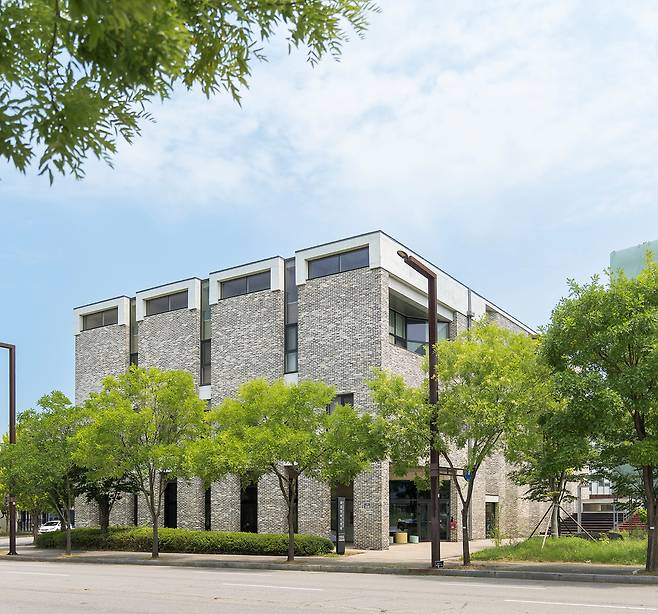
PAJU, Gyeonggi Province — As one of South Korea's northernmost cities, Paju in Gyeonggi Province is also one of the closest to the inter-Korean border. Those making the trip from Seoul to Paju along Jayu-ro, meaning "freedom road," will soon see the Ha Chong-Hyung Art Center.
On view at the center, which opens Monday, are some 50 paintings and archival materials by art master Ha Chong-hyun from the 1960s to the present, held by Ha Chong-Hyun Art Foundation.
“The symbolism of Paju as a city in a border region was one of the reasons (for choosing Paju). The political and social circumstances after the Korean War inspired the artist’s early works,” said Ha Yoon, director of Ha Chong-Hyun Art Foundation and the artist’s son, during a press tour Friday.
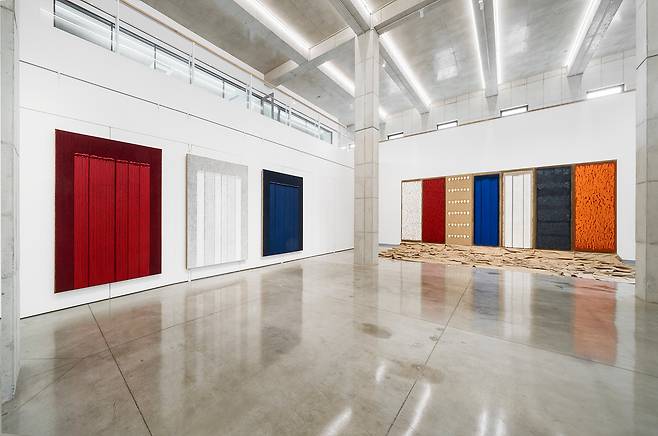
When entering the center, visitors are greeted by the monumental “Conjunction” painting series from the mid-2010s. The artist, 90, is widely known as a master of "dansaekhwa," or Korean monochrome painting. Artists associated with this movement that emerged in the 1960s often focused on repetition, meditation and the material nature of their chosen mediums.
Ha overturned traditional painting styles and developed the unique “bae-ap-beop” painting method, which literally translates to “back-pressure technique.” Using canvases made of hemp cloth, he would push thick layers of paint onto the back of the canvas until the paint oozed through to the front.
The technique became the foundation of Ha's signature "Conjunction" series, which he started in the 1970s.
The art master told The Korea Herald in 2020 that he got the idea for his painting process after the Korean War (1950-1953), when he spotted burlap sacks containing rice for the military in Seoul. At the time, canvas was too expensive, so he made do with burlap instead. The artist said he has always been "experimental" throughout his life.
The foundation had considered opening an art center in Seoul, the director said, but it was hard to find adequate space in the capital city. The nearly 3,000-square-meter building in Paju, approximately 35 kilometers northwest of Seoul, features a high ceiling and was formerly a book repository and office building for the Mimesis publication company.
The Ha Chong-Hyun Art Foundation acquired the building in 2022 to transform it into an art center.
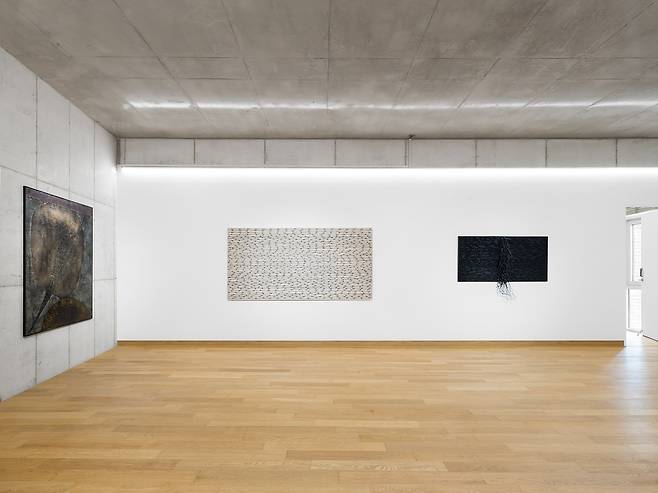
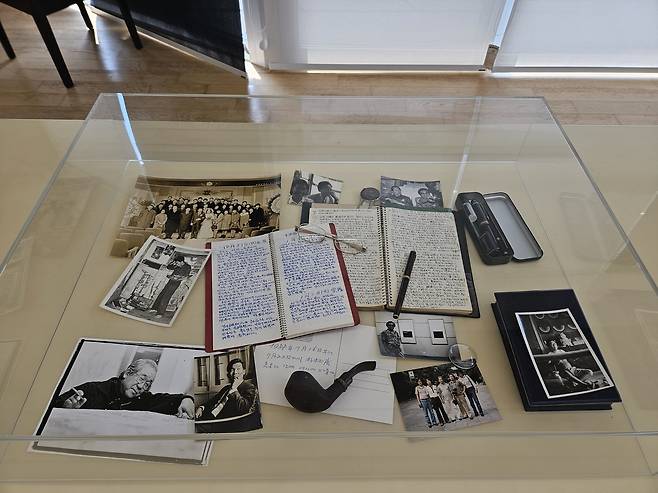
On view in the second gallery are Ha’s art informel works from the 1960s and early 1970s — before he gained attention as a dansaekhwa master. With their thick layers of dark colors, the works show the emotional impact of the Korean War. Archival materials such as photographs with peers Paik Nam-june, Lee U-fan and Park Seo-bo are on display as well, offering visitors a glimpse into the era.
Ha was a leading member of the Korean Avant Garde Association, established in 1969 and active until 1975. He experimented with genres such as object-based works, installations and conceptual art; artworks created during this period are displayed on the second floor. Ha used materials of violence, such as barbed wire, to create works of symbolic criticism and silent resistance toward Korea's military regime in the 1970s.
The exhibition continues to "Conjunction" works and post-"Conjunction" paintings that he began to create in 2010. The latter expanded on the bae-ap-beop technique to explore vibrant colors and forms that often accompany wood or mirror sticks.
“My father had always dreamed of a place in the form of an art center or a museum. Although the foundation still lacks sufficient staff, once the conditions are right, we plan to open it to the public regularly and discuss the possibility of transitioning into a museum,” the director said.
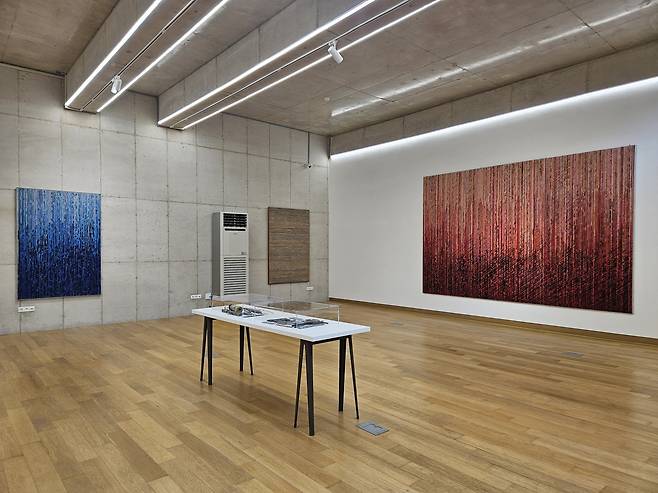
The center will open for private viewings by appointment only, starting Monday.
The 14th Ha Chong-Hyun Art Prize ceremony is scheduled to take place at 3 p.m. on Monday, according to Kukje Gallery, which represents the artist.
Copyright © 코리아헤럴드. 무단전재 및 재배포 금지.