BOK signals cuts on the horizon after holding rate at 2.5%
![Bank of Korea Gov. Rhee Chang-yong speaks in a press conference following the Monetary Policy Board meeting held in the bank's building in central Seoul on Thursday. [BANK OF KOREA]](https://img3.daumcdn.net/thumb/R658x0.q70/?fname=https://t1.daumcdn.net/news/202508/28/koreajoongangdaily/20250828180209341jtuu.jpg)
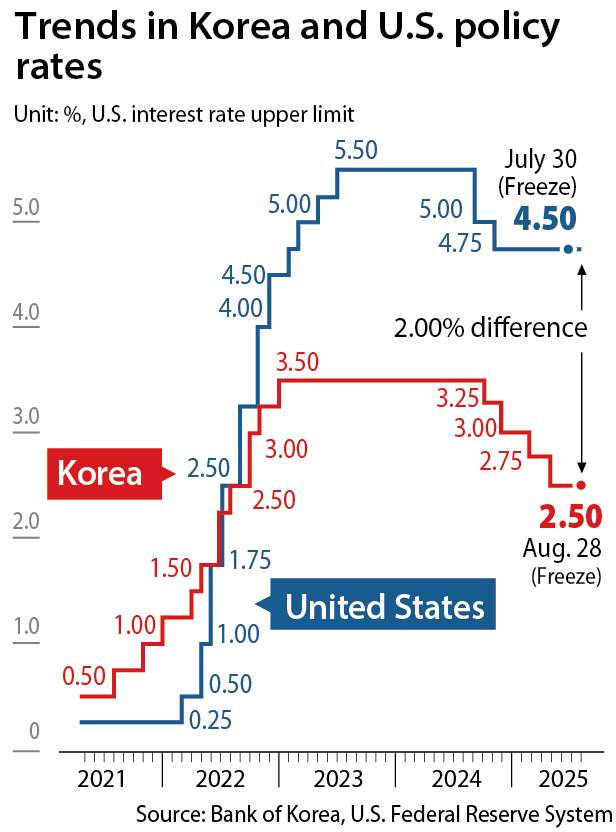
The Bank of Korea (BOK) will continue its rate-cut cycle through the first half of next year, as the country’s economic growth is projected to stay below its potential, the central bank said Thursday after announcing its decision to hold the benchmark rate steady at 2.5 percent for a second consecutive meeting.
The BOK held off on cutting rates, which was dissented by board member Shin Sung-hwan, who called for a 25-basis-point rate cut, citing slowing household debt growth and the U.S. Federal Reserve's impending rate cuts.
Still, the bank signaled that rate cuts may be on the horizon. Five of six board members signaled openness to lowering rates within the next three months, citing expectations that the country’s growth rate will remain below its potential.
“At this point, cutting rates too quickly could have bigger side effects, like raising household debt, than contributing to growth,” said BOK Gov. Rhee Chang-yong following the rate-setting meeting at the bank’s building in central Seoul. “We will not excessively inject liquidity into the market in a way that could heighten expectations of rising home prices.”
He added that some time is needed for the government’s real estate measures to take effect, noting the Lee Jae Myung administration’s housing loan regulations, which cap mortgages at 600 million won ($430,000), regardless of home price and household income. “If the government announces additional real estate measures, policy coordination will be necessary.”
It typically takes two to three months to settle the final payment on a home purchase, which is when the loan is executed.
The BOK revised up this year’s growth forecast to 0.9 percent from the previous 0.8 percent, noting improved consumer sentiment from the government’s fiscal spending and the solid performance of semiconductor and automobile exports. It kept next year’s forecast at 1.6 percent.
“We expect low growth to persist through the first half of next year before it rises to around the potential level in the second half,” said Rhee.
The governor noted several potential factors that could affect the country’s growth.
As for downside risks, Rhee pointed to the potential reignition of tariff negotiations, labor-management conflicts stemming from Korean companies shifting production to the United States, ongoing restructuring in petrochemicals and real estate project financing as well as intense competition from China in the steel industry.
The United States slapped Korea with a 15 percent levy for key Korean suppliers of cars, smartphones and machinery.
Rhee added that smoother tariff negotiations on semiconductors and stronger-than-expected semiconductor exports, supported by an extended chip cycle, could serve as potential upside factors.
Exports increased for a second consecutive month in July on solid chip and car sales, as suppliers front-loaded shipments to avoid any increase in U.S. tariffs.
Political factors — like the political vacuum following former President Yoon Suk Yeol's impeachment — and the U.S. tariffs have only made it “natural” for Korea’s growth rate to stay below its potential rate, according to Rhee.
“We need to accept that this year’s growth will fall short of the potential rate. The goal is to prevent it from falling too low,” Rhee said, adding that Korea’s potential growth rate has fallen below 2 percent.
The next rate-setting meeting is scheduled in October.
BY JIN MIN-JI [jin.minji@joongang.co.kr]
Copyright © 코리아중앙데일리. 무단전재 및 재배포 금지.
- Nurse sentenced to 2.5 years for groping surgery patient: 'The defendant failed to show restraint'
- BTS's Jimin and actor Song Da-eun reignite dating rumors with viral video
- Woman who killed 7-month-old twin daughters says disabilities, stress were motives
- Women accused of severing 'important piece' of husband's anatomy had help from daughter and son-in-law, prosecutors say
- Handcrafted Korean fountain pen becomes impromptu gift to Trump
- How a new Costco tore a Korean province in half
- Law limiting student smartphone use in class passes in bipartisan vote
- Forget 'just one.' Cocktail courses are the new trend in Seoul's bar scene.
- President Lee visits Philly Shipyard, says Korean and U.S. shipbuilding industries will grow together
- A third of foreign companies considering closing shop after 'Yellow Envelope Bill'