Businesses close, demolition platforms rise across Seoul
이 글자크기로 변경됩니다.
(예시) 가장 빠른 뉴스가 있고 다양한 정보, 쌍방향 소통이 숨쉬는 다음뉴스를 만나보세요. 다음뉴스는 국내외 주요이슈와 실시간 속보, 문화생활 및 다양한 분야의 뉴스를 입체적으로 전달하고 있습니다.
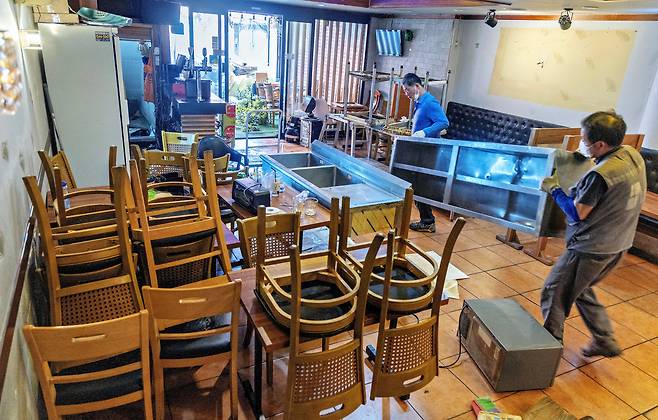
Five demolition workers arrive at a recently closed restaurant at Yongsan District, Seoul at 7 a.m. They appear to do no real work, and only begin when a 30-year-old man, referred to as “manager” arrives on site for inspection. Throughout the process, he kept busy with hit phone, documenting the process. Later on, he explained that it was to “post the demolition process on social media for promotional purposes.” The manager later turned out to be a field manager affiliated with a newly emerging “demolition platform.”
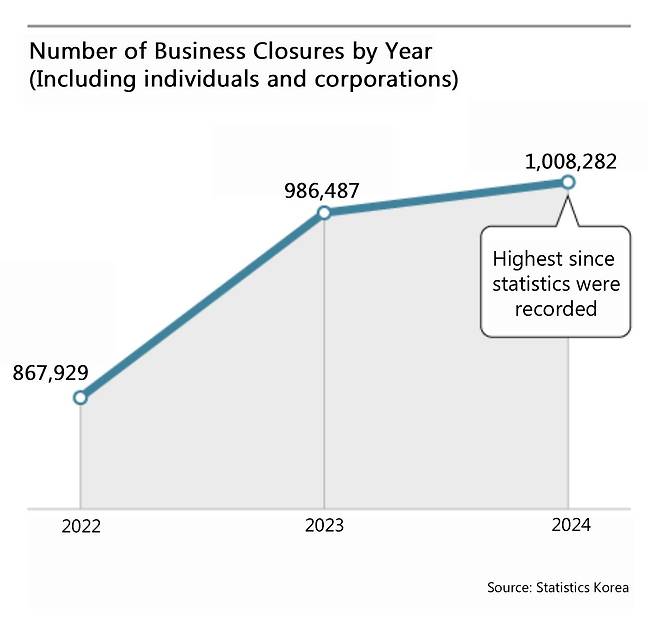
According to the National Tax Service, the number of businesses that filed for closure reached 1,008,282 last year—surpassing 1 million for the first time since statistics were recorded. Struggling domestic demand had driven the surge of closing businesses, forcing many small businesses to close. Last year, closure rates were 9.04%, which meant 9 out of 100 businesses were shut down. Amid a nationwide, self-employment slump, small-scale neighborhood demolition trades are evolving into an industry. Now “demolition startups” have emerged, operating headquarters, nationwide marketing, subcontractor management, and on-site supervision. It’s perceived as a “sad boom” born from the downfall of many businesses.
One demolition company, headquartered on Teheran street in Gangam District, Seoul, markets themselves as a “platform company.” Their main marketing revolves around the so-called “artificial intelligence (AI) instant estimate system,” developed from tens and thousands of demolition data points nationwide. Inputting the type of business and floor area of a store it will be closing, and attaching photos of the space results in a provided cost estimate within seconds. This specific company refers to its 200 and more demolition-related subcontractors as “partners.” One representative shared, “As of July this year, the number of requests have increased by about 400% compared to the same period last year.” Since October, 2024, the company has been promoting discounts through the food delivery app Baedal Minjok.
Demolition platforms like these have been appearing rapidly from the previous year. Clients accrue because they are able to quickly provide preliminary estimates upon request, while promoting their low prices in partnership with subcontractors. One representative from a waste disposal company said, “If you don’t join one of these demolition partners, it’s hard to get any work.”
The rise of the demolition industry is tied to the nature of South Korea’s self-employment market, where trends shift quickly and business opening-and-closing cycles are short. A prime example is the tanghulu craze. Last year, more than 1,200 tanghulu specialty shops opened, but the number of new openings plummeted to 77. Closure numbers reached 397. Every month, closures have far outnumbered new openings. Sudden fads, intensified competition, and mass closures drive many stores to close, skyrocketing demolition demand. “Revolving door startups,” where business owners shut down their stores, only to return, further fueling this demand.
Another factor driving the growth of the demolition market is the government’s introduction of financial support programs for demolition costs.
Some business owners find ways to re-enter the market by signing contracts with franchise companies. Their purpose: open new franchise outlets within the same industry. This move stems from a lack of capability to shift into other sectors and a belief that corporate support will lead to better results rather than trying it alone. The relatively low entry barrier also plays a role—if they can cover the initial startup cost of 90 million won, including franchise fees, the headquarters will cover the store.
According to a survey by the Ministry of SMEs and Startups, 26.1% of respondents said they had been “business owners in the same industry” immediately before starting their current business as of 2023. Chon So-ra, a professor of economics at Inha University, said, “Many self-employed people, who have already closed their businesses, end up starting over, reluctantly, because they cannot find other jobs,” adding, “The government should explore various measures, such as operating continuous post-closure training programs, so that self-employed individuals who shut down can pursue alternative career paths.”
Copyright © 조선일보. 무단전재 및 재배포 금지.