Korean auto parts-makers to get W630b in financing relief amid US tariffs
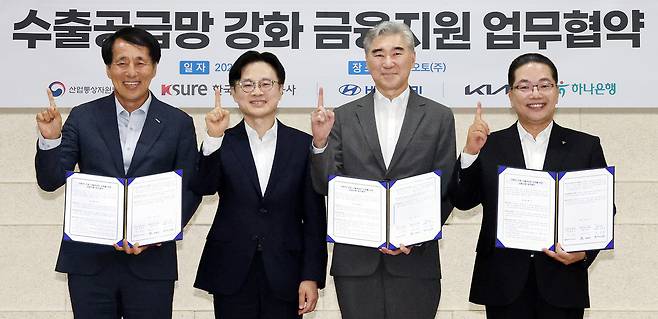
Hyundai Motor Group, Hana Bank and the state-run Korea Trade Insurance Corp. have launched a 630 billion won ($453 million) financing program to support auto parts-makers hit by US tariffs.
The three parties held a signing ceremony Monday to back Hyundai Motor Group’s domestic suppliers, which face risks of declining sales after the US imposed a 25 percent tariff on car parts in May.
The ceremony was attended by Minister of Trade, Industry and Energy Kim Jung-kwan, Hyundai Motor Group President Sung Kim, KTIC CEO Jang Young-jin and Hana Bank CEO Lee Ho-sung at the headquarters of DY Auto in Asan, South Chungcheong Province.
DY Auto, a manufacturer of car window motors, was selected as the first recipient.
Based on funds from Hana Bank’s contribution of 30 billion won and Hyundai Motor Group’s 10 billion won, KTIC will provide up to 630 billion won in preferential financing to parts makers recommended by the Group.
Participating suppliers will be eligible for loans with interest rates up to 2 percentage points below market rates. KTIC will also extend the guarantee period from the current one year to three years and increase guarantee ceilings for loans under the program.
“In a trade environment that has become more challenging following the recent US tariffs, this new financing program will provide significant support to the auto parts market and, from an original equipment manufacturer perspective, is expected to help stabilize the supply chain,” said President Sung Kim.
Although Korea and the US agreed on July 30 to lower the car parts tariff from 25 percent to 15 percent, the change ended the zero-tariff benefit that Korean parts makers had enjoyed under the Korea-US Free Trade Agreement.
As a result, Hyundai Motor Co., an automaker under Hyundai Motor Group that still relies heavily on Korean partners for its US production, said in July that it is considering shifting part of its supply chain to local US suppliers.
Currently, Hyundai Motor Co. sources less than 50 percent of its parts for US assembly from within the US. The company disclosed that 20 percent of its 828.2 billion won tariff-related losses in the second quarter stemmed from parts alone.
The auto parts industry also faces new risks from a 50 percent US tariff on steel and aluminum starting Monday, which is applied based on the proportion of these metals in the parts.
After the signing ceremony, Minister Kim toured DY Auto and was briefed on the impact of the US tariffs.
“In response to these tariff measures, the government will prepare follow-up support, including easing export difficulties, helping companies enter alternative markets, providing tax incentives, and strengthening self-sufficiency,” Minister Kim said.
Copyright © 코리아헤럴드. 무단전재 및 재배포 금지.