Summer heat returns to continue throughout the week
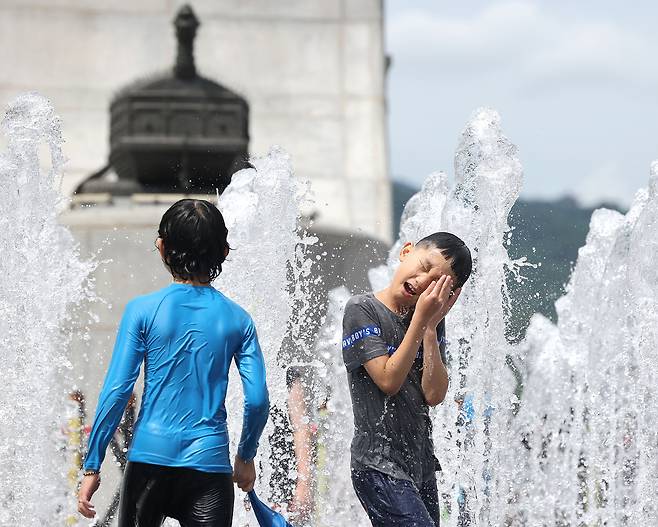
Though temperatures seemed relatively cooler last week, hot and humid conditions returned once again over the weekend and are projected to continue throughout the week.
Heat wave advisories are also back in place in most parts of South Korea.
According to the Korea Meteorological Administration, heat wave advisories were issued in most parts of the country, excluding mountainous regions, as of 5 p.m., Sunday, as nationwide apparent temperatures ranged between 32 to 36 degrees Celsius.
Heat wave watches and warnings in Korea are issued when the maximum apparent temperature is expected to remain above 33 C and 35 C, respectively, for two or more consecutive days.
Heat wave watches were issued in most parts of the country on Sunday, including the Greater Seoul region, which includes Incheon and Gyeonggi Province, as well as inland parts of Gangwon Province and the North and South Chungcheong provinces. In Korea's southern regions — the North and South Jeolla provinces, North and South Gyeongsang provinces and Jeju Island — heat wave warnings were issued.
As of 5 p.m. on Sunday, Seoul saw temperatures reach as high as 32.6 C, while temperatures in Daegu, North Gyeongsang Province, and Changwon, South Gyeongsang Province, neared 35 C.
According to the KMA, such intense temperatures are expected to continue into the new week, accompanied by tropical nights and continued heat wave watches.
In Seoul, apparent temperatures could feel as high as 33 C throughout the week and temperatures may not drop below 28 C, even at night. In southern regions, temperatures could reach as high as 36 C.
The prolonged heat is due to the return of the dual high-pressure system that caused extreme heat near the end of July.
Since Friday and Saturday, both the Tibetan high-pressure system and the North Pacific high-pressure system have been covering the Korean Peninsula, creating a “heat dome” effect that traps the heat in the atmosphere.
“However, as the sun’s altitude is lower than it was in July and solar radiation is relatively weaker, the intensity of the heat wave is expected to be somewhat lower,” the KMA said.
Though subject to change, the KMA added that rain may fall, particularly in central parts of Korea and the Greater Seoul region on Wednesday, lowering overall temperatures.
Depending on rainfall, the pressure systems surrounding the Korean Peninsula could change, possibly bringing lower temperatures.
Copyright © 코리아헤럴드. 무단전재 및 재배포 금지.