Seoul Station's invisible people: Homelessness drops, but why?
전체 맥락을 이해하기 위해서는 본문 보기를 권장합니다.
"At this point, we have enough services and programs in place that a homeless person who wants to be housed can most likely be housed," Woo said. "Conditions may not be great, but they can still get off the streets if they wish."
"But the exact reason behind the decline is hard to determine at this point with the survey alone."
이 글자크기로 변경됩니다.
(예시) 가장 빠른 뉴스가 있고 다양한 정보, 쌍방향 소통이 숨쉬는 다음뉴스를 만나보세요. 다음뉴스는 국내외 주요이슈와 실시간 속보, 문화생활 및 다양한 분야의 뉴스를 입체적으로 전달하고 있습니다.
![A homeless person at Seoul Station in a photo taken in 2024 [JOONGANG ILBO]](https://img1.daumcdn.net/thumb/R658x0.q70/?fname=https://t1.daumcdn.net/news/202508/16/koreajoongangdaily/20250816071039459wvck.jpg)
On a bustling Tuesday morning at Seoul Station, throngs of commuters hustled through the sprawling transit hub at the city’s center. The weekday rush looked no different from any other — except for what was missing.
Once a gathering place for one of the country’s most visible and oldest street homeless communities, the station’s steps now hosted only two men in threadbare clothes, crouching quietly to the sides and observing a crowd that barely saw them. The eastern side of the station, once lined with a dozen makeshift tents, was mostly empty.
![Homeless people's tents are scattered around the eastern part of the Seoul Station plaza on July 27. [LEE JIAN]](https://img4.daumcdn.net/thumb/R658x0.q70/?fname=https://t1.daumcdn.net/news/202508/16/koreajoongangdaily/20250816071040915mgnq.jpg)
According to Seoul Metropolitan City’s Dasiseogi Support Center for the Homeless, about 140 people now live on and within a 10-minute walk of the station grounds, which is nearly half the figure from before the Covid-19 pandemic.
Nationally, the trend is similar: The total homeless population dropped 11.6 percent in three years, from 14,404 in 2021 to 12,725 in 2024, according to the Ministry of Health and Welfare’s quinquennial report published in June.
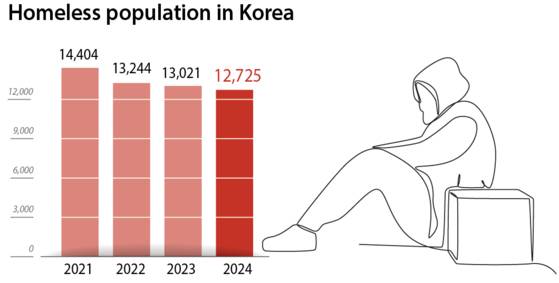
At first glance, the numbers suggest a rare global success. While homelessness has surged in countries such as the United States and across Europe since the pandemic, Korea’s counts are falling.
Yet experts caution that the apparent decline reflects as much about how the country defines and manages homelessness as it does about any real improvement. The problem is less visible, but not necessarily less severe.
On the scene: The disappearing homeless people of Seoul's streets
![Commuters are walking through Seoul Station in Jung District, central Seoul. [YONHAP]](https://img4.daumcdn.net/thumb/R658x0.q70/?fname=https://t1.daumcdn.net/news/202508/16/koreajoongangdaily/20250816071043697bvwj.jpg)
Seoul Station has been a gathering point for the unhoused since the 1997 Asian financial crisis, which left thousands jobless and subsequently displaced.
The most common reasons for a homeless person choosing an overnight location are “convenient access to facilities like restrooms” and “the presence of other homeless people nearby,” according to the Welfare Ministry’s report, and Seoul Station offers both. It also sits within walking distance of free meal stands and support centers for people without homes.
“If you are homeless around here, you can eat three meals a day just by wandering a few hundred meters,” social worker Woo Dae-kyung at the Seoul Station Dasiseogi Support Center told the Korea JoongAng Daily.
![Social workers of the Dasiseogi Support Center for the Homeless help the homeless around Seoul Station. [JOONGANG ILBO]](https://img4.daumcdn.net/thumb/R658x0.q70/?fname=https://t1.daumcdn.net/news/202508/16/koreajoongangdaily/20250816071045098byxm.jpg)
The center offers about a dozen services, from baths and used clothing to temporary overnight shelter. But its most important role, Woo says, is helping people get off the streets by connecting them to facilities or housing types. Last year, the Seoul Station Dasiseogi Support Center placed 250 in facilities and 392 in temporary housing. The temporary housing program, run by respective city governments, has proven particularly effective.
The program was established in Seoul in 2011. Applicants are housed and given financial support for six months, during which they are guided through job opportunities. Woo says that he frequently sees homeless people who were once housed through the program but returned to the streets upon its conclusion. But city officials still say that it has been effective in decreasing the number of homeless people around the Seoul Station area, which used to hover around 300 in 2011 and is now half that number.
“At this point, we have enough services and programs in place that a homeless person who wants to be housed can most likely be housed,” Woo said. “Conditions may not be great, but they can still get off the streets if they wish.”
The rise of homeless people in housing
![A man sits in a jjokbang, a type of substandard housing in Korea that consists of micro-unit rooms with shared bathrooms. [YONHAP]](https://img1.daumcdn.net/thumb/R658x0.q70/?fname=https://t1.daumcdn.net/news/202508/16/koreajoongangdaily/20250816071046486jibw.jpg)
Seo Sang-il, 46, became homeless in 2017. The following year, the Dasiseogi Support Center directed him to a “jjokbang” near Seoul Station. Jjokbang, which literally translates to “sliced rooms,” are partitioned micro-units of about 6 square meters (64.6 square feet), often with shared bathrooms and without kitchens or living rooms.
“The most difficult part about living there is the heat during the summer and the cold during the winter,” said Seo.
While the number of people living on the streets has steadily declined from 2021 to 2024, Welfare Ministry data shows that the population of jjokbang residents rose slightly, from 4,651 in 2023 to 4,717 in 2024. This indicates that although the homelessness situation is consistently improving, the issue of inadequate housing is slower to improve.
“Having a roof over their heads doesn’t mean that they are living sustainably. They need as much care as those on the streets,” Woo said, adding that fewer people sleeping outside hasn't led to reduced work for his center.
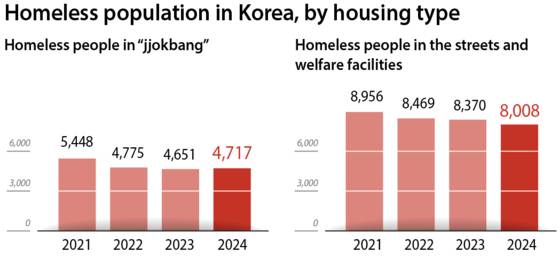
In Korea, people living in the five government-recognized “jjokbang chon,” or clusters of jjokbang, and receiving welfare services from support centers are included in the count of homeless people. This accounts for five jjokbang clusters in Seoul and others in cities like Busan, Daegu and Incheon. The Seoul Metropolitan Government estimates that in 2024, about 2,240 people lived in jjokbang citywide, with roughly 800 people near Seoul Station.
On paper: Korea’s disappearing homeless people In terms of what is causing the nationwide drop in homeless people, the Korea Institute for Health and Social Affairs’ Researcher Lim Deok-young, who was part of the team that wrote the Welfare Ministry’s report on homelessness in June, said that the cities’ expansion of temporary housing programs could be one reason.
“But the exact reason behind the decline is hard to determine at this point with the survey alone.”
Experts are wary of reading too much into Korea’s declining numbers, especially when comparing them to Western countries, because of the country’s “narrower definition of homelessness,” Lim said.
Under Korean law, the term applies to adults 18 or older who sleep on the streets or use temporary facilities for homeless people; live in longer-term institutional facilities such as rehabilitation centers or welfare centers for older adults; or reside in jjokbang clusters while receiving counseling and management from designated centers in certain districts.
Excluded are children, women in domestic violence shelters, migrants or refugees in protection facilities, and disabled people in social welfare institutions, unless those facilities are officially classified as welfare centers for homeless people. People in other forms of inadequate housing are also excluded.
According to official counts from the Korean government in 2024, roughly one in every 4,000 people in Korea is homeless, while European institute FEANTSA states that one in every 370 people in Europe is homeless. But if Europe's broader definition of homelessness were applied to Korea's methodology, the number of people in inadequate housing alone would drastically increase the prevalence of homelessness in Korea. Data from Statistics Korea shows that in 2023, 575,345 people in Korea were in inadequate housing, such as motels, shacks and vinyl greenhouses. Europe's homelessness is calculated through FEANTSA's Ethos (European Typology of Homelessness and Housing Exclusion) Light, which covers people, including children without housing, in temporary shelters, in institutions, in nonconventional dwellings or temporarily staying with others due to a lack of housing.
In the United States, homelessness, as defined by the United States' Homeless Emergency Assistance and Rapid Transition to Housing Act, also includes people at immediate risk of losing their home, unaccompanied youth under 25 and anyone fleeing domestic violence, sexual assault, stalking or other life-threatening situations. The United States recorded 770,000 homeless people in 2024, or one in every 440 people, according to the country's Department of Housing and Urban Development.
"Categories such as homeless people, children and persons with disabilities are not mutually exclusive, so rather than excluding children or others who are receiving welfare services in different areas from homelessness statistics, it is essential to accurately represent their circumstances to build appropriate welfare services for homeless and housing-vulnerable populations," Dongduk Women's University’s social welfare professor Nam Ki-cheol writes in his research paper “The Issues of Underestimation in the Number of Homeless People in Korea,” published in May.
Nam, via email to the Korea JoongAng Daily, also highlighted that Korea’s welfare model only focuses on moving people into facilities, and on distinguishing between those admitted and those who are not.
“Homelessness is fundamentally an issue of housing insecurity, and should be viewed along a spectrum, from extreme vulnerability in housing to less severe, yet still inadequate, living conditions."
He claimed that the government’s facility-centered approach has led Korea to define homelessness differently from Western countries, narrowing the scope of official statistics and ultimately underestimating the reality of the problem.
“So while it may be true that the number of homeless people hasn’t increased nationally, many factors not included in the official count obscure the case for a meaningful decline in the homeless population,” he said.
BY LEE JIAN [lee.jian@joongang.co.kr]
Copyright © 코리아중앙데일리. 무단전재 및 재배포 금지.
- [단독] 美 관세 전쟁의 승자? K배터리, 중국 밀어내고 대미 수출 1300% 급증 '역대 최대'
- Seoul court denies request to block Netflix docuseries, 'The Echoes of Survivors' to be released as scheduled
- Army trainee is apprehended after romantic escape to Busan with girlfriend
- Thanks, Nvidia: SK hynix dethrones Samsung as world's top DRAM maker for first time in over 30 years
- Mediation between NewJeans' Minji, Danielle and agency ADOR fails
- 'This tiramisu isn't like what I ate in the U.S.': American fined for threatening bakery manager over dessert in Gimhae
- Passengers baffled as AirAsia flight to Incheon lands at Gimpo Airport
- Found guilty for biting off attempted-rapist's tongue 6 decades ago, Choi Mal-ja gets overdue apology
- Why Vietnam is turning to Korea for K9 howitzers and shipbuilding cooperation
- History and 'people's sovereignty' take center stage at President Lee's ceremonial inauguration