This 'silver town' charges a 1 billion won deposit and 5 million won a month, but retirees are lining up. Why?
![The exterior of the luxury Classic 500 retirement community complex located in eastern Seoul [THE CLASSIC 500]](https://img3.daumcdn.net/thumb/R658x0.q70/?fname=https://t1.daumcdn.net/news/202508/15/koreajoongangdaily/20250815070253026aidk.jpg)
The interior and exterior of the Classic 500 building near Seoul's Konkuk University in eastern Seoul evoke the feeling of a top-of-the-line mall or luxury resort. Indeed, the lower floors feature resort-like facilities like an indoor golf driving range, tennis court and spa, but access comes with a catch — the offerings are exclusively for the older residents who are willing to pay 1 billion won ($730,000) up front with a minimum monthly payment of at least 5 million won per individual.
Despite the exorbitant fee, the luxury retirement community and other high-end facilities boast waitlists that can take months to clear.
These luxury facilities catering only to the older populace — commonly referred to as “silver towns” in Korea — are attracting growing investment, as companies enter the market to meet rising demand driven by one of the world’s fastest-aging populations and a declining expectation that children will care for their parents.
![The interior of a unit at Classic 500 retirement community complex in eastern Seoul. [THE CLASSIC 500]](https://img1.daumcdn.net/thumb/R658x0.q70/?fname=https://t1.daumcdn.net/news/202508/15/koreajoongangdaily/20250815070254333tejv.jpg)
The market for retirement communities is projected to more than double from 72 trillion won in 2020 to 168 trillion won in 2030, according to Colliers, an investment management firm in Canada.
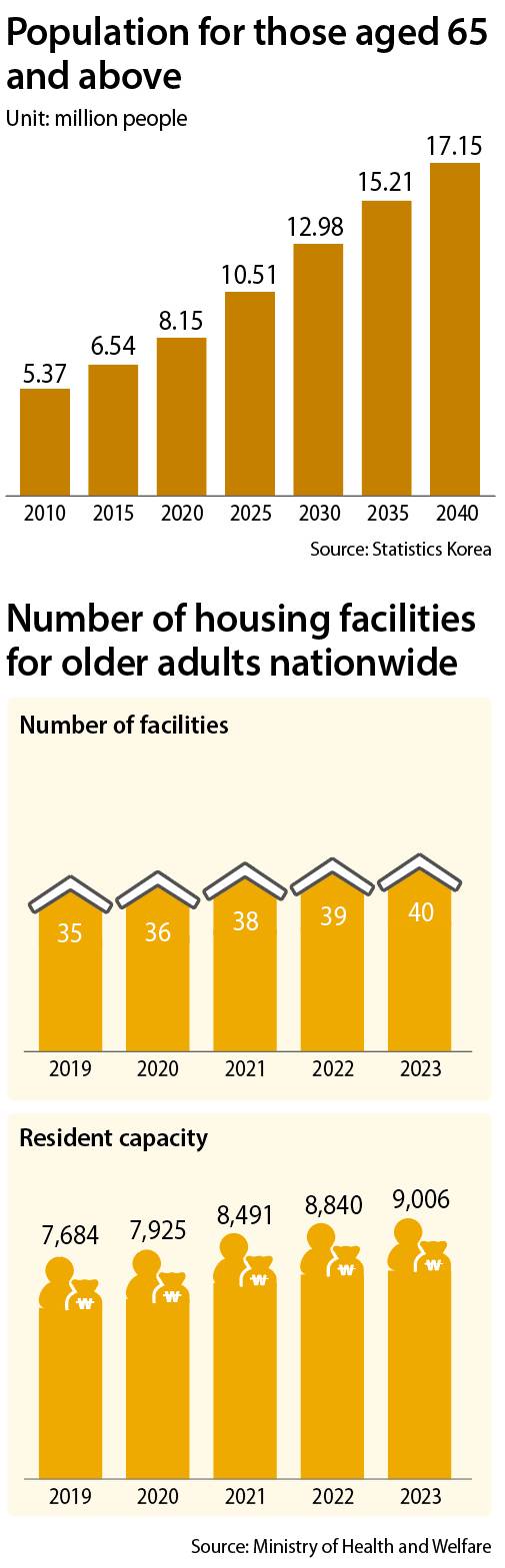
Korea became a super-aged society in December, with the number of people aged 65 and older accounting for more than 20 percent of the population of 51 million, according to data from the Ministry of the Interior and Safety. People in their 70s exceeded those in their 20s for the first time in 2023.
The premium players like the Classic 500 and Samsung Noble County have popularized the silver town concept. But as the market expands, they are facing growing competition from new entrants — including major hotel chains and construction firms — drawn to the industry by its strong potential.
![A golf range in Classic 500 retirement community complex in eastern Seoul [THE CLASSIC 500]](https://img2.daumcdn.net/thumb/R658x0.q70/?fname=https://t1.daumcdn.net/news/202508/15/koreajoongangdaily/20250815070255810gfmw.jpg)
The Classic 500 is operated by Konkuk University, while Samsung Noble County is run by Samsung Life Public Welfare Foundation.
“The market for today’s older adults, who are financially independent and enjoy their own lifestyles, presents a significant opportunity for businesses,” said Samil PwC in a report in April.
“With a deepening aging demographic, changing perceptions of family and a growing preference among older adults for independent living, there is vast potential in the field. The potential has already been recognized with companies in construction, hospitality and insurance now actively entering the retirement community market as a new line of business.”
Residences for older adults, which include the silver town concept, are subsets of residence facilities for older adults. These retirement facilities are open to those aged 60 or above who are capable of independent living.
![An exterior of Samsung Noble County retirement community complex in Yonggin, Gyeonggi [SAMSUNG NOBLE COUNTY]](https://img2.daumcdn.net/thumb/R658x0.q70/?fname=https://t1.daumcdn.net/news/202508/15/koreajoongangdaily/20250815070257191pvvg.jpg)
Tapping into the untapped
It’s not just the upscale amenities that attract older adults to these residences, but also the medical support — a major concern for people in this age group.
Three years ago, Park Ok-soon, 78, moved into Seoul Seniors Gayang Tower in western Seoul to prepare for health emergencies.
"We desperately needed to be in the environment where we could prepare for the outbreak of unexpected situations," said the retired art professor. “We don’t live in a society where you can easily call out for help.”
That kind of anxiety is no longer a concern in such a residence.
Each unit is equipped with emergency pull cords in key areas, allowing residents to call for assistance from on-site nursing staff, available around the clock. In addition, motion sensors automatically notify the operations team if no movement is detected for six hours. A family medicine doctor also operates a clinic within the same building, providing convenient access to medical care.
For this service, she paid a substantial 600 million won up front — an amount that varies depending on square footage — along with a monthly fee of under 3 million won for herself and her husband. This covers access to amenities and includes two meals per day.
The Classic 500 charges 1 billion won up front for 183-square-meter (1,970-square-foot) units, while Samsung Noble County charges up to 1.4 billion won for its largest option, which spans 238 square meters.
Despite the large deposit, there is a long waitlist to get into a unit.
The Classic 500 said there are roughly 70 people on the waitlist while Samsung Noble County has around 150.
“The highest demand comes from people in their late 70s to early 80s, who mainly live in the metropolitan areas and cover their living expenses through various types of personal assets,” said Park Sung-hyun, CEO at Samsung Noble County.
Buoyed by potential, Lotte Hotels & Resorts is opening its second luxury retirement community, VL Lewest, in western Seoul in October. That’s just four months after its first such residence, VL Rauer, opened in Busan.
The hotel-themed VL Lewest, which offers concierge, housekeeping and hotel chef-cooked meals, charges up to 3.8 million won every month per person, depending on the size of the unit.
“We consider the retirement community business to be the company's new growth engine,” said Jeong Jung-won, the company spokesperson.
Lotte Hotels & Resorts, which provides consulting services for its operator, plans to launch a platform exclusively for older adults in a joint project with the affiliated Lotte Innovate.
In March, Hotel Shilla, an operator of duty-free stores, amended its articles of incorporation to include new business areas, including retirement homes. Josun Hotel & Resorts last year opened recruitment for its division for retirement community service planning.
SK D&D, a real estate developer, in February signed an agreement with its subsidiary, D&D Investment, and the global private equity firm Warburg Pincus to develop and operate retirement residences in key areas of greater Seoul, including the posh district of Seocho, southern Seoul.
![The swimming pool at Samsung Noble County [SAMSUNG NOBLE COUNTY]](https://img1.daumcdn.net/thumb/R658x0.q70/?fname=https://t1.daumcdn.net/news/202508/15/koreajoongangdaily/20250815070259942ntlz.jpg)
Some companies are offering specialized services.
The Community A, an indoor golf driving range in Goyang in Gyeonggi, opened a residence for older adults in 2023, targeting golf lovers.
The opening was part of the company's strategy to diversify the golf range business, which opened in 1988.
Science Village in Daejeon is a retirement community for scientists and engineers.
It accepts retired science professionals or their parents with a goal of serving as a hub for interaction among members of the scientific and technological community, according to the facility's operator, the Korea Scientists & Engineers Mutual-aid Association. The road map to resilient growth
Despite companies’ ambitious vows, the current number of these residences can only accommodate a tiny fraction of the older generation.
In 2023, there were just 40 housing facilities for older adults nationwide that could accommodate 9,006 people, or 0.09 percent of the population aged 65 and above, according to Ministry of Health and Welfare data.
Some say that supply is not insufficient, considering the emotional hurdles many Koreans feel toward moving into a retirement home, but most experts agree that more need to be developed to accommodate the rapidly growing older generation.
“There's a huge shortage in terms of quantity,” said Heo Jun-su, a professor who teaches at the Department of Social Welfare at Soongsil University.
“We've been talking about housing for older adults for decades, but in all that time, only a small number of units have been developed by the private sector,” he added.
With Korea on track to become the world’s most aged society by 2044, the older adult housing market is poised for significant growth, and experts say it's time for the government to ease restrictions on the sale of such residences.
Presales were banned in 2015 due to controversies over real estate fraud, poor facility management and the admission of unqualified residents, including those who do not meet the age requirement.
“Allowing the sale of retirement community units to some extent is necessary for investors to recover capital,” said Prof. Justin Lee, who teaches in the Department of Silver Business at Sookmyung Women’s University.
But in order not to repeat the missteps of the past, “Some housing units should be sold while the rest are rented out within a retirement community, which would incentivize the management company to stay actively involved in overseeing the facilities and fostering a vibrant community,” Lee added.
Last year, the government announced plans to permit the presale of such residences in 89 population-declining areas. But they have not yet been proposed to the National Assembly.
These living spaces also need more programs that encourage resident activity and raise the understanding of the kind of places they are.
“In Korea, the lack of well-designed programs and supportive services in retirement communities makes it hard for older adults to explore and engage with these facilities, which are still widely associated with nursing homes,” said Heo from Soongsil University.
He pointed to the example of university-affiliated Continuing Care Retirement Communities in the United States, where residents can access educational opportunities, cultural events and recreational facilities — alongside housing, services and health care.
“So offering more diverse programs and encouraging their visitors to explore living in the property would help them better understand the benefits of moving into one,” he added.
BY JIN MIN-JI [jin.minji@joongang.co.kr]
Copyright © 코리아중앙데일리. 무단전재 및 재배포 금지.
- [단독] 美 관세 전쟁의 승자? K배터리, 중국 밀어내고 대미 수출 1300% 급증 '역대 최대'
- Mediation between NewJeans' Minji, Danielle and agency ADOR fails
- Army trainee is apprehended after romantic escape to Busan with girlfriend
- Passengers baffled as AirAsia flight to Incheon lands at Gimpo Airport
- Young Koreans want spouses, but not kids. A new study reveals why.
- ‘Nothing short of a death knell’: U.S. tariffs hit small auto firms harder
- K-pop labels killed it in the second quarter. Domes and dolls were the key.
- NewJeans' Minji and Danielle attend mediation session with agency ADOR
- Vietnam emerges as key rare earth source as Korea reduces reliance on China
- Actor Rhee Ji-hoon accused of domestic violence