K-beauty’s rapid rise and the next frontier: Becoming a source technology powerhouse
Kim Myung-ja
The author is the Chair of the Board at KAIST, and former Minister of Environment
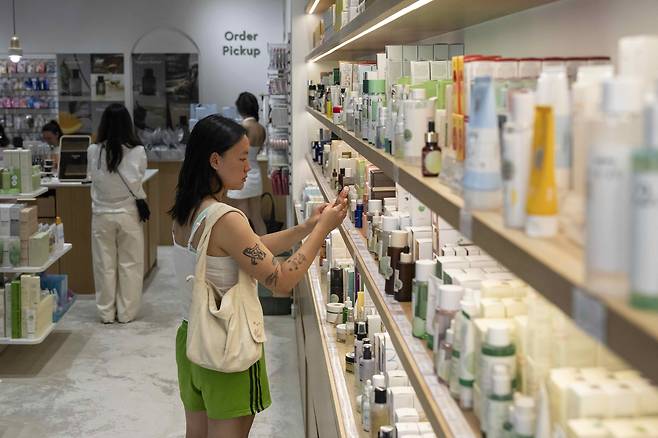
A cosmetics company, listed for just 18 months, recently surpassed Korea’s two leading beauty firms to claim the top spot in market capitalization at more than 8 trillion won at $5.8 billion, driven largely by exports. According to the Ministry of Food and Drug Safety, Korea’s cosmetics exports reached a record $10.2 billion in 2024, making the country the world’s third-largest exporter after France at $23.3 billion and the United States at $11.2 billion. Korea has become the top exporter to the United States, the world’s largest cosmetics market, and Japan, the third largest. It ranks third in China, following France and Japan. The share of exports to the United States rose the most, and Korean products accounted for 30 percent of imported cosmetics in Japan.
For me, this milestone has personal meaning. Forty-five years ago, as a chemistry professor, I authored “Fragrance and Cosmetics” (1980) and “The World of Cosmetics” (1985) when cosmetics literature was scarce and universities largely ignored the field. I introduced a course on cosmetic chemistry, with some graduates entering the industry. When I arrived at KAIST, I found researchers developing a natural-ingredient shampoo using polyphenols extracted from green tea, grape seeds and walnut shells. I took part in a product trial last year and saw a clear reduction in hair loss. In an aging society, research and development (R&D) for everyday well-being is no less important.
The use of beauty substances dates back to 4000 B.C. in Egypt, where frankincense and myrrh were used for scent and sterilization in religious rituals. Cleopatra applied kohl — made from lead and antimony compounds — to her eyes and cochineal dye to her lips. Queen Elizabeth I, scarred by smallpox at 29, masked her face with a mixture of lead and vinegar, and painted her lips with mercury-based red dye. She suffered from lead and mercury poisoning, wore a red wig due to hair loss, and reigned until 1603.
![A visitor looks around APR's beauty products during the CES 2025 tech fair held in Las Vegas on Jan. 12. [APR]](https://img2.daumcdn.net/thumb/R658x0.q70/?fname=https://t1.daumcdn.net/news/202508/15/koreajoongangdaily/20250815000442576jnrk.jpg)
The United States enacted its first cosmetics law in 1938 to establish safety standards. Since the 1980s, the industry has expanded beyond skin care, makeup and shampoos to include hair care and perfumes. In the 2000s, it broadened further to beauty devices, clinical procedures, home-use devices and health supplements. The global beauty market is projected to reach $677.1 billion in 2025, with an annual growth rate of 5 to 7 percent, according to the Korea Trade-Investment Promotion Agency.
The industry now advances through the development of functional new materials such as hyaluronic acid for hydration, niacinamide for whitening and anti-inflammation, peptides for antiaging, alpha hydroxy acids and retinol. Alternatives to silicones, natural surfactants and sustainable bio-based materials are emerging. Polydeoxyribonucleotide (PDRN), derived from salmon testes, is effective for skin regeneration and wound healing, but ethical and sustainability concerns are pushing research toward plant-based and microbial fermentation alternatives.
Centella asiatica extract, used in skin repair creams and ampoules, entered Europe and the United States from Korea in the early 2010s. BB cream, cushion compacts and sheet masks were also popularized by Korea. Product innovation and strong price competitiveness remain K-beauty’s core strengths, along with packaging and formulation expertise, AI-powered customization, app-based skin analysis and medical beauty services. Regulatory advances have also helped: in 2024, the Ministry of Food and Drug Safety adopted OECD guidelines for alternatives to animal testing in cosmetics safety evaluations, reducing corporate risk.
Yet, challenges remain. Compared to global luxury brands, Korean cosmetics have lower brand loyalty and repurchase rates, relying heavily on cost-conscious consumers seeking mid- to low-priced products. Export composition is also skewed, with basic skin care accounting for 59 percent, makeup 15 percent, body cleansers 12 percent and hair care 10 percent. The Korea Health Industry Development Institute projects the fastest growth from 2024 to 2030 in Iran at 26 percent, Saudi Arabia at 11 percent and Mexico at 10 percent. Greater diversification will require a broader color palette and innovations in high-value source technologies such as skin delivery systems, sustained release and biocompatibility, where Korea currently lags.
![Convenience store chain GS25 will introduce “AI beauty devices” starting in August, offering a one-stop beauty service from personal color analysis to cosmetics purchases. [GS25]](https://img3.daumcdn.net/thumb/R658x0.q70/?fname=https://t1.daumcdn.net/news/202508/15/koreajoongangdaily/20250815000445331txxc.jpg)
To become a global leader, Korea must build an innovation ecosystem linking academia, industry and research so that R&D investment translates into breakthroughs. France’s Cosmetic Valley cluster, founded in 1994, connects a global network in perfume and cosmetics with top-tier R&D capabilities. Japan promotes open innovation by integrating overseas regional R&D hubs into its academic-industrial collaborations.
The future of beauty will center on AI-based analysis, augmented reality-powered virtual trials, personalized solutions, social media content marketing, the integration of medical beauty and wellness, vegan and clean beauty, natural and refillable products, sustainability, value-driven consumption, and fusion with K-culture. Regulatory environments will be critical. For instance, Korea should align with global trends by allowing the use of hemp-derived cannabidiol or CBD — within strict limits on tetrahydrocannabinol or THC — for cosmetics with anti-inflammatory, soothing and antioxidant properties. The experience of operating the hemp special zone in Andong, North Gyeongsang, could be extended to interested regions such as North Jeolla Province to develop this as a new industry.
This article was originally written in Korean and translated by a bilingual reporter with the help of generative AI tools. It was then edited by a native English-speaking editor. All AI-assisted translations are reviewed and refined by our newsroom.
Copyright © 코리아중앙데일리. 무단전재 및 재배포 금지.
- Passengers baffled as AirAsia flight to Incheon lands at Gimpo Airport
- Vietnam emerges as key rare earth source as Korea reduces reliance on China
- [단독] 美 관세 전쟁의 승자? K배터리, 중국 밀어내고 대미 수출 1300% 급증 '역대 최대'
- 3 dead, buildings evacuated amid heavy rains and flooding in greater Seoul
- Thousands of children are hidden from the Korean government. Here's how they live.
- Leave your printer at home: Starbucks Korea cracks down on people working, studying all day in cafes
- Exclusive: U.S. EV battery imports from Korea top 1,300% as tariffs push shift from China
- Prison life begins for Kim Keon Hee after court issues first pretrial detention warrant for former first lady
- Korean Air to cram extra — smaller — seat in each economy row
- Disney+ series 'Tempest' with Jun Ji-hyun coming Sept. 10