Beyond barbed wire: Artists reimagine Korean Demilitarized Zone
전체 맥락을 이해하기 위해서는 본문 보기를 권장합니다.
The Korean title of the artwork includes the word "Bi-haeng," which has double meanings of "flying" and "misdeed."
"Whenever I enter the DMZ, I am reminded of the meaning of living as a 'civilian.' While most of our lives take place in 'civilian spaces,' we rarely stop to reflect on that reality," Yang said. "I wanted to explore how the space bound by military restrictions could be reinterpreted through the eyes of a civilian."
이 글자크기로 변경됩니다.
(예시) 가장 빠른 뉴스가 있고 다양한 정보, 쌍방향 소통이 숨쉬는 다음뉴스를 만나보세요. 다음뉴스는 국내외 주요이슈와 실시간 속보, 문화생활 및 다양한 분야의 뉴스를 입체적으로 전달하고 있습니다.
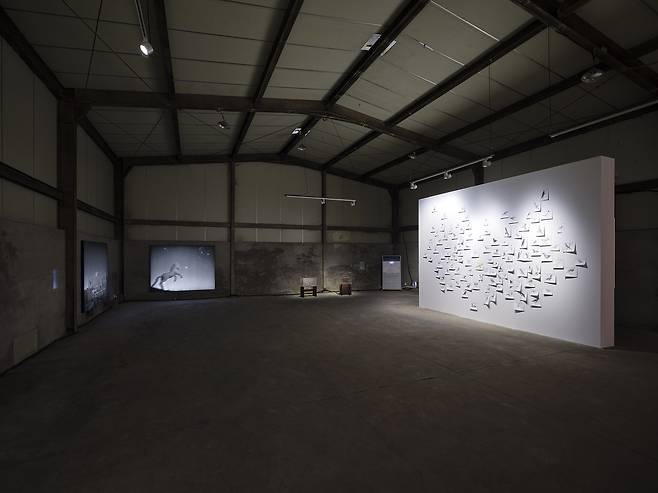
PAJU, Gyeonggi Province -- Located about 50 kilometers from Seoul, the Unification Village, or Tongilchon in Korean, is home to around 400 residents in the city of Paju. To enter the town, visitors must cross the 900-meter-long Unification Bridge, pass through a security checkpoint, present their ID and obtain prior authorization.
The hamlet lies about two kilometers south of the Korean Demilitarized Zone within a restricted area that serves as a buffer zone between the heavily militarized border and the general civilian region. The DMZ itself is a 4-kilometer-wide zone that separates the two Koreas.
While driving through the northern part of Paju toward the Unification Bridge, visitors may sense the reality of the divided country with barbed wire and observation posts seen along the banks of the Imjin River, whose far side belongs to North Korea.
Now there is a rare opportunity for general civilians to step into the neighborhood — the exhibition “DMZ Open Exhibition: Undo DMZ” unfolds in a limited part of the border village. It is directed by Kim Sun-jeong, who is one of Korea’s leading curators and has been carrying on the DMZ project since 2012, and features 10 artists.
“Until recently, my DMZ project had mostly focused on its political context and the complex realities surrounding it. But over the past three years, I shifted toward recognizing its ecological potential after decades without human presence,” Kim said Monday while giving a press tour for the exhibition that runs through Nov. 5.
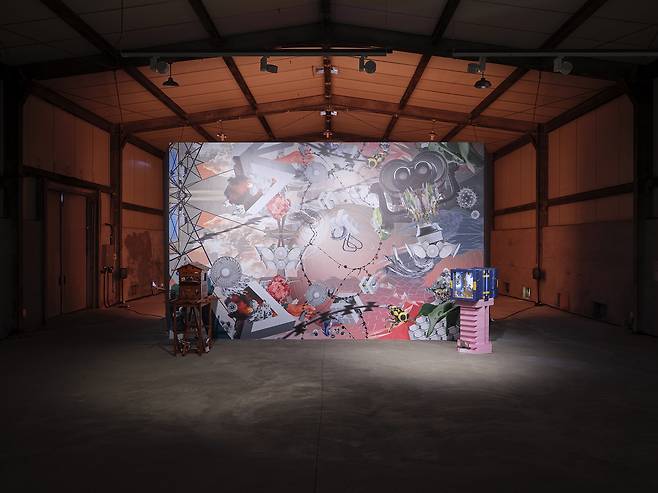
The title of the project was borrowed from artist Yang Hae-gue’s wallpaper work “DMZ Un-Do.” Displayed in the neighborhood's grain storage, it shows images of pollen, robot bees, solar panels, an electric fan and an electricity transmission tower, using a bird’s eye view to render the complex spatiality of DMZ.
The Korean title of the artwork includes the word “Bi-haeng,” which has double meanings of “flying” and “misdeed."
“Whenever I enter the DMZ, I am reminded of the meaning of living as a 'civilian.' While most of our lives take place in 'civilian spaces,’ we rarely stop to reflect on that reality,” Yang said. “I wanted to explore how the space bound by military restrictions could be reinterpreted through the eyes of a civilian.”
The video work “Yellow Dance,” set in an imaginary postwar Cheorwon neighborhood near the DMZ, reframes a story of the historical conflict through the lens of the non-human, “Bonghee,” worker bee. It accompanies the piece “Piri for Solo Oboe” by Yun I-sang, a renowned Korean composer who was stigmatized as a pro-North Korean figure in the late 1960s when the Korean government heavily cracked down on political ideology.
“Yun I-sang’s life, to me, epitomizes the fate of an artist shaped by the Cold War. His work I used is both famous and, in my view, a masterpiece. While his name is known to almost every Korean, I couldn’t recall a single piece of his music — and I suspect many others are the same,” Yang said.
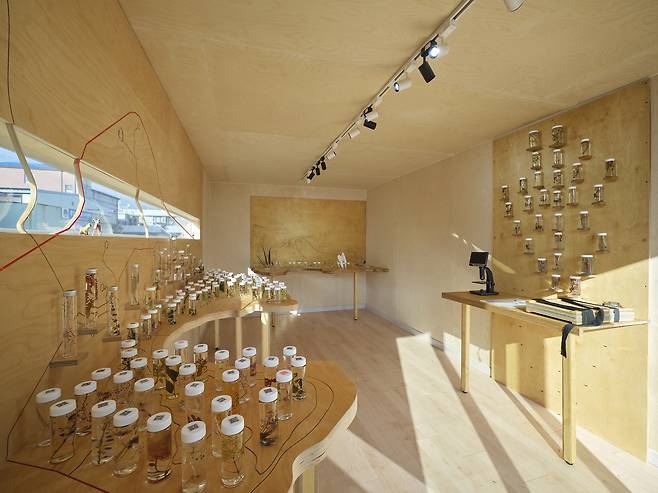
Artist Park Jung-sik researched the ecological environment of the DMZ’s Paju region and collected leaves, seeds, flowers and birds’ feathers from nearby neighborhoods such as Tongilchon and preserved them with wet and dry techniques.
Park’s installation “A Flower on a (Sorrowfully) Fertile Land” conveys the biodiversity thriving near the border area and is arranged geographically to show the locations where each plant and animal specimen was collected.
“Even in the face of war and division, nature has continued its beauty,” Park told the reporters.
The exhibition continues at Gallery Greaves near Tongilchon, formerly a bowling alley within the former US military base Camp Greaves that was in use from 1953 to 2004.
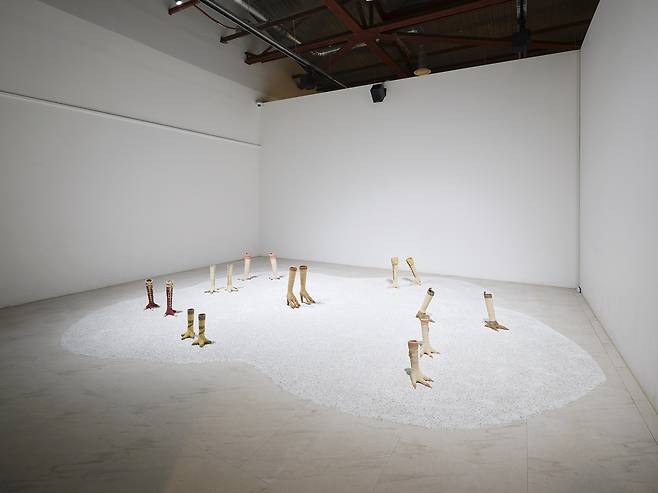
Inside the gallery, the sound of cranes from the sound installation “Accidental Paradise” by Hong Young-in fills the space. It complements the installation of eight pairs of shoes for cranes, titled “White Cranes and Snowfall,” produced in collaboration with straw-weaving masters.
Each pair of shoes carries a sense of whimsical humor, personifying the birds that wear designed boots as humans. Hong said she encountered the cranes migrating to the area, which then became a “paradise” to the birds, during her research trip to the DMZ in the winter of 2024.
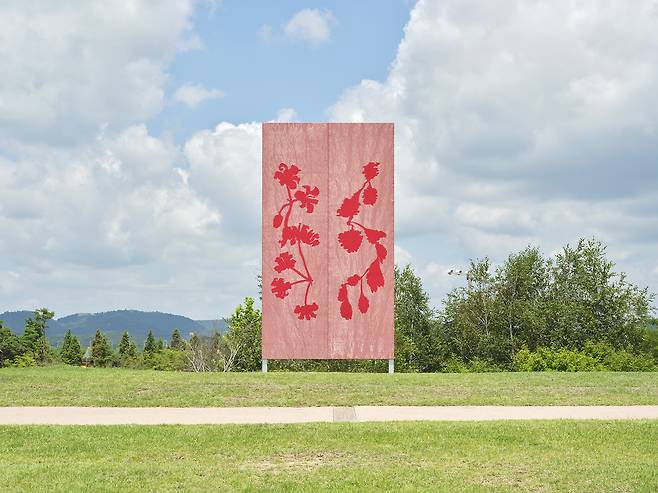
Another venue, the Imjingak Pyeonghwa Nuri Park, presents a vast landscape with wide green lawns to show four installations by Oh Sang-min, Won Seoung-won and Yang Hae-gue. The installation “Light: Of Nature and Lines In Between” by Oh abstracted the forms of plants native to the DMZ through a knitting technique using metallic yarn, a material reflecting the symbolism of the DMZ’s barbed wire fences.
For general audiences, Tongilchon can be visited by booking the Peace Tour Shuttle and Gallery Greaves is accessible via the Peace Gondola. Both the shuttle and gondola depart from Imjingak, a tourism complex for DMZ activities in Paju. The Imjingak Pyeonghwa Nuri Park, part of the tourism complex, is open to the public.
Copyright © 코리아헤럴드. 무단전재 및 재배포 금지.